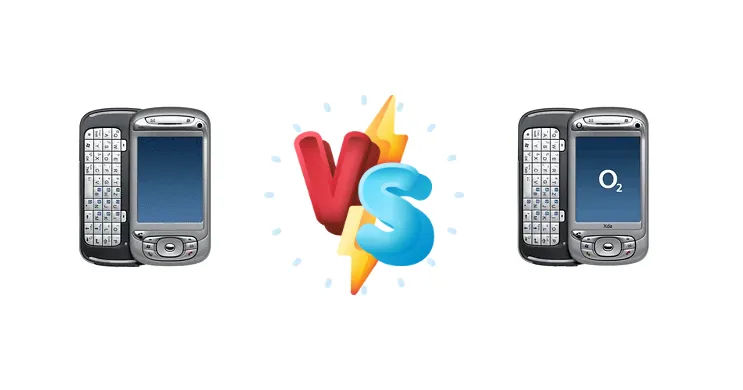
The Qtek 9600 and O2 XDA Trion represent a pivotal moment in smartphone history, bridging the gap between PDAs and modern mobile phones. Both devices ran Windows Mobile, offering a full desktop-like experience on the go. This comparison dissects their similarities and differences, focusing on the nuances that mattered to early adopters and power users.
🏆 Quick Verdict
For the average user seeking a robust Windows Mobile experience, the O2 XDA Trion edges out the Qtek 9600. While both share the same 400MHz Samsung processor, the Trion’s broader availability and potentially refined software experience give it a slight advantage.
| Network |
|---|
| 2G bands | GSM 850 / 900 / 1800 / 1900 | GSM 850 / 900 / 1800 / 1900 |
| 3G bands | UMTS 850 / 1900 / 2100 | UMTS 850 / 1900 / 2100 |
| Speed | Yes, 384 kbps | Yes, 384 kbps |
| Technology | GSM / UMTS | GSM / UMTS |
| Launch |
|---|
| Announced | 2006, June | 2006, May |
| Status | Discontinued | Discontinued |
| Body |
|---|
| Dimensions | 113 x 58 x 22 mm (4.45 x 2.28 x 0.87 in) | 113 x 58 x 22 mm (4.45 x 2.28 x 0.87 in) |
| Keyboard | QWERTY | QWERTY |
| SIM | Mini-SIM | Mini-SIM |
| Weight | 176 g (6.21 oz) | 160 g (5.64 oz) |
| Display |
|---|
| Resolution | 240 x 320 pixels, 4:3 ratio (~143 ppi density) | 240 x 320 pixels, 4:3 ratio (~143 ppi density) |
| Size | 2.8 inches, 42 x 57 mm, 24.3 cm2 (~37.0% screen-to-body ratio) | 2.8 inches, 42 x 57 mm, 24.3 cm2 (~37.0% screen-to-body ratio) |
| Type | TFT resistive touchscreen, 65K colors | TFT resistive touchscreen, 65K colors |
| | Handwriting recognition
| Handwriting recognition
|
| Platform |
|---|
| CPU | 400 MHz Samsung | 400 MHz Samsung |
| OS | Microsoft Windows Mobile 5.0 PocketPC | Microsoft Windows Mobile 5.0 PocketPC |
| Memory |
|---|
| Card slot | microSD (dedicated slot) | microSD (dedicated slot) |
| Internal | 64MB RAM, 128MB ROM | 64MB RAM, 128MB ROM |
| Main Camera |
|---|
| Features | LED flash | LED flash |
| Single | 2 MP | 2 MP |
| Video | Yes | Yes |
| Selfie camera |
|---|
| Single | QCIF videocall camera | QCIF videocall camera |
| Sound |
|---|
| 3.5mm jack | No | No |
| 35mm jack | No | No |
| Alert types | Vibration; Downloadable polyphonic, MP3 ringtones | Vibration; Downloadable polyphonic, MP3 ringtones |
| Loudspeaker | Yes | Yes |
| Comms |
|---|
| Bluetooth | 2.0 | 2.0 |
| Infrared port | Yes | Yes |
| Positioning | No | No |
| Radio | No | No |
| USB | 1.1 | Proprietary |
| WLAN | Wi-Fi 802.11b/g | Wi-Fi 802.11b/g |
| Features |
|---|
| Browser | WAP 2.0/xHTML, HTML (PocketIE) | WAP 2.0/xHTML, HTML (PocketIE) |
| | Pocket Office
Voice memo
MP3/AAC player | Pocket Office
Voice memo
MP3/AAC player |
| Battery |
|---|
| Stand-by | Up to 300 h | Up to 300 h |
| Talk time | Up to 5 h | Up to 5 h |
| Type | Removable Li-Po 1350 mAh battery | Removable Li-Ion 1350 mAh battery |
| Misc |
|---|
| Colors | Silver | Silver |
| Price | - | About 360 EUR |
Qtek 9600
- Potentially lower cost of entry.
- Direct access to Qtek's support network (if available).
- May offer more customization options for advanced users.
- Potentially limited software support and updates.
- May require more effort to source accessories.
- Brand recognition less established than O2.
O2 XDA Trion
- Stronger brand recognition and support from O2.
- Potentially more refined software experience.
- Wider availability of accessories and support resources.
- May be slightly more expensive than the Qtek 9600.
- Software customization options may be more limited.
- Reliance on O2's software update schedule.
Display Comparison
Given the era, detailed display specifications are scarce. Both the Qtek 9600 and O2 XDA Trion featured resistive touchscreens, common for the time, requiring a stylus for accurate input. The screen size and resolution were likely similar, prioritizing information density over multimedia consumption. The lack of IPS or OLED technology means viewing angles and color reproduction were limited compared to modern displays. The user experience hinged on stylus accuracy, making a quality stylus essential for both devices.
Camera Comparison
Camera capabilities on both the Qtek 9600 and O2 XDA Trion were rudimentary by today’s standards. Expect low-resolution sensors (likely VGA or 1.3MP) with limited features. Image quality would be poor in anything other than ideal lighting conditions. The cameras were primarily intended for basic documentation, such as capturing business cards or quick notes, rather than serious photography. Lens apertures and sensor sizes were small, resulting in limited dynamic range and significant noise.
Performance
Both devices are powered by a 400 MHz Samsung processor, meaning raw processing power is virtually identical. Performance differences would stem from RAM allocation, software optimization, and the specific version of Windows Mobile installed. The 400MHz CPU was sufficient for basic tasks like email, contacts, and simple applications, but struggled with demanding multimedia or multitasking. Thermal management wasn't a significant concern given the low power consumption of the processor, but sustained use could lead to noticeable slowdowns.
Battery Life
Battery life on both devices was heavily dependent on usage patterns. The Windows Mobile operating system, while powerful, was not particularly energy efficient. Expect a full charge to last a day with moderate use (calls, email, some application usage). Heavy use, including prolonged web browsing or running demanding applications, would significantly reduce battery life. Charging times were likely several hours using the included chargers. The lack of fast charging technology meant patience was required.
Buying Guide
Buy the Qtek 9600 if you prioritize a potentially lower price point and are comfortable with sourcing accessories and software updates independently. Buy the O2 XDA Trion if you prefer a device with wider support, a more established brand presence within the O2 ecosystem, and a potentially more polished user experience out of the box. Both are ideal for users deeply invested in the Windows Mobile platform and requiring advanced productivity features.
Frequently Asked Questions
❓ Is it possible to upgrade the Windows Mobile version on either the Qtek 9600 or O2 XDA Trion?
Upgrading the Windows Mobile version was possible, but often complex and risky. It typically involved flashing a custom ROM, which could void the warranty and potentially brick the device. The availability of custom ROMs depended on the device's popularity and the efforts of the developer community.
❓ What type of storage does each device use, and is it expandable?
Both devices likely utilized a combination of internal ROM and external storage via SD card. The amount of internal ROM was limited, typically used for the operating system and core applications. SD card support allowed users to expand storage for multimedia files and applications. The maximum supported SD card capacity varied depending on the device and Windows Mobile version.
❓ Are there any common issues or known vulnerabilities associated with these devices?
Common issues included stylus drift, touchscreen unresponsiveness, and software crashes. Security vulnerabilities were also a concern, as early versions of Windows Mobile were not as secure as modern operating systems. Users were advised to exercise caution when downloading and installing applications from untrusted sources.