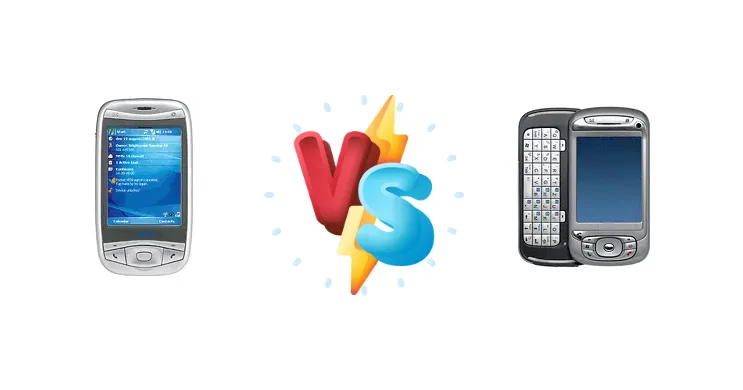
The Qtek 9100 and 9600 represent a pivotal moment in early Windows Mobile development. The 9100, powered by a TI OMAP 850, established Qtek as a player, while the 9600 aimed to leapfrog the competition with a faster 400MHz Samsung CPU. This comparison dissects whether that speed increase justified an upgrade, and for whom.
🏆 Quick Verdict
For the average user prioritizing responsiveness in basic tasks like calls, messaging, and contact management, the Qtek 9600 is the clear winner. The doubled CPU clock speed provides a noticeably smoother experience. However, the 9100 remains a viable option for those on a tighter budget or less demanding users.
| Network |
|---|
| 2G bands | GSM 850 / 900 / 1800 / 1900 | GSM 850 / 900 / 1800 / 1900 |
| 3G bands | - | UMTS 850 / 1900 / 2100 |
| EDGE | Class 10 | - |
| GPRS | Class 10 | - |
| Speed | - | Yes, 384 kbps |
| Technology | GSM | GSM / UMTS |
| Launch |
|---|
| Announced | 2005, Q3 | 2006, June |
| Status | Discontinued | Discontinued |
| Body |
|---|
| Dimensions | 109 x 58 x 23 mm (4.29 x 2.28 x 0.91 in) | 113 x 58 x 22 mm (4.45 x 2.28 x 0.87 in) |
| Keyboard | QWERTY | QWERTY |
| SIM | Mini-SIM | Mini-SIM |
| Weight | 160 g (5.64 oz) | 176 g (6.21 oz) |
| Display |
|---|
| Resolution | 240 x 320 pixels, 4:3 ratio (~143 ppi density) | 240 x 320 pixels, 4:3 ratio (~143 ppi density) |
| Size | 2.8 inches, 42 x 57 mm, 24.3 cm2 (~38.4% screen-to-body ratio) | 2.8 inches, 42 x 57 mm, 24.3 cm2 (~37.0% screen-to-body ratio) |
| Type | TFT resistive touchscreen, 65K colors | TFT resistive touchscreen, 65K colors |
| | - | Handwriting recognition
|
| Platform |
|---|
| CPU | 200 MHz ARM926EJ-S | 400 MHz Samsung |
| Chipset | TI OMAP 850 | - |
| OS | Microsoft Windows Mobile 5.0 PocketPC | Microsoft Windows Mobile 5.0 PocketPC |
| Memory |
|---|
| Card slot | miniSD | microSD (dedicated slot) |
| Internal | 64MB RAM, 128MB ROM | 64MB RAM, 128MB ROM |
| Main Camera |
|---|
| Features | LED flash | LED flash |
| Single | 1.3 MP | 2 MP |
| Video | Yes | Yes |
| Selfie camera |
|---|
| Single | - | QCIF videocall camera |
| | No | - |
| Sound |
|---|
| 3.5mm jack | No | No |
| 35mm jack | No | No |
| Alert types | Vibration; Downloadable polyphonic, MP3 ringtones | Vibration; Downloadable polyphonic, MP3 ringtones |
| Loudspeaker | Yes | Yes |
| Comms |
|---|
| Bluetooth | 2.0 | 2.0 |
| Infrared port | Yes | Yes |
| Positioning | No | No |
| Radio | No | No |
| USB | Proprietary | 1.1 |
| WLAN | Wi-Fi 802.11b/g | Wi-Fi 802.11b/g |
| Features |
|---|
| Browser | WAP 2.0/xHTML, HTML (PocketIE) | WAP 2.0/xHTML, HTML (PocketIE) |
| | Microsoft ActiveSync
Pocket Office
MP3/AAC player
Predictive text input | Pocket Office
Voice memo
MP3/AAC player |
| Battery |
|---|
| Stand-by | Up to 200 h | Up to 300 h |
| Talk time | Up to 4 h | Up to 5 h |
| Type | Removable Li-Po 1250 mAh battery | Removable Li-Po 1350 mAh battery |
| Misc |
|---|
| Colors | Stylish black | Silver |
Qtek 9100
- Potentially longer battery life due to slower CPU.
- Likely lower purchase price (at the time of release).
- Proven reliability of the OMAP 850 platform.
- Significantly slower CPU performance.
- Less responsive user interface.
- Slower application loading times.
Qtek 9600
- Doubled CPU speed for a smoother experience.
- Faster application launch times.
- Improved multitasking capabilities.
- Reduced battery life compared to the 9100.
- Potentially higher purchase price.
- Samsung CPU may have had different thermal characteristics.
Display Comparison
Information regarding display specifications (resolution, size, panel type) is unavailable. However, both devices likely utilized resistive touchscreens common to the era, meaning accuracy and multi-touch were limited. The user experience would have been similar in terms of visual fidelity, with the primary difference being the responsiveness of the UI due to the CPU.
Camera Comparison
Details regarding camera specifications are unavailable. Given the era, both devices likely featured basic VGA or 1.3MP cameras primarily intended for quick snapshots and video calls. Image quality would have been limited by sensor size, lens quality, and processing power. The faster CPU in the 9600 *might* have resulted in slightly faster image capture and processing, but the difference would be minimal.
Performance
The core difference lies in the CPU. The Qtek 9100’s 200 MHz TI OMAP 850, while capable, is significantly outpaced by the Qtek 9600’s 400 MHz Samsung CPU. This doubling of clock speed directly impacts application launch times and overall system responsiveness. While both utilize the ARM926EJ-S architecture, the higher clock speed of the 9600 allows it to process instructions faster. This is particularly noticeable when running multiple applications or navigating complex menus. The OMAP 850 included an integrated DSP, potentially offering advantages in audio processing, but this is unlikely to be a significant differentiator for most users.
Battery Life
Battery capacity details are unavailable. However, the faster CPU in the Qtek 9600 will undoubtedly consume more power. Users opting for the 9600 should expect slightly shorter battery life compared to the 9100, especially with heavy usage. The impact on standby time would be less pronounced, but active use will reveal the difference.
Buying Guide
Buy the Qtek 9100 if you need a functional, reliable Windows Mobile device for core communication tasks and are sensitive to price. It's ideal for users who primarily make calls, send texts, and manage contacts. Buy the Qtek 9600 if you prioritize a snappier user interface, faster application loading times, and a more responsive experience when multitasking or using more demanding Windows Mobile applications.
Frequently Asked Questions
❓ Will the Qtek 9600's faster CPU significantly improve my experience with Windows Mobile's Pocket Office suite?
Yes, the 400MHz Samsung CPU in the 9600 will noticeably improve performance within Pocket Office. Expect faster spreadsheet calculations, quicker document loading, and a more responsive interface when editing documents on the go. The 9100's 200MHz CPU may struggle with larger or more complex files.
❓ Is the performance difference between the Qtek 9100 and 9600 noticeable for basic tasks like making calls and sending SMS messages?
While both phones will handle calls and SMS messages adequately, the 9600's faster CPU will contribute to a smoother and more responsive overall experience. The difference won't be dramatic, but you'll likely notice quicker transitions between applications and a more fluid user interface.
❓ Given the limited RAM available on these devices, will the faster CPU in the 9600 actually translate to a better multitasking experience?
The limited RAM is a significant constraint. However, the faster CPU in the 9600 will still help. It can switch between applications more quickly and handle background processes more efficiently, reducing the likelihood of slowdowns when multitasking. Don't expect to run many applications simultaneously, but the 9600 will handle a few better than the 9100.