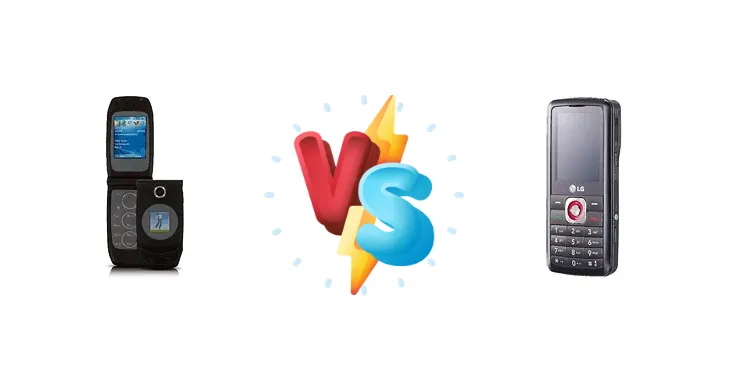
The Qtek 8500 and LG GM200 Brio represent a pivotal moment in mobile technology – the transition from feature phones to early smartphones. The Qtek 8500, powered by a Texas Instruments OMAP 850, aimed for business users, while the LG GM200 Brio, though lacking detailed specs, likely targeted a broader consumer base. This comparison examines the architectural differences and potential user experiences of these two devices.
🏆 Quick Verdict
For the user seeking a device with documented processing power and a more established platform, the Qtek 8500 is the clear winner. Its 200 MHz ARM926EJ-S processor, while dated, provides a known quantity, unlike the LG GM200 Brio, which lacks publicly available specifications, making a performance assessment impossible.
| Network |
|---|
| 2G bands | GSM 850 / 900 / 1800 / 1900 | GSM 900 / 1800 / 1900 |
| EDGE | Class 10 | Class 10 |
| GPRS | Class 10 | Class 10 |
| Technology | GSM | GSM |
| Launch |
|---|
| Announced | 2006, February | 2009, March. Released 2009, June |
| Status | Discontinued | Discontinued |
| Body |
|---|
| Dimensions | 98.5 x 51.4 x 15.8 mm (3.88 x 2.02 x 0.62 in) | 106 x 48 x 14.4 mm (4.17 x 1.89 x 0.57 in) |
| SIM | Mini-SIM | Mini-SIM |
| Weight | 99 g (3.49 oz) | 85 g (3.00 oz) |
| Display |
|---|
| Resolution | 240 x 320 pixels, 4:3 ratio (~182 ppi density) | 176 x 220 pixels (~141 ppi density) |
| Size | 2.2 inches, 34 x 45 mm, 15.0 cm2 (~29.6% screen-to-body ratio) | 2.0 inches, 12.6 cm2 (~24.7% screen-to-body ratio) |
| Type | TFT, 65K colors | TFT, 256K colors |
| | Second external 1.2-inch TFT display, 65K colors (128 x 128 pixels) | - |
| Platform |
|---|
| CPU | 200 MHz ARM926EJ-S | - |
| Chipset | TI OMAP 850 | - |
| OS | Microsoft Windows Mobile 5.0 Smartphone | - |
| Memory |
|---|
| Call records | - | 50 dialed, 50 received, 50 missed calls |
| Card slot | microSD (dedicated slot) | microSD (dedicated slot) |
| Internal | 64MB RAM, 64MB ROM | 14MB |
| Phonebook | - | 1000 entries , Photocall |
| Main Camera |
|---|
| Single | 1.3 MP | 2 MP |
| Video | Yes | QCIF@15fps |
| Sound |
|---|
| 3.5mm jack | No | Yes |
| 35mm jack | No | Yes |
| Alert types | Vibration; Downloadable polyphonic, MP3 ringtones | - |
| Loudspeaker | Yes | Yes |
| | - | 3 speakers (two stereo speakers + one woofer) |
| Comms |
|---|
| Bluetooth | 1.2 | 2.0, A2DP |
| Positioning | No | No |
| Radio | No | FM radio, RDS, built-in antenna |
| USB | 1.1 | 2.0 |
| WLAN | No | No |
| Features |
|---|
| Browser | WAP 2.0/xHTML, HTML (PocketIE) | WAP 2.0/xHTML |
| Games | - | Sudoku Puzzle, ZooZooClub |
| Java | - | Yes, MIDP 2.0 |
| Messaging | - | SMS, MMS, Email |
| | Pocket Office
Voice memo
MP3/AAC player
Predictive text input | MP4/H.263 player
MP3/AAC/AAC+/AAC++/WMA/AMR/MIDI player
Organizer |
| Battery |
|---|
| Stand-by | - | Up to 450 h |
| Talk time | - | 8 h 24 min |
| Type | Removable Li-Ion 750 mAh battery | Removable Li-Po 1100 mAh battery |
| Misc |
|---|
| Colors | Stylish black | Black, Silver, Gold (GM200); Black, Red (GM205) |
| Price | About 190 EUR | About 50 EUR |
Qtek 8500
- Known processor performance with the OMAP 850
- Established Windows Mobile platform
- Likely more robust build quality for business use
- Relatively slow processor by modern standards
- Limited multitasking capabilities
- Resistive touchscreen may feel less responsive
LG GM200 Brio
- Potentially more compact form factor
- Possibly simpler user interface
- May have been more affordable at launch
- Lack of publicly available specifications
- Unknown processor performance
- Potential for limited software support
Display Comparison
Without specifications for the LG GM200 Brio's display, a direct comparison is impossible. The Qtek 8500 likely featured a resistive touchscreen common for the era, prioritizing input accuracy over multi-touch capabilities. Display resolution was likely limited to QVGA (240x320) to conserve processing power and battery life. The Brio, given its likely consumer focus, may have had a slightly larger display, but without data, this remains speculative.
Camera Comparison
Information regarding camera specifications for both devices is scarce. It's reasonable to assume both featured basic VGA (0.3MP) cameras, primarily for video calls and low-resolution snapshots. Image quality would have been limited by the sensor size, lens quality, and lack of image stabilization. The Qtek 8500, being business-oriented, may have included software features for business card scanning, while the Brio might have focused on simple photo sharing.
Performance
The Qtek 8500's TI OMAP 850 chipset, featuring a 200 MHz ARM926EJ-S CPU, was a standard for early Windows Mobile devices. This processor was capable of handling basic tasks like phone calls, messaging, and simple applications. The LG GM200 Brio's processor remains unknown. Given the era, it likely utilized a similar ARM architecture, but potentially at a lower clock speed or with fewer features, impacting application responsiveness and multitasking capabilities. The OMAP 850's integrated graphics processor would have provided basic 2D acceleration, sufficient for the UI and simple games.
Battery Life
Battery capacity for both devices was likely in the range of 1000-1500 mAh, typical for the time. Given the Qtek 8500's more powerful processor, it may have experienced slightly faster battery drain during intensive tasks. However, both devices would have offered similar talk and standby times, prioritizing longevity over rapid charging, as fast charging technology was not prevalent at the time.
Buying Guide
Buy the Qtek 8500 if you need a device with a known processor architecture for running early Windows Mobile applications and appreciate a more robust, business-focused experience. Buy the LG GM200 Brio if you prioritize a potentially more compact form factor and a simpler user interface, assuming it runs a less demanding operating system, but be aware of the lack of detailed specifications and potential performance limitations.
Frequently Asked Questions
❓ Is the Qtek 8500 capable of running modern applications?
No. The Qtek 8500's 200 MHz ARM926EJ-S processor and limited RAM are insufficient to run modern smartphone applications. It is designed for early Windows Mobile software, which is largely obsolete.
❓ What operating system did the LG GM200 Brio likely use?
Given its consumer focus, the LG GM200 Brio likely ran a simplified version of Windows Mobile or a proprietary operating system designed for basic smartphone functionality. Without specific information, it's difficult to determine the exact OS version.
❓ Would the Qtek 8500 be suitable for everyday use in 2024?
No. While it's a fascinating piece of mobile history, the Qtek 8500's limited processing power, small screen, and outdated software make it impractical for everyday use in 2024. It's best suited for collectors or enthusiasts interested in early smartphone technology.