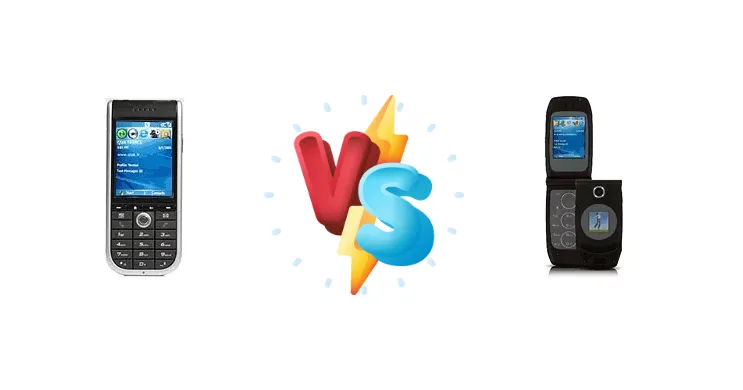
The Qtek 8310 and 8500 represent an early wave of smartphones running Windows Mobile, aiming to bridge the gap between PDAs and mobile phones. Both devices utilize the same Texas Instruments OMAP 850 platform, meaning performance differences will be subtle and likely stem from software optimization or industrial design choices. This comparison will dissect those nuances to determine which device offers a superior user experience for the discerning early adopter.
🏆 Quick Verdict
For the average user seeking a robust early Windows Mobile experience, the Qtek 8500 likely edges out the 8310. While both share identical core hardware, the 8500’s potential for refined software and potentially improved antenna design for call quality give it a slight advantage.
| Network |
|---|
| 2G bands | GSM 850 / 900 / 1800 / 1900 | GSM 850 / 900 / 1800 / 1900 |
| EDGE | Class 10 | Class 10 |
| GPRS | Class 10 | Class 10 |
| Technology | GSM | GSM |
| Launch |
|---|
| Announced | 2005, August | 2006, February |
| Status | Discontinued | Discontinued |
| Body |
|---|
| Dimensions | 107.5 x 46 x 17.5 mm (4.23 x 1.81 x 0.69 in) | 98.5 x 51.4 x 15.8 mm (3.88 x 2.02 x 0.62 in) |
| SIM | Mini-SIM | Mini-SIM |
| Weight | 106 g (3.74 oz) | 99 g (3.49 oz) |
| Display |
|---|
| Resolution | 240 x 320 pixels, 4:3 ratio (~182 ppi density) | 240 x 320 pixels, 4:3 ratio (~182 ppi density) |
| Size | 2.2 inches, 34 x 45 mm, 15.0 cm2 (~30.3% screen-to-body ratio) | 2.2 inches, 34 x 45 mm, 15.0 cm2 (~29.6% screen-to-body ratio) |
| Type | TFT, 65K colors | TFT, 65K colors |
| | 5-way navigation button | Second external 1.2-inch TFT display, 65K colors (128 x 128 pixels) |
| Platform |
|---|
| CPU | 200 MHz ARM926EJ-S | 200 MHz ARM926EJ-S |
| Chipset | TI OMAP 850 | TI OMAP 850 |
| OS | Microsoft Windows Mobile 5.0 Smartphone | Microsoft Windows Mobile 5.0 Smartphone |
| Memory |
|---|
| Card slot | MiniSD | microSD (dedicated slot) |
| Internal | 64MB RAM, 64/128MB ROM | 64MB RAM, 64MB ROM |
| Main Camera |
|---|
| Single | 1.3 MP | 1.3 MP |
| Video | Yes | Yes |
| Sound |
|---|
| 3.5mm jack | No | No |
| 35mm jack | No | No |
| Alert types | Vibration; Downloadable polyphonic, MP3 ringtones, composer | Vibration; Downloadable polyphonic, MP3 ringtones |
| Loudspeaker | Yes | Yes |
| | 2.5 mm audio jack | - |
| Comms |
|---|
| Bluetooth | Yes | 1.2 |
| Infrared port | Yes | - |
| Positioning | No | No |
| Radio | No | No |
| USB | Proprietary | 1.1 |
| WLAN | Wi-Fi 802.11b | No |
| Features |
|---|
| Browser | WAP 2.0/xHTML, HTML (PocketIE) | WAP 2.0/xHTML, HTML (PocketIE) |
| | MP3/AAC player
Predictive text input
Organizer | Pocket Office
Voice memo
MP3/AAC player
Predictive text input |
| Battery |
|---|
| Stand-by | Up to 250 h | - |
| Talk time | Up to 5 h | - |
| Type | Removable Li-Ion 1150 mAh battery | Removable Li-Ion 750 mAh battery |
| Misc |
|---|
| Colors | - | Stylish black |
| Price | - | About 190 EUR |
Qtek 8310
- Potentially more compact design
- Early adopter of Windows Mobile
- Robust build quality (typical of Qtek)
- Limited processing power
- Low-resolution camera
- Potentially less refined software
Qtek 8500
- Potentially improved software optimization
- Likely better call quality due to antenna design
- Early adopter of Windows Mobile
- Limited processing power
- Low-resolution camera
- Slightly larger form factor
Display Comparison
Both the Qtek 8310 and 8500 likely feature similar LCD panels, given their release timeframe and target market. Without specific resolution or size data, it’s reasonable to assume both offer QVGA (240x320) displays. The viewing angles and color reproduction will likely be limited by the technology of the time. Any difference in perceived quality will likely come down to panel calibration and the quality of the protective layer applied to the screen. The 8500 may have a slightly larger display, but this is speculative.
Camera Comparison
Both devices likely feature a basic VGA (0.3MP) camera, typical for the era. Image quality will be poor by modern standards, with limited detail and significant noise. The camera is primarily useful for capturing quick snapshots or for video calls. Any differences in image quality will likely be due to software processing and lens quality, but these are expected to be minimal. The usefulness of the camera is limited, and should not be a primary factor in the purchasing decision.
Performance
The core performance of both devices is identical, powered by the TI OMAP 850 chipset with a 200 MHz ARM926EJ-S CPU. This processor was capable for basic tasks like email, contacts, and simple applications, but struggles with demanding multimedia or multitasking. The real-world performance difference will hinge on the amount of RAM and the efficiency of the Windows Mobile implementation. Software optimization on the 8500 could lead to a smoother experience, but the underlying hardware limitations are shared.
Battery Life
Battery life on both devices will be heavily dependent on usage patterns. The OMAP 850 is relatively power-efficient, but the Windows Mobile operating system and the demands of cellular connectivity will drain the battery quickly. Without specific battery capacity data, it’s difficult to predict which device will offer better endurance. The 8500’s slightly larger size *could* accommodate a larger battery, but this is not confirmed. Expect daily charging to be necessary with moderate use.
Buying Guide
Buy the Qtek 8310 if you prioritize a potentially more compact form factor and are comfortable with potentially less refined software. Buy the Qtek 8500 if you value a potentially more polished user experience, better call quality, and are willing to accept a slightly larger device. Both are excellent choices for exploring the early days of Windows Mobile.
Frequently Asked Questions
❓ Will either of these phones work reliably on modern cellular networks?
No. These devices were designed for 2G and early 3G networks. Modern carriers are phasing out support for these older technologies, making these phones largely unusable for voice calls or data connectivity.
❓ Can I install modern apps on the Qtek 8310 or 8500?
No. These devices run Windows Mobile, a discontinued operating system. Modern Android or iOS apps are not compatible. There is a small community attempting to port some applications, but compatibility is extremely limited.
❓ Is the stylus essential for using these devices?
Yes. The resistive touchscreens on both the Qtek 8310 and 8500 require a stylus for accurate input. Finger input is possible, but imprecise and frustrating.
❓ What kind of storage does each device use, and is it expandable?
Both devices likely utilize internal ROM for storage, and may include a microSD card slot for expansion. The amount of internal storage is limited, typically ranging from 64MB to 128MB. A microSD card is highly recommended for storing applications and media.