
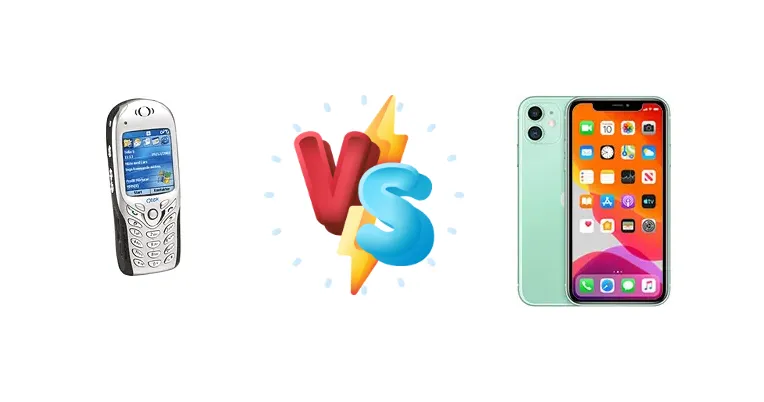
Qtek 8080 vs. Apple iPhone 11: A 15-Year Leap in Smartphone Technology
| Phones Images | |||||
|---|---|---|---|---|---|
|
🏆 Quick Verdict
The Apple iPhone 11 unequivocally wins this comparison. While the Qtek 8080 was innovative for its time, the iPhone 11’s A13 Bionic chip, superior display, and modern features offer a user experience that is simply incomparable. The iPhone 11 is the clear choice for any modern smartphone user.
| PHONES | ||
|---|---|---|
| Phone Names | Qtek 8080 | Apple iPhone 11 |
| Network | ||
|---|---|---|
| 2G bands | GSM 900 / 1800 / 1900 | GSM 850 / 900 / 1800 / 1900 |
| 3G bands | - | HSDPA 850 / 900 / 1700(AWS) / 1900 / 2100 |
| 4G bands | - | 1, 2, 3, 4, 5, 7, 8, 11, 12, 13, 17, 18, 19, 20, 21, 25, 26, 28, 29, 30, 32, 34, 38, 39, 40, 41, 42, 46, 48, 66 - A2221 |
| EDGE | No | - |
| GPRS | Class 8 | - |
| Speed | - | HSPA 42.2/5.76 Mbps, LTE Cat16 1024/150 Mbps, EV-DO Rev.A 3.1 Mbps |
| Technology | GSM | GSM / CDMA / HSPA / EVDO / LTE |
| - | 1, 2, 3, 4, 5, 7, 8, 12, 13, 14, 17, 18, 19, 20, 25, 26, 29, 30, 34, 38, 39, 40, 41, 42, 46, 48, 66, 71 - A2111, A2223 | |
| Launch | ||
|---|---|---|
| Announced | 2004, Q1 | 2019, September 10 |
| Status | Discontinued | Available. Released 2019, September 20 |
| Body | ||
|---|---|---|
| Build | - | Glass front (Corning-made glass), glass back (Corning-made glass), aluminum frame (7000 series) |
| Dimensions | 120 x 50 x 23.5 mm, 105 cc (4.72 x 1.97 x 0.93 in) | 150.9 x 75.7 x 8.3 mm (5.94 x 2.98 x 0.33 in) |
| SIM | Mini-SIM | · Nano-SIM + eSIM· Nano-SIM + Nano-SIM (China) |
| Weight | 130 g (4.59 oz) | 194 g (6.84 oz) |
| - | IP68 dust/water resistant (up to 2m for 30 min) Apple Pay (Visa, MasterCard, AMEX certified) | |
| Display | ||
|---|---|---|
| Protection | - | Scratch-resistant glass |
| Resolution | 176 x 220 pixels (~128 ppi density) | 828 x 1792 pixels, 19.5:9 ratio (~326 ppi density) |
| Size | 2.2 inches, 35 x 44 mm, 15.2 cm2 (~25.4% screen-to-body ratio) | 6.1 inches, 90.3 cm2 (~79.0% screen-to-body ratio) |
| Type | TFT, 65K colors | Liquid Retina IPS LCD, 625 nits (typ) |
| White LED back light 5-way navigation button Downloadable logos | - | |
| Platform | ||
|---|---|---|
| CPU | 133 MHz ARM925 | Hexa-core (2x2.65 GHz Lightning + 4x1.8 GHz Thunder) |
| Chipset | TI OMAP 710 | Apple A13 Bionic (7 nm+) |
| GPU | - | Apple GPU (4-core graphics) |
| OS | Microsoft Windows Mobile 2003 Smartphone | iOS 13, upgradable to iOS 26.1 |
| Memory | ||
|---|---|---|
| Card slot | SDIO/MMC | No |
| Internal | 32MB RAM, 64MB ROM | 64GB 4GB RAM, 128GB 4GB RAM, 256GB 4GB RAM |
| - | NVMe | |
| Main Camera | ||
|---|---|---|
| Dual | - | 12 MP, f/1.8, 26mm (wide), 1/2.55", 1.4µm, dual pixel PDAF, OIS 12 MP, f/2.4, 120˚, 13mm (ultrawide), 1/3.6" |
| Features | - | Dual-LED dual-tone flash, HDR (photo/panorama) |
| Single | VGA | - |
| Video | No | 4K@24/25/30/60fps, 1080p@25/30/60/120/240fps, HDR, stereo sound rec. |
| Selfie camera | ||
|---|---|---|
| Features | - | HDR |
| Single | - | 12 MP, f/2.2, 23mm (wide), 1/3.6", 1.0µm SL 3D, (depth/biometrics sensor) |
| Video | - | 4K@24/25/30/60fps, 1080p@25/30/60/120fps, gyro-EIS |
| No | - | |
| Sound | ||
|---|---|---|
| 3.5mm jack | No | No |
| 35mm jack | No | No |
| Alert types | Vibration; Downloadable polyphonic, MP3 ringtones | - |
| Loudspeaker | Yes | Yes, with stereo speakers |
| Comms | ||
|---|---|---|
| Bluetooth | Yes | 5.0, A2DP, LE |
| Infrared port | Yes | - |
| NFC | - | Yes |
| Positioning | No | GPS, GLONASS, GALILEO, QZSS |
| Radio | No | No |
| USB | Proprietary | Lightning, USB 2.0 |
| WLAN | No | Wi-Fi 802.11 a/b/g/n/ac/6, dual-band, hotspot |
| Features | ||
|---|---|---|
| Browser | HTML (Pocket IE) | - |
| Languages | 7 | - |
| Sensors | - | Face ID, accelerometer, gyro, proximity, compass, barometer |
| Microsoft ActiveSync Calculator Predictive text input MP3 player | Ultra Wideband (UWB) support | |
| Battery | ||
|---|---|---|
| Charging | - | Wired, PD2.0, 50% in 30 min Wireless (Qi) |
| Stand-by | Up to 90 h | - |
| Talk time | Up to 6 h | - |
| Type | Removable Li-Ion 1000 mAh battery | Li-Ion 3110 mAh, non-removable (11.91 Wh) |
| Misc | ||
|---|---|---|
| Colors | - | Black, Green, Yellow, Purple, Red, White |
| Models | - | A2221, A2111, A2223, iPhone12,1 |
| Price | - | $ 167.50 / C$ 228.68 / £ 175.00 / € 193.32 |
| SAR | - | 1.09 W/kg (head) 1.18 W/kg (body) |
| SAR EU | - | 0.95 W/kg (head) 0.99 W/kg (body) |
| Pricing | ||
|---|---|---|
| 128GB 4GB RAM | - | $ 359.95 |
| 256GB 4GB RAM | - | $ 469.99 |
| 64GB 4GB RAM | - | $ 292.79 |
| RENEWED | - | £ 214.00 |
| Tests | ||
|---|---|---|
| Audio quality | - | Noise -94.2dB / Crosstalk -80.8dB |
| Battery life | - | Endurance rating 94h |
| Camera | - | Photo / Video |
| Display | - | Contrast ratio: 1505:1 (nominal) |
| Loudspeaker | - | Voice 70dB / Noise 72dB / Ring 76dB |
| Performance | - | AnTuTu: 419453 (v7) GeekBench: 13882 (v4.4) GFXBench: 60fps (ES 3.1 onscreen) |
Qtek 8080
- Historical significance – a glimpse into early smartphone design.
- Compact size (likely smaller than modern phones).
- Unique user experience for retro tech enthusiasts.
- Extremely limited processing power.
- Poor display quality.
- Outdated operating system and software.
- Limited battery life.
Apple iPhone 11
- Powerful A13 Bionic chip for smooth performance.
- High-quality display with excellent brightness and contrast.
- Advanced camera system with computational photography.
- Long battery life and fast charging options.
- Access to a vast app ecosystem.
- Older model – may not receive future software updates.
- Battery life has degraded with age (as noted in the context).
- Relatively large size compared to the Qtek 8080.
Display Comparison
The Qtek 8080’s display specifications are unavailable, but typical of the era, it would have been a small, low-resolution LCD. In contrast, the iPhone 11 boasts a significantly larger display with a measured peak brightness of 644 nits and a 1505:1 contrast ratio. This translates to a much more visible and vibrant screen, especially outdoors. The iPhone 11’s display technology allows for accurate color reproduction and a far superior viewing experience, something the Qtek 8080 simply couldn’t achieve.
Camera Comparison
Both devices offer photo and video capabilities, but the comparison ends there. The Qtek 8080’s camera resolution is unknown, but likely very low. The iPhone 11, while not a camera champion in 2024, features a sophisticated camera system with advanced image processing. While specific sensor sizes and apertures aren’t provided, the iPhone 11’s computational photography capabilities, including Smart HDR and Portrait mode, are light years ahead of anything available on the Qtek 8080. The iPhone 11’s video recording capabilities are also far superior.
Performance
The performance gap is astronomical. The Qtek 8080’s 133 MHz TI OMAP 710 processor with an ARM925 core is dwarfed by the Apple A13 Bionic’s hexa-core architecture (2x2.65 GHz Lightning + 4x1.8 GHz Thunder) built on a 7nm+ process. The A13 Bionic delivers orders of magnitude more processing power, enabling complex tasks like video editing, gaming, and augmented reality. The Qtek 8080 would struggle with even basic web browsing by today’s standards. The A13’s efficiency also contributes to the iPhone 11’s impressive battery life.
Battery Life
The Qtek 8080’s battery capacity is unknown, but typical of early smartphones, it would have offered limited talk time and standby time. The iPhone 11, with its endurance rating of 94 hours, provides significantly longer battery life. While the Qtek 8080 likely charged via a proprietary connector, the iPhone 11 supports both wired charging with PD2.0 (50% in 30 minutes) and wireless charging via Qi, offering greater convenience and flexibility.
Buying Guide
Buy the Qtek 8080 if you're a collector of vintage technology, interested in the history of mobile computing, or need a device for very basic communication tasks and are willing to accept significant limitations. Buy the Apple iPhone 11 if you require a modern smartphone experience with fast performance, a high-quality camera, a vibrant display, and access to a vast ecosystem of apps and services.