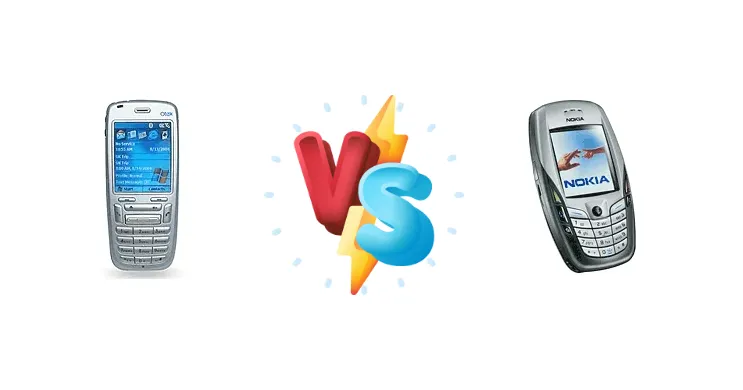
The Qtek 8010 and Nokia 6600 represent pivotal moments in the transition from feature phones to smartphones. Released around the same era, they targeted different user bases with distinct operating systems and hardware approaches. This comparison dissects their core components to understand which device offered a more compelling experience given the technological landscape of the early 2000s.
🏆 Quick Verdict
For the user prioritizing processing power and a more versatile operating system, the Qtek 8010 emerges as the stronger choice. Its 200 MHz TI OMAP 730 chipset provides a noticeable performance advantage over the Nokia 6600’s 104 MHz ARM 9, making it better suited for running more demanding applications and multitasking.
| Network |
|---|
| 2G bands | GSM 900 / 1800 / 1900 | GSM 900 / 1800 / 1900 |
| EDGE | No | No |
| GPRS | Class 10 | Class 6 |
| Technology | GSM | GSM |
| Launch |
|---|
| Announced | 2004, Q2 | 2003, Q4 |
| Status | Discontinued | Discontinued |
| Body |
|---|
| Dimensions | 107 x 46 x 17.5 mm (4.21 x 1.81 x 0.69 in) | 109 x 58 x 24 mm, 113 cc (4.29 x 2.28 x 0.94 in) |
| SIM | Mini-SIM | Mini-SIM |
| Weight | 106 g (3.74 oz) | 122 g (4.30 oz) |
| Display |
|---|
| Resolution | 176 x 220 pixels (~128 ppi density) | 176 x 208 pixels (~130 ppi density) |
| Size | 2.2 inches, 35 x 44 mm, 15.2 cm2 (~30.9% screen-to-body ratio) | 2.1 inches, 35 x 41 mm, 14.0 cm2 (~22.2% screen-to-body ratio) |
| Type | TFT, 65K colors | TFT, 65k colors |
| | 5-way navigation button
3-color LED indicator
Downloadable logos | 5-way joystick navigation
Selectable themes |
| Platform |
|---|
| CPU | 200 MHz ARM926EJ-S | 104 MHz ARM 9 |
| Chipset | TI OMAP 730 | - |
| OS | Microsoft Windows Mobile 2003 SE Smartphone | Symbian 7.0s, Series 60 v2.0 UI |
| Memory |
|---|
| Card slot | MiniSD | MMC, 32 MB included |
| Internal | 32MB RAM | 6MB |
| | - | 25 voice command slots
Voice memo |
| Main Camera |
|---|
| Single | VGA | VGA |
| Video | Yes | Yes |
| Sound |
|---|
| 3.5mm jack | No | No |
| 35mm jack | No | No |
| Alert types | Vibration; Downloadable polyphonic, MP3 ringtones | Vibration; Downloadable polyphonic, monophonic ringtones |
| Loudspeaker | Yes | Yes |
| Comms |
|---|
| Bluetooth | Yes | 1.1 |
| Infrared port | Yes | Yes |
| Positioning | No | No |
| Radio | No | No |
| USB | Proprietary | - |
| WLAN | No | No |
| Features |
|---|
| Alarm | - | Yes |
| Browser | HTML (Pocket IE) | WAP 2.0/xHTML |
| Clock | - | Yes |
| Languages | 8 | Major Europe and Asia-Pacific |
| | Microsoft ActiveSync
MP3/AAC player
Predictive text input | Mono audio player
Predictive text input |
| Battery |
|---|
| Stand-by | Up to 140 h | Up to 150 h - 240 h |
| Talk time | Up to 5 h | Up to 2 h - 4 h |
| Type | Removable Li-Ion 1050 mAh battery | Removable Li-Ion 850 mAh battery (BL-5C) |
| Misc |
|---|
| Colors | Cool metallic, Light blue | Light Gray |
| SAR | - | 0.61 W/kg (head) 0.44 W/kg (body) |
| SAR EU | - | 0.44 W/kg (head) |
Qtek 8010
- Faster processor for smoother multitasking
- More versatile Windows Mobile operating system
- Potential for running more advanced applications
- Likely shorter battery life due to higher power consumption
- Windows Mobile OS had a steeper learning curve
- Potentially larger and heavier design
Nokia 6600
- Simpler and more intuitive Series 60 OS
- Potentially longer battery life due to lower power consumption
- Nokia’s reputation for build quality and reliability
- Slower processor limits performance
- Less versatile operating system
- Limited application ecosystem compared to Windows Mobile
Display Comparison
Neither device boasts a particularly advanced display by modern standards. Both likely utilized resistive touchscreen technology, common for the era. Specifics regarding resolution and color depth are unavailable, but the Nokia 6600’s focus on call quality suggests a display optimized for readability rather than vibrant visuals. The Qtek 8010, geared towards productivity, may have had a slightly higher resolution to accommodate text-heavy applications, but this is speculative.
Camera Comparison
Both devices featured integrated cameras, but image quality was limited by the technology of the time. Specific megapixel counts are not provided, but it’s safe to assume both cameras were primarily intended for basic photo capture and video calls, not high-resolution photography. The Nokia 6600, with its emphasis on multimedia, may have offered slightly better image processing capabilities, but the difference would be minimal. Neither device offered optical image stabilization or advanced features like HDR.
Performance
The core difference lies in the chipsets. The Qtek 8010’s TI OMAP 730, featuring a 200 MHz ARM926EJ-S CPU, significantly outpaces the Nokia 6600’s 104 MHz ARM 9. This 92% clock speed increase translates to faster application loading times, smoother multitasking, and the ability to handle more complex software. While both CPUs are based on the ARM9 architecture, the OMAP 730 likely included additional hardware acceleration features, further enhancing performance. The Nokia 6600 prioritized power efficiency, resulting in a slower processor but potentially longer battery life.
Battery Life
Battery life is difficult to assess without specific mAh ratings. However, the Nokia 6600’s lower-powered processor likely contributed to longer talk time and standby duration. The Qtek 8010, with its more demanding chipset and Windows Mobile OS, would have experienced faster battery drain, especially during intensive use. Charging times were also significantly longer compared to modern smartphones, likely requiring several hours for a full charge.
Buying Guide
Buy the Qtek 8010 if you need a device capable of running Windows Mobile applications, require more processing power for tasks like document editing or early mobile gaming, and are comfortable with a more complex user interface. Buy the Nokia 6600 if you prefer a simpler, more intuitive user experience with the Series 60 OS, prioritize strong call quality and network connectivity, and value Nokia’s reputation for durability and reliability.
Frequently Asked Questions
❓ Was the Qtek 8010 significantly more expensive than the Nokia 6600 at launch?
While exact pricing data is difficult to obtain, Qtek devices generally commanded a premium due to their more advanced features and Windows Mobile OS. The Nokia 6600, benefiting from Nokia’s economies of scale, was likely more affordable, making it accessible to a wider audience.
❓ Could the Qtek 8010 run third-party applications like modern smartphones?
Yes, the Qtek 8010, running Windows Mobile, supported the installation of third-party applications. However, the application ecosystem was far less mature than today’s app stores. Finding and installing software was more complex, and compatibility issues were common.
❓ How did the network connectivity of the Nokia 6600 compare to the Qtek 8010?
Nokia was renowned for its radio performance. The 6600 likely offered superior call quality and network signal strength compared to the Qtek 8010, particularly in areas with weak coverage. This was a key strength of Nokia devices at the time.