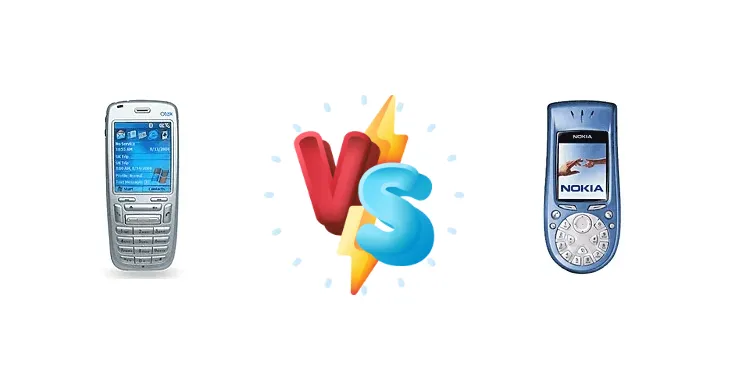
The Qtek 8010 and Nokia 3650 represent pivotal moments in the transition from feature phones to smartphones. Released around the same era, they both aimed to deliver more than just calls and texts, but approached the challenge with different operating systems and hardware philosophies. This comparison dissects their core components to understand which device offered a more compelling experience for the early adopter.
🏆 Quick Verdict
For the user seeking raw processing capability and a more versatile operating system, the Qtek 8010 emerges as the stronger choice. Its 200 MHz TI OMAP 730 chipset provides a noticeable performance advantage over the Nokia 3650’s 104 MHz ARM 9, making it better suited for running more demanding applications and multitasking.
| Network |
|---|
| 2G bands | GSM 900 / 1800 / 1900 | GSM 900 / 1800 / 1900 |
| EDGE | No | No |
| GPRS | Class 10 | Class 4 |
| Technology | GSM | GSM |
| Launch |
|---|
| Announced | 2004, Q2 | 2003, Q1 |
| Status | Discontinued | Discontinued |
| Body |
|---|
| Dimensions | 107 x 46 x 17.5 mm (4.21 x 1.81 x 0.69 in) | 130 x 57 x 26 mm, 139 cc (5.12 x 2.24 x 1.02 in) |
| SIM | Mini-SIM | Mini-SIM |
| Weight | 106 g (3.74 oz) | 130 g (4.59 oz) |
| Display |
|---|
| Resolution | 176 x 220 pixels (~128 ppi density) | 176 x 208 pixels (~130 ppi density) |
| Size | 2.2 inches, 35 x 44 mm, 15.2 cm2 (~30.9% screen-to-body ratio) | 2.1 inches, 35 x 41 mm, 14.0 cm2 (~18.9% screen-to-body ratio) |
| Type | TFT, 65K colors | TFT, 4096 colors |
| | 5-way navigation button
3-color LED indicator
Downloadable logos | 5-way scroll key
Wallpapers |
| Platform |
|---|
| CPU | 200 MHz ARM926EJ-S | 104 MHz ARM 9 |
| Chipset | TI OMAP 730 | - |
| OS | Microsoft Windows Mobile 2003 SE Smartphone | Symbian 6.1, Series 60 v1.0 UI |
| Memory |
|---|
| Card slot | MiniSD | MMC |
| Internal | 32MB RAM | 4MB |
| | - | Calendar notes
Editable message templates |
| Main Camera |
|---|
| Single | VGA | VGA |
| Video | Yes | Yes |
| Sound |
|---|
| 3.5mm jack | No | No |
| 35mm jack | No | No |
| Alert types | Vibration; Downloadable polyphonic, MP3 ringtones | Vibration; Downloadable polyphonic, monophonic, WAV ringtones, composer |
| Loudspeaker | Yes | Yes |
| Comms |
|---|
| Bluetooth | Yes | 1.1 |
| Infrared port | Yes | Yes |
| Positioning | No | No |
| Radio | No | No |
| USB | Proprietary | - |
| WLAN | No | No |
| Features |
|---|
| Alarm | - | Yes |
| Browser | HTML (Pocket IE) | WAP 2.0/xHTML |
| Clock | - | Yes |
| Languages | 8 | Most major European, Asian and American |
| | Microsoft ActiveSync
MP3/AAC player
Predictive text input | Predictive text input
Calculator
Voice dial
Voice record
Xpress-on covers |
| Battery |
|---|
| Stand-by | Up to 140 h | up to 150 - 200 h |
| Talk time | Up to 5 h | up to 2 h - 4 h |
| Type | Removable Li-Ion 1050 mAh battery | Removable Li-Ion 850 mAh battery (BL-5C) |
| Misc |
|---|
| Colors | Cool metallic, Light blue | Dark Blue, Grey and Yellow |
| SAR | - | 0.55 W/kg (head) 0.83 W/kg (body) |
| SAR EU | - | 0.72 W/kg (head) |
Qtek 8010
- Faster processor (200 MHz OMAP 730)
- More versatile Windows Mobile OS
- Potential for running a wider range of applications
- Likely shorter battery life
- More complex user interface
- Potentially larger and heavier form factor
Nokia 3650
- Simpler and more user-friendly Symbian OS
- Integrated camera with a focus on ease of use
- Potentially longer battery life
- Slower processor (104 MHz ARM 9)
- Limited application ecosystem compared to Windows Mobile
- Less capable for multitasking
Display Comparison
Detailed display specifications are unavailable for either device. However, both likely utilized resistive touchscreens common to the era, impacting usability. The Nokia 3650’s display was notable for its color screen, a step up from monochrome devices, but likely suffered from limited viewing angles and lower brightness compared to modern displays. The Qtek 8010, being a PDA-focused device, may have had a slightly higher resolution display to accommodate its Windows Mobile interface, but this remains speculative without concrete data.
Camera Comparison
The Nokia 3650 gained recognition for its integrated camera, a relatively novel feature for the time. While resolution details are limited, it was marketed as a key selling point. The Qtek 8010, being primarily a PDA, likely had a less emphasized camera, potentially with lower resolution and fewer features. The Nokia 3650’s camera was designed for quick snapshots and sharing, while the Qtek’s camera was likely more of an afterthought for basic documentation.
Performance
The core difference lies in the chipsets. The Qtek 8010’s TI OMAP 730, featuring a 200 MHz ARM926EJ-S CPU, significantly outpaces the Nokia 3650’s 104 MHz ARM 9. This 96 MHz clock speed difference translates to faster application loading times, smoother multitasking, and a more responsive user experience on the Qtek. While both utilize the ARM9 architecture, the OMAP 730 likely included additional hardware acceleration features, further enhancing performance. The Nokia 3650, while adequate for basic tasks, would struggle with more complex applications or running multiple programs simultaneously.
Battery Life
Battery capacity details for both devices are scarce. However, given the Qtek 8010’s more powerful processor and Windows Mobile OS, it likely consumed more power than the Nokia 3650. The Nokia 3650, running the more efficient Symbian OS and with a less demanding processor, would likely offer longer battery life under typical usage. The Qtek 8010’s battery life would be heavily dependent on application usage and screen brightness.
Buying Guide
Buy the Qtek 8010 if you need a device capable of running Windows Mobile applications, prioritize processing power for tasks beyond basic communication, and are comfortable with a more complex, PDA-focused interface. Buy the Nokia 3650 if you prefer a simpler, more user-friendly Symbian OS experience, value Nokia’s established brand reputation, and prioritize a more integrated camera experience for its time.
Frequently Asked Questions
❓ Can the Qtek 8010 run modern applications, even emulated?
While the Qtek 8010’s hardware is severely outdated, enthusiasts have explored running emulators for older consoles and even limited versions of Linux. However, performance will be significantly constrained, and compatibility is limited. It's more suited for experiencing software designed for Windows Mobile at the time of its release.
❓ Is the Nokia 3650’s camera quality comparable to even basic modern smartphone cameras?
Absolutely not. The Nokia 3650’s camera, while innovative for its time, produced low-resolution images with limited dynamic range and significant noise. It’s best viewed as a novelty feature rather than a serious photography tool. Modern smartphones, even budget models, vastly surpass its capabilities.
❓ Which device is easier to find replacement parts for today?
The Nokia 3650 generally has better parts availability due to Nokia’s larger production volumes and continued collector interest. Qtek 8010 parts are scarcer and more expensive to acquire, making repairs more challenging.