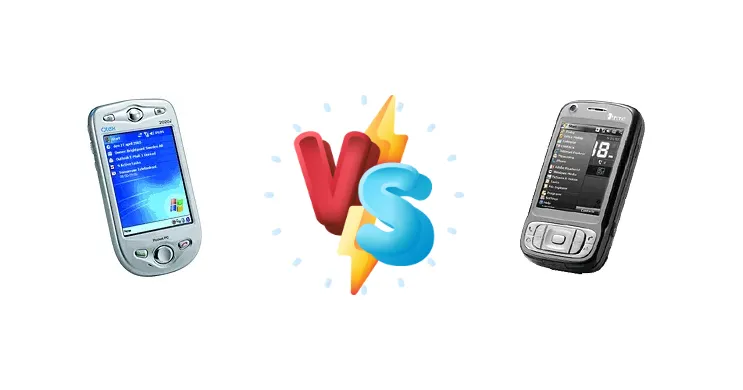
The early 2000s saw a fierce competition in the burgeoning smartphone market, particularly within the Windows Mobile ecosystem. The Qtek 2020i, powered by an Intel processor, and the HTC TyTN II, utilizing a Qualcomm ARM-based chipset, represent distinct approaches to delivering mobile productivity. This comparison dissects their core differences to determine which device better served the needs of power users.
🏆 Quick Verdict
For the average user prioritizing raw processing power for tasks like document editing and running demanding applications, the Qtek 2020i’s Intel Bulverde CPU offers a noticeable advantage. However, the HTC TyTN II’s Qualcomm chipset provides a more balanced experience with potentially better battery life and a more mature platform.
| Network |
|---|
| 2G bands | GSM 900 / 1800 / 1900 | GSM 850 / 900 / 1800 / 1900 |
| 3G bands | - | HSDPA 850 / 1900 / 2100 |
| EDGE | No | - |
| GPRS | Class 10 | - |
| Speed | - | HSPA 3.6/0.384 Mbps |
| Technology | GSM | GSM / HSPA |
| Launch |
|---|
| Announced | 2004, Q2 | 2007, July |
| Status | Discontinued | Discontinued |
| Body |
|---|
| Dimensions | 130 x 70 x 18 mm, 105 cc (5.12 x 2.76 x 0.71 in) | 112 x 59 x 19 mm (4.41 x 2.32 x 0.75 in) |
| Keyboard | - | QWERTY |
| SIM | Mini-SIM | Mini-SIM |
| Weight | 190 g (6.70 oz) | 190 g (6.70 oz) |
| Display |
|---|
| Resolution | 240 x 320 pixels, 4:3 ratio (~114 ppi density) | 240 x 320 pixels, 4:3 ratio (~143 ppi density) |
| Size | 3.5 inches, 53 x 71 mm, 37.9 cm2 (~41.7% screen-to-body ratio) | 2.8 inches, 24.3 cm2 (~36.7% screen-to-body ratio) |
| Type | TFT resistive touchscreen, 65K colors | TFT resistive touchscreen, 65K colors |
| | 5-way navigation button
Downloadable logos | Handwriting recognition
|
| Platform |
|---|
| CPU | Intel Bulverde 520 MHz | 400 MHz ARM 11 |
| Chipset | - | Qualcomm MSM7200 |
| GPU | - | Adreno 130 |
| OS | Microsoft Windows Mobile 2003 SE PocketPC | Microsoft Windows Mobile 6.0 Professional |
| Memory |
|---|
| Card slot | SDIO/MMC | microSD (dedicated slot) |
| Internal | 128MB RAM, 128MB ROM | 128MB RAM, 256MB ROM |
| Main Camera |
|---|
| Single | 1.3 MP | 3.15 MP, AF |
| Video | Yes | Yes |
| Selfie camera |
|---|
| Single | - | VGA videocall camera |
| | No | - |
| Sound |
|---|
| 3.5mm jack | No | No |
| 35mm jack | No | No |
| Alert types | Vibration; Downloadable polyphonic, MP3 ringtones | Vibration; Downloadable polyphonic, MP3 ringtones |
| Loudspeaker | Yes | Yes |
| Comms |
|---|
| Bluetooth | Yes | 2.0 |
| Infrared port | Yes | - |
| Positioning | No | GPS, A-GPS |
| Radio | No | No |
| USB | Proprietary | 2.0 |
| WLAN | Wi-Fi 802.11b | Wi-Fi 802.11b/g |
| Features |
|---|
| Browser | WAP 2.0/xHTML, HTML (PocketIE) | WAP 2.0/xHTML, HTML (PocketIE) |
| | Microsoft ActiveSync
MP3 player
Predictive text input | Pocket Office
Voice memo
Media Player 10 |
| Battery |
|---|
| Stand-by | Up to 168 h | Up to 400 h |
| Talk time | Up to 4 h | Up to 6 h |
| Type | Removable Li-Ion 1300 mAh battery | Removable Li-Po 1350 mAh battery |
| Misc |
|---|
| Colors | Silver | Silver |
| Price | - | About 140 EUR |
| SAR | - | 0.39 W/kg (head) 1.66 W/kg (body) |
| Tests |
|---|
| Loudspeaker | - |
Voice 76dB / Noise 75dB / Ring 82dB
|
Qtek 2020i
- Faster processor (Intel Bulverde 520 MHz)
- Stronger single-core performance for demanding apps
- x86 architecture compatibility
- Potentially shorter battery life
- Higher power consumption
- Limited information on display quality
HTC TyTN II
- More power-efficient ARM architecture
- Potentially longer battery life
- Integrated Qualcomm MSM7200 chipset for modem/multimedia
- Slower processor (ARM 11 400 MHz)
- Lower raw processing power
- Limited information on display quality
Display Comparison
Unfortunately, detailed display specifications for either device are unavailable. However, given the era, both likely featured resistive touchscreens with limited viewing angles and color reproduction. The focus was on functionality over visual fidelity. The TyTN II, being a later model, *may* have benefited from slight improvements in screen technology, but this is speculative. Both would have struggled in direct sunlight.
Camera Comparison
Camera details are scarce for both devices. It’s safe to assume both featured basic camera modules for the time, likely with resolutions around 1-2 megapixels. Image quality would have been limited by sensor size, lens quality, and the lack of advanced image processing. Neither device was intended as a photography powerhouse; the cameras served primarily for basic documentation and video calls.
Performance
The core difference lies in the CPUs. The Qtek 2020i boasts an Intel Bulverde processor clocked at 520 MHz, an x86 architecture known for its strong single-core performance. This translates to faster application loading and smoother multitasking, particularly for applications compiled for x86. Conversely, the HTC TyTN II utilizes a 400 MHz ARM 11 processor, coupled with the Qualcomm MSM7200 chipset. While ARM processors generally excel in power efficiency, the lower clock speed and older ARM 11 architecture place it at a disadvantage in raw processing power compared to the Intel Bulverde. The MSM7200 chipset likely provided better integrated modem and multimedia capabilities, but the CPU performance gap is significant.
Battery Life
Battery capacity specifics are unavailable. However, the ARM-based Qualcomm MSM7200 chipset in the HTC TyTN II is inherently more power-efficient than the Intel Bulverde in the Qtek 2020i. This suggests the TyTN II would likely offer longer battery life under typical usage scenarios. The Intel processor, while powerful, demands more energy, potentially leading to shorter runtimes between charges. The 2020i’s performance advantage would come at the cost of battery endurance.
Buying Guide
Buy the Qtek 2020i if you absolutely need the fastest possible processing speed within the Windows Mobile environment for complex tasks and are willing to potentially sacrifice battery life. Buy the HTC TyTN II if you prioritize a more refined user experience, potentially longer battery endurance, and a device built on a more established ARM architecture, even if it means a slight performance trade-off.
Frequently Asked Questions
❓ Will the Qtek 2020i run modern applications?
No. The Qtek 2020i runs Windows Mobile, a discontinued operating system. Modern applications are not compatible. Its strength lies in running software designed for that specific platform, primarily productivity tools available at the time.
❓ Is the HTC TyTN II easier to find replacement parts for?
Potentially. The HTC TyTN II was a more widely produced device than the Qtek 2020i, meaning replacement parts and accessories might be slightly more readily available, though finding them will still be challenging given the age of both devices.
❓ Can either of these devices be upgraded to a more modern operating system?
No. Upgrading to a modern OS like Android or iOS is not feasible due to hardware limitations and the lack of available custom ROMs for these platforms on these specific devices.