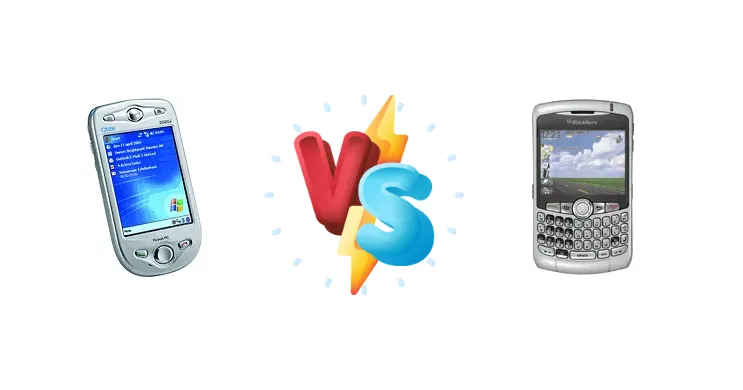
The early 2000s saw a burgeoning smartphone market, with Windows Mobile and BlackBerry vying for dominance. The Qtek 2020i, powered by an Intel Bulverde processor, represented a push towards more PC-like functionality, while the BlackBerry Curve 8300 focused on efficient communication and a refined user experience. This comparison dissects their core differences, revealing which device better suited the needs of the time.
🏆 Quick Verdict
For users prioritizing raw processing power and a more open operating system, the Qtek 2020i emerges as the winner. Its 520 MHz Intel Bulverde CPU significantly outperforms the BlackBerry Curve 8300’s 312 MHz XScale, making it better suited for running demanding applications. However, the BlackBerry’s superior ergonomics and email focus remain compelling.
| Network |
|---|
| 2G bands | GSM 900 / 1800 / 1900 | GSM 850 / 900 / 1800 / 1900 |
| EDGE | No | Class 10 |
| GPRS | Class 10 | Class 10 |
| Technology | GSM | GSM |
| Launch |
|---|
| Announced | 2004, Q2 | 2007, May |
| Status | Discontinued | Discontinued |
| Body |
|---|
| Dimensions | 130 x 70 x 18 mm, 105 cc (5.12 x 2.76 x 0.71 in) | 107 x 60 x 15.5 mm (4.21 x 2.36 x 0.61 in) |
| Keyboard | - | QWERTY |
| SIM | Mini-SIM | Mini-SIM |
| Weight | 190 g (6.70 oz) | 111 g (3.92 oz) |
| | - | Trackball |
| Display |
|---|
| Resolution | 240 x 320 pixels, 4:3 ratio (~114 ppi density) | 320 x 240 pixels, 4:3 ratio (~160 ppi density) |
| Size | 3.5 inches, 53 x 71 mm, 37.9 cm2 (~41.7% screen-to-body ratio) | 2.5 inches, 19.4 cm2 (~30.1% screen-to-body ratio) |
| Type | TFT resistive touchscreen, 65K colors | 65K colors |
| | 5-way navigation button
Downloadable logos | - |
| Platform |
|---|
| CPU | Intel Bulverde 520 MHz | 32-bit Intel XScale PXA272 312 MHz |
| OS | Microsoft Windows Mobile 2003 SE PocketPC | BlackBerry OS |
| Memory |
|---|
| Card slot | SDIO/MMC | microSDHC (dedicated slot) |
| Internal | 128MB RAM, 128MB ROM | 64MB |
| Main Camera |
|---|
| Features | - | LED flash |
| Single | 1.3 MP | 2 MP |
| Video | Yes | Yes |
| Sound |
|---|
| 3.5mm jack | No | Yes |
| 35mm jack | No | Yes |
| Alert types | Vibration; Downloadable polyphonic, MP3 ringtones | Vibration; MP3, WAV ringtones |
| Loudspeaker | Yes | Yes |
| Comms |
|---|
| Bluetooth | Yes | 2.0, A2DP |
| Infrared port | Yes | - |
| Positioning | No | No |
| Radio | No | No |
| USB | Proprietary | miniUSB 2.0 |
| WLAN | Wi-Fi 802.11b | No |
| Features |
|---|
| Browser | WAP 2.0/xHTML, HTML (PocketIE) | HTML |
| | Microsoft ActiveSync
MP3 player
Predictive text input | BlackBerry maps
Document editor (Word, Excel, PowerPoint, PDF)
MP4/WMV/H.263/H.264 player
MP3/WAV/eAAC+/WMA player
Organizer
Voice memo/dial |
| Battery |
|---|
| Stand-by | Up to 168 h | Up to 408 h |
| Talk time | Up to 4 h | Up to 4 h |
| Type | Removable Li-Ion 1300 mAh battery | Removable Li-Ion 1100 mAh battery |
| Misc |
|---|
| Colors | Silver | Black |
| Price | - | About 130 EUR |
| SAR | - | 1.51 W/kg (head) 1.12 W/kg (body) |
| SAR EU | - | 0.82 W/kg (head) 0.64 W/kg (body) |
Qtek 2020i
- Faster processor for demanding tasks
- More flexible Windows Mobile OS
- Potentially larger screen size
- Higher power consumption
- Less optimized for email
- Potentially shorter battery life
BlackBerry Curve 8300
- Excellent keyboard for typing
- Superior email experience
- Longer battery life due to efficient processor
- Slower processor
- Less flexible operating system
- Limited application ecosystem
Display Comparison
Neither device boasts a particularly advanced display by modern standards. Details regarding screen resolution and panel technology are scarce, but both likely utilized reflective LCDs common at the time. The Qtek 2020i’s larger form factor *potentially* allowed for a slightly larger display, but the BlackBerry Curve 8300’s focus on readability and contrast for text-heavy email would have been prioritized. Bezels were substantial on both, reflecting the design constraints of the era.
Camera Comparison
Camera capabilities were rudimentary on both devices. Details are limited, but both likely featured low-resolution cameras (likely around 1-2 megapixels) primarily intended for basic photo capture. Image quality would have been poor by today’s standards. The BlackBerry Curve 8300 may have had a slight edge in software processing, given BlackBerry’s focus on user experience, but the fundamental limitations of the sensors would have been the primary constraint.
Performance
The core difference lies in the CPUs. The Qtek 2020i’s 520 MHz Intel Bulverde processor represents a substantial clock speed advantage over the BlackBerry Curve 8300’s 312 MHz Intel XScale PXA272. While both are 32-bit processors, the Bulverde architecture, though older, generally offered better performance per clock cycle. This translates to faster application loading times and smoother multitasking on the Qtek. However, the XScale was known for its power efficiency, potentially giving the BlackBerry a battery life advantage. The lack of significant RAM details makes a direct comparison difficult, but the Qtek’s more demanding OS likely required more.
Battery Life
Battery life is difficult to assess without specific mAh ratings. However, the Intel XScale PXA272 in the BlackBerry Curve 8300 was renowned for its power efficiency. This, combined with BlackBerry’s optimized software, likely resulted in longer battery life compared to the Qtek 2020i, which was burdened by the more power-hungry Intel Bulverde processor and the resource-intensive Windows Mobile operating system. Charging times would have been slow on both, relying on proprietary connectors.
Buying Guide
Buy the Qtek 2020i if you need a smartphone capable of running more complex applications, potentially emulating older PC software, and appreciate the flexibility of the Windows Mobile operating system. Buy the BlackBerry Curve 8300 if you prioritize secure email communication, a physical QWERTY keyboard for efficient typing, and a device optimized for one-handed operation and long battery life.
Frequently Asked Questions
❓ Is the Qtek 2020i capable of running modern applications?
No. The Qtek 2020i runs Windows Mobile, an outdated operating system with no support for modern applications. While some enthusiasts have attempted to port alternative operating systems, compatibility remains limited.
❓ How does the BlackBerry Curve 8300’s trackball compare to touchscreen navigation?
The BlackBerry Curve 8300’s trackball offered a precise and tactile navigation experience, particularly for scrolling through long lists and menus. While less intuitive than a touchscreen, it was a hallmark of the BlackBerry experience and favored by users who preferred physical controls.
❓ Would the Qtek 2020i be suitable for playing emulators of older consoles?
Potentially. The Intel Bulverde processor offers more processing power than the XScale, making the Qtek 2020i a better candidate for emulating older consoles like the Game Boy Advance or SNES. However, performance will vary depending on the emulator and game.
❓ Is it easy to find replacement batteries or accessories for either device today?
Finding original accessories is increasingly difficult. Third-party batteries are available, but quality can vary. The BlackBerry Curve 8300 may have slightly better aftermarket support due to its larger user base.