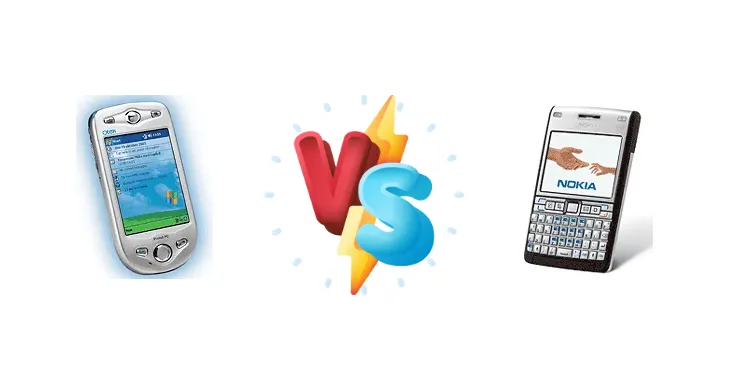
The early 2000s saw a battle for smartphone supremacy, with Windows Mobile and Symbian OS leading the charge. The Qtek 2020, powered by Intel's PXA263, and the Nokia E61i, utilizing a dual ARM 9 processor, represent distinct approaches to mobile computing. This comparison dissects their core architectures to determine which device offered a more responsive and capable experience for its time.
🏆 Quick Verdict
For the average user seeking responsiveness in early smartphone tasks, the Qtek 2020 emerges as the winner. Its 400 MHz Intel PXA263 processor provides a significant performance advantage over the Nokia E61i’s 220 MHz dual ARM 9, translating to faster application loading and smoother multitasking, despite potential battery life trade-offs.
| Network |
|---|
| 2G bands | GSM 900 / 1800 / 1900 | GSM 850 / 900 / 1800 / 1900 |
| 3G bands | - | UMTS 2100 |
| EDGE | No | - |
| GPRS | Class 10 | - |
| Speed | - | Yes, 384 kbps |
| Technology | GSM | GSM / UMTS |
| Launch |
|---|
| Announced | 2004, Q2 | 2007, February |
| Status | Discontinued | Discontinued |
| Body |
|---|
| Dimensions | 130 x 70 x 18 mm, 105 cc (5.12 x 2.76 x 0.71 in) | 117 x 70 x 13.9 mm, 97 cc (4.61 x 2.76 x 0.55 in) |
| Keyboard | - | QWERTY |
| SIM | Mini-SIM | Mini-SIM |
| Weight | 190 g (6.70 oz) | 150 g (5.29 oz) |
| Display |
|---|
| Resolution | 240 x 320 pixels, 4:3 ratio (~114 ppi density) | 320 x 240 pixels, 4:3 ratio (~143 ppi density) |
| Size | 3.5 inches, 53 x 71 mm, 37.9 cm2 (~41.7% screen-to-body ratio) | 2.8 inches, 24.3 cm2 (~29.6% screen-to-body ratio) |
| Type | TFT resistive touchscreen, 65K colors | TFT, 16M colors |
| | 5-way navigation button
Downloadable logos | Five-way scroll key
|
| Platform |
|---|
| CPU | Intel PXA263 400 MHz | 220 MHz Dual ARM 9 |
| OS | Microsoft Windows Mobile 2003 PocketPC | Symbian OS 9.1, Series 60 v3.0 UI |
| Memory |
|---|
| Card slot | SDIO/MMC | microSD (dedicated slot) |
| Internal | 64MB RAM (128MB optional) | 60MB 64MB RAM |
| Main Camera |
|---|
| Single | VGA | 2 MP |
| Video | Yes | CIF |
| Sound |
|---|
| 3.5mm jack | No | No |
| 35mm jack | No | No |
| Alert types | Vibration; Downloadable polyphonic, MP3 ringtones | Vibration; Downloadable polyphonic, monophonic, MP3 ringtones |
| Loudspeaker | Yes | Yes |
| Comms |
|---|
| Bluetooth | Yes | 1.2 |
| Infrared port | Yes | Yes |
| Positioning | No | No |
| Radio | No | No |
| USB | Proprietary | Pop-Port 2.0 |
| WLAN | No | Wi-Fi 802.11b/g |
| Features |
|---|
| Browser | HTML (Pocket IE) | WAP 2.0/xHTML, HTML |
| Languages | 7 | - |
| | Microsoft ActiveSync
MP3 player
Predictive text input | MP3/AAC/MP4 player
Document viewer (Word, Excel, PowerPoint, PDF)
Blackberry connectivity
Push to talk
Voice command/dial
Organizer
Printing |
| Battery |
|---|
| Stand-by | Up to 160 h | Up to 400 h (2G) / 456 h (3G) |
| Talk time | Up to 3 h 30 min | Up to 9 h (2G) / 5 h (3G) |
| Type | Removable Li-Ion 1200 mAh battery | Removable Li-Po 1500 mAh battery (BP-4L) |
| Misc |
|---|
| Colors | Silver | Silver, Mocca |
| Price | - | About 200 EUR |
| SAR | - | 1.12 W/kg (head) 0.81 W/kg (body) |
| SAR EU | - | 0.57 W/kg (head) |
Qtek 2020
- Faster processor (400 MHz Intel PXA263)
- Potentially better multimedia performance
- More capable of running demanding applications
- Likely shorter battery life
- Windows Mobile OS could be less refined than Symbian
Nokia E61i
- Longer battery life (due to efficient ARM 9 processor)
- More established and refined Symbian OS
- Focus on core communication features
- Slower processor (220 MHz dual ARM 9)
- Limited performance for demanding applications
- Less capable multimedia experience
Display Comparison
Neither device boasts a particularly advanced display by modern standards. Details regarding screen resolution and panel technology are unavailable, but both likely utilized resistive touchscreens common at the time. The focus was on functionality rather than visual fidelity. The Qtek 2020’s larger processing power *could* have been leveraged for more complex UI rendering, but without specific display specs, a direct comparison is difficult.
Camera Comparison
Camera specifications for both devices are not provided. However, given the era, both likely featured low-resolution cameras primarily intended for basic photo capture. Image processing capabilities would have been limited by the processor power. The Qtek 2020’s more powerful CPU *could* have handled slightly more sophisticated image processing, but the overall camera experience would have been similar on both devices.
Performance
The core difference lies in the CPUs. The Qtek 2020’s 400 MHz Intel PXA263 is a significantly faster processor than the Nokia E61i’s 220 MHz dual ARM 9. While the ARM 9 benefits from being a dual-core design, the higher clock speed and architectural advantages of the PXA263 likely outweigh this. The PXA263 was designed for more complex tasks, including running a full Windows Mobile OS, while the ARM 9 was optimized for efficiency within the Symbian environment. This translates to faster application launch times and smoother multitasking on the Qtek 2020. The PXA263 also included hardware acceleration for multimedia, further enhancing its performance.
Battery Life
Battery capacity details are unavailable for either device. However, the Intel PXA263 is known to be more power-hungry than the ARM 9. Therefore, the Nokia E61i likely offered superior battery life due to its more efficient processor. The Qtek 2020’s performance advantage would have come at the cost of reduced runtime between charges.
Buying Guide
Buy the Qtek 2020 if you prioritized speed and responsiveness for running Windows Mobile applications, even at the expense of potentially shorter battery life. It's ideal for users who needed to run demanding productivity tools or multimedia applications. Buy the Nokia E61i if you valued battery life and a more established, refined operating system (Symbian) with a focus on email and basic productivity. It’s better suited for users who primarily needed a reliable communication device.
Frequently Asked Questions
❓ Would the Qtek 2020 struggle with modern app equivalents if ported over?
Absolutely. The Intel PXA263, while powerful for its time, lacks the processing power and architectural features to efficiently run modern smartphone applications. Even basic tasks would likely be sluggish and unresponsive. The limited RAM available on these devices would also be a significant bottleneck.
❓ How did the choice of operating system (Windows Mobile vs. Symbian) impact performance on these devices?
Windows Mobile, running on the Qtek 2020, was generally considered more resource-intensive than Symbian OS on the Nokia E61i. Symbian was designed for efficiency and optimized for lower-powered hardware. Windows Mobile attempted to replicate a desktop experience on a mobile device, requiring more processing power and RAM. This contributed to the Qtek 2020 needing a faster processor to maintain acceptable performance.
❓ Could the Nokia E61i's dual ARM 9 architecture compensate for its lower clock speed compared to the Qtek 2020?
While a dual-core design offers some performance benefits, the 220 MHz clock speed of the Nokia E61i’s ARM 9 processors was significantly lower than the 400 MHz of the Qtek 2020’s Intel PXA263. The architectural advantages of the PXA263, combined with its higher clock speed, likely outweighed the benefits of the dual-core ARM 9 in most real-world scenarios.