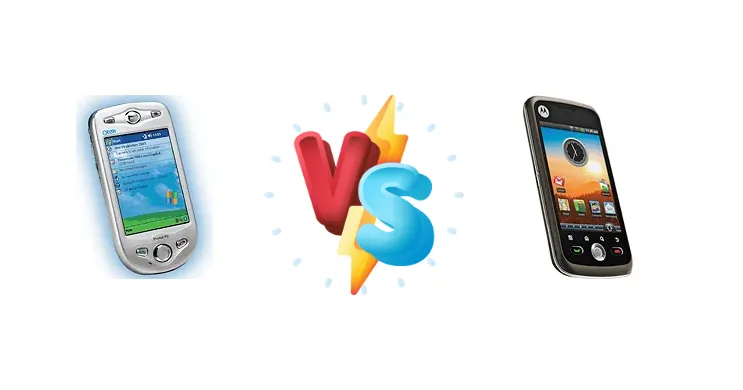
The Qtek 2020 and Motorola Quench XT3 represent a pivotal moment in smartphone history, bridging the gap between feature phones and the modern smartphone. Both devices aimed to deliver connected experiences, but they took fundamentally different approaches to processing power, relying on Intel's PXA263 and Qualcomm's Snapdragon S1 respectively. This comparison dissects these architectures to understand their strengths and weaknesses in the context of early smartphone usage.
🏆 Quick Verdict
For the average user seeking a functional early smartphone experience, the Motorola Quench XT3 XT502 emerges as the slightly better choice. Its 600 MHz ARM 11 processor, built on a more modern architecture, provides a noticeable performance advantage over the Qtek 2020’s 400 MHz Intel PXA263, translating to snappier application loading and a more responsive user interface.
| Network |
|---|
| 2G bands | GSM 900 / 1800 / 1900 | GSM 850 / 900 / 1800 / 1900 |
| 3G bands | - | HSDPA 850 / 1900 / 2100 |
| EDGE | No | - |
| GPRS | Class 10 | - |
| Speed | - | HSPA 7.2/0.384 Mbps |
| Technology | GSM | GSM / HSPA |
| Launch |
|---|
| Announced | 2004, Q2 | 2010, July. Released 2010, August |
| Status | Discontinued | Discontinued |
| Body |
|---|
| Dimensions | 130 x 70 x 18 mm, 105 cc (5.12 x 2.76 x 0.71 in) | 114.9 x 56.8 x 12.6 mm, 80 cc (4.52 x 2.24 x 0.50 in) |
| SIM | Mini-SIM | Mini-SIM |
| Weight | 190 g (6.70 oz) | 114 g (4.02 oz) |
| | - | Trackball |
| Display |
|---|
| Protection | - | Corning Gorilla Glass |
| Resolution | 240 x 320 pixels, 4:3 ratio (~114 ppi density) | 320 x 480 pixels, 3:2 ratio (~180 ppi density) |
| Size | 3.5 inches, 53 x 71 mm, 37.9 cm2 (~41.7% screen-to-body ratio) | 3.2 inches, 30.5 cm2 (~46.7% screen-to-body ratio) |
| Type | TFT resistive touchscreen, 65K colors | TFT, 256K colors |
| | 5-way navigation button
Downloadable logos | MOTOBLUR UI with Live Widgets |
| Platform |
|---|
| CPU | Intel PXA263 400 MHz | 600 MHz ARM 11 |
| Chipset | - | Qualcomm MSM7227 Snapdragon S1 |
| GPU | - | Adreno 200 |
| OS | Microsoft Windows Mobile 2003 PocketPC | Android 1.6 (Donut) |
| Memory |
|---|
| Card slot | SDIO/MMC | microSDHC (dedicated slot) |
| Internal | 64MB RAM (128MB optional) | 512MB 256MB RAM |
| Main Camera |
|---|
| Features | - | LED flash |
| Single | VGA | 3.15 MP |
| Video | Yes | 320x480@15fps |
| Sound |
|---|
| 3.5mm jack | No | Yes |
| 35mm jack | No | Yes |
| Alert types | Vibration; Downloadable polyphonic, MP3 ringtones | - |
| Loudspeaker | Yes | Yes |
| Comms |
|---|
| Bluetooth | Yes | 2.0, A2DP, EDR |
| Infrared port | Yes | - |
| Positioning | No | GPS, A-GPS |
| Radio | No | No |
| USB | Proprietary | microUSB 2.0 |
| WLAN | No | Wi-Fi 802.11 b/g |
| Features |
|---|
| Browser | HTML (Pocket IE) | HTML |
| Languages | 7 | - |
| Sensors | - | Accelerometer, proximity, compass |
| | Microsoft ActiveSync
MP3 player
Predictive text input | MP3/WMA/WAV/eAAC+ player
MP4/DivX/H.264 player
Document viewer
Photo viewer/editor
Organizer
Voice memo
Predictive text input |
| Battery |
|---|
| Stand-by | Up to 160 h | Up to 560 h (2G) / Up to 445 h (3G) |
| Talk time | Up to 3 h 30 min | Up to 8 h 10 min (2G) / Up to 6 h 30 min (3G) |
| Type | Removable Li-Ion 1200 mAh battery | Removable Li-Po 1270 mAh battery |
| Misc |
|---|
| Colors | Silver | Brown |
| Models | - | xt502 |
| Price | - | About 170 EUR |
| SAR | - | 1.16 W/kg (head) 0.59 W/kg (body) |
| SAR EU | - | 0.96 W/kg (head) |
Qtek 2020
- Potential for wider Windows Mobile application compatibility.
- Potentially slightly better battery life due to lower CPU clock speed.
- Represents a significant step forward from feature phones.
- Slower processor performance compared to the Quench XT3.
- Less efficient architecture.
- Likely a less responsive user interface.
Motorola Quench XT3 XT502
- Faster processor (600 MHz ARM 11).
- More efficient Snapdragon S1 chipset.
- Android operating system offers a different user experience.
- Android ecosystem was less mature at the time of release.
- Potentially slightly shorter battery life.
- May have limited application availability compared to Windows Mobile.
Display Comparison
Unfortunately, detailed display specifications for both devices are unavailable. However, given their release timeframe, it’s safe to assume both utilized resistive touchscreen technology with relatively low resolutions. The display experience on both would have been limited by the processing power available to render graphics and handle touch input. Bezels were substantial on both devices, typical of the era.
Camera Comparison
Details regarding camera specifications are scarce for both devices. It’s reasonable to assume both featured basic camera modules, likely with resolutions around 2-3 megapixels. Image quality would have been heavily reliant on ambient lighting and processing capabilities of the respective processors. Given the Snapdragon S1’s integrated GPU, the Quench XT3 likely had a slight edge in image processing speed, but the difference would be minimal. Neither device would be considered a photography powerhouse by today’s standards.
Performance
The core difference lies in the processors. The Motorola Quench XT3 boasts a 600 MHz ARM 11 processor within the Qualcomm MSM7227 Snapdragon S1 chipset. This ARM architecture, while not as powerful as today’s processors, offered a more efficient and scalable design compared to the Intel PXA263 in the Qtek 2020. The Qtek’s 400 MHz Intel processor, while a significant step up from feature phone processors, struggled to keep pace with the ARM 11 in real-world multitasking and application responsiveness. The Snapdragon S1 also integrated a GPU, providing a hardware acceleration for graphics, something the PXA263 likely lacked or had in a less capable form. This translates to a smoother experience when viewing images or basic web pages on the Quench.
Battery Life
Battery capacity details are unavailable for either device. However, given the lower clock speed of the Intel PXA263 in the Qtek 2020, it *potentially* offered slightly better battery life under similar usage conditions. However, the more efficient ARM 11 architecture in the Quench XT3 could offset the higher clock speed, resulting in comparable real-world battery performance. Charging times would have been slow on both devices, relying on micro-USB connections and limited charging wattage.
Buying Guide
Buy the Qtek 2020 if you prioritize a device with a potentially wider range of Windows Mobile applications, and are comfortable with a slower, more deliberate user experience. Buy the Motorola Quench XT3 XT502 if you prefer a more responsive interface and a platform built around Android, offering a smoother experience for basic smartphone tasks like web browsing and messaging.
Frequently Asked Questions
❓ Was the Qtek 2020 capable of running demanding applications like modern mobile games?
No. The Intel PXA263 processor and limited RAM in the Qtek 2020 were not powerful enough to handle the graphical demands of even basic 3D games. It was primarily designed for productivity tasks like email, messaging, and basic web browsing.
❓ How did the Qualcomm Snapdragon S1 chipset impact the user experience on the Motorola Quench XT3 compared to previous Motorola phones?
The Snapdragon S1 represented a significant leap forward for Motorola. The integrated GPU and more efficient ARM 11 processor resulted in a noticeably smoother and more responsive user interface, particularly when navigating menus and loading applications. It allowed for a more fluid experience than Motorola’s previous feature phone-based smartphones.
❓ Which operating system, Windows Mobile on the Qtek 2020 or Android on the Motorola Quench XT3, was more popular at the time of release?
Windows Mobile had a stronger foothold in the early smartphone market at the time of these devices’ release. However, Android was rapidly gaining traction, and the Quench XT3 represented Motorola’s bet on the future of mobile operating systems. While Windows Mobile had a larger existing user base, Android’s open-source nature and growing developer support were key factors in its eventual dominance.