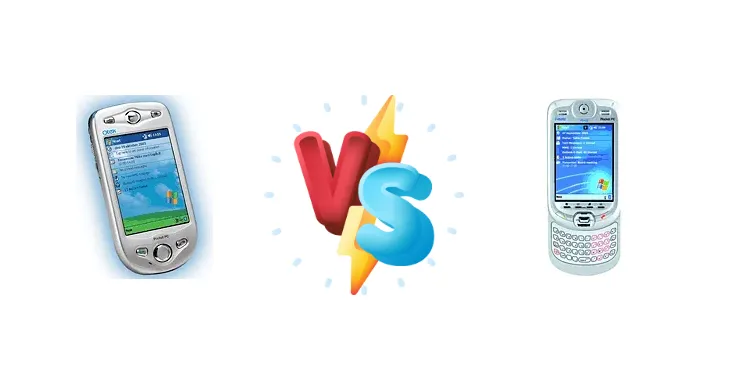
The Qtek 2020 and i-mate PDA2k represent a pivotal moment in mobile computing – the convergence of PDAs and cellular phones running Windows Mobile. Both devices aimed to deliver smartphone functionality to early adopters, but differed in their approach to design and potentially, software optimization. This comparison dissects their similarities and differences, focusing on the impact of their shared Intel PXA263 processor.
🏆 Quick Verdict
For the average user seeking a functional piece of early smartphone history, the i-mate PDA2k likely offers a slightly more refined experience due to i-mate’s established brand recognition and focus on user interface. However, the Qtek 2020 remains a viable option, particularly for those prioritizing a potentially more customizable software experience.
| Network |
|---|
| 2G bands | GSM 900 / 1800 / 1900 | GSM 850 / 900 / 1800 / 1900 |
| EDGE | No | No |
| GPRS | Class 10 | Class 10 |
| Technology | GSM | GSM |
| Launch |
|---|
| Announced | 2004, Q2 | 2004, Q3 |
| Status | Discontinued | Discontinued |
| Body |
|---|
| Dimensions | 130 x 70 x 18 mm, 105 cc (5.12 x 2.76 x 0.71 in) | 125 x 71.6 x 18.7 mm (4.92 x 2.82 x 0.74 in) |
| Keyboard | - | QWERTY |
| SIM | Mini-SIM | Mini-SIM |
| Weight | 190 g (6.70 oz) | 210 g (7.41 oz) |
| Display |
|---|
| Resolution | 240 x 320 pixels, 4:3 ratio (~114 ppi density) | 240 x 320 pixels, 3.5 inches, 4:3 ratio (~114 ppi density) |
| Size | 3.5 inches, 53 x 71 mm, 37.9 cm2 (~41.7% screen-to-body ratio) | 3.5 inches, 53 x 71 mm, 37.9 cm2 (~42.4% screen-to-body ratio) |
| Type | TFT resistive touchscreen, 65K colors | TFT resistive touchscreen, 65K colors |
| | 5-way navigation button
Downloadable logos | - |
| Platform |
|---|
| CPU | Intel PXA263 400 MHz | Intel PXA263 400 MHz |
| OS | Microsoft Windows Mobile 2003 PocketPC | Microsoft Windows Mobile 2003 SE PocketPC |
| Memory |
|---|
| Card slot | SDIO/MMC | SDIO/MMC |
| Internal | 64MB RAM (128MB optional) | 128MB RAM, 64MB ROM |
| Main Camera |
|---|
| Single | VGA | VGA |
| Video | Yes | Yes |
| Sound |
|---|
| 3.5mm jack | No | No |
| 35mm jack | No | No |
| Alert types | Vibration; Downloadable polyphonic, MP3 ringtones | Vibration; Downloadable polyphonic, WAV ringtones |
| Loudspeaker | Yes | Yes |
| Comms |
|---|
| Bluetooth | Yes | 1.1 |
| Infrared port | Yes | Yes |
| Positioning | No | No |
| Radio | No | No |
| USB | Proprietary | Proprietary |
| WLAN | No | Wi-Fi 802.11b |
| Features |
|---|
| Browser | HTML (Pocket IE) | HTML (PocketIE) |
| Languages | 7 | 8 |
| | Microsoft ActiveSync
MP3 player
Predictive text input | Microsoft ActiveSync
MP3/AAC player
Predictive text input |
| Battery |
|---|
| Stand-by | Up to 160 h | Up to 168 h |
| Talk time | Up to 3 h 30 min | Up to 4 h |
| Type | Removable Li-Ion 1200 mAh battery | Removable Li-Ion 1050 mAh battery |
| Misc |
|---|
| Colors | Silver | Stylish black and silver |
Qtek 2020
- Potential for greater software customization due to Qtek’s approach.
- May offer a wider range of available ROMs and community support.
- Represents a unique brand within the early Windows Mobile landscape.
- Potentially less refined user interface compared to i-mate.
- Limited information available regarding specific hardware components.
- May require more technical expertise for optimal configuration.
i-mate PDA2k
- i-mate was a well-established brand in the Windows Mobile space.
- Likely benefits from a more polished and user-friendly software experience.
- Potentially better support and troubleshooting resources available.
- May offer less flexibility for advanced customization.
- Could be more susceptible to software bloat from i-mate’s customizations.
- Limited hardware differentiation from the Qtek 2020.
Display Comparison
Both the Qtek 2020 and i-mate PDA2k likely featured resistive touchscreen displays common for the era, with resolutions around 320x240 pixels. Given the shared target market, display quality – brightness, viewing angles, and color reproduction – would have been heavily influenced by panel sourcing and calibration rather than inherent technological differences. The absence of detailed display specifications necessitates focusing on the user experience; the responsiveness of the resistive touch layer and the clarity of the display under various lighting conditions would be key differentiators, potentially favoring the device with better calibration.
Camera Comparison
Information regarding camera specifications for both devices is scarce. It’s highly probable that both featured low-resolution cameras (likely VGA or 1MP) primarily intended for basic photo capture and video calls. Image quality would be limited by the sensor size, lens quality, and image processing capabilities of the PXA263. Given the era, focusing on camera features is less relevant than assessing the overall usability of the camera application and the speed of image capture.
Performance
The core of both devices is the Intel PXA263 processor clocked at 400 MHz. This CPU, based on the XScale architecture, was a workhorse for early smartphones and PDAs. Performance differences, therefore, hinge on RAM allocation, storage speed (likely CompactFlash or SD card), and the efficiency of the Windows Mobile implementation. While both share the same CPU clock speed, i-mate’s software optimization could yield a smoother user experience, particularly in multitasking scenarios. The amount of RAM, a critical factor for Windows Mobile, is unknown for both devices, but would significantly impact performance.
Battery Life
Battery life on both the Qtek 2020 and i-mate PDA2k would be heavily dependent on usage patterns – cellular connectivity, screen brightness, and application load. Battery capacity details are unavailable, but both devices likely utilized proprietary battery solutions. The efficiency of the power management system within Windows Mobile and the optimization of background processes would be crucial factors. Given the shared processor, differences in battery life would likely stem from variations in display power consumption and software efficiency.
Buying Guide
Buy the Qtek 2020 if you are a collector interested in exploring the broader range of Qtek’s software customizations and potential for ROM development. Buy the i-mate PDA2k if you prefer a more polished, out-of-the-box experience from a brand known for its Windows Mobile devices and a potentially more active community for support and troubleshooting.
Frequently Asked Questions
❓ Is it possible to upgrade the operating system on either the Qtek 2020 or i-mate PDA2k?
While officially upgrading beyond the originally shipped Windows Mobile version is unlikely, the enthusiast community may have developed custom ROMs for both devices. However, attempting to flash custom ROMs carries inherent risks and may void any remaining warranty (though these devices are well past their warranty period). Researching forums dedicated to early Windows Mobile devices is crucial before attempting any modifications.
❓ What type of storage does each device use, and is it expandable?
Both the Qtek 2020 and i-mate PDA2k likely utilized either CompactFlash (CF) cards or Secure Digital (SD) cards for storage. Expandability depended on the specific model and available card slots. Checking the device’s documentation or online resources is necessary to determine the maximum supported storage capacity.
❓ How well do these devices handle modern applications or connectivity?
These devices are not designed to handle modern applications or connectivity standards. Their limited processing power, RAM, and outdated operating system make them unsuitable for running contemporary software. Connectivity is limited to 2G cellular networks and potentially Wi-Fi (depending on the model), and modern web browsing will be slow and often incompatible.