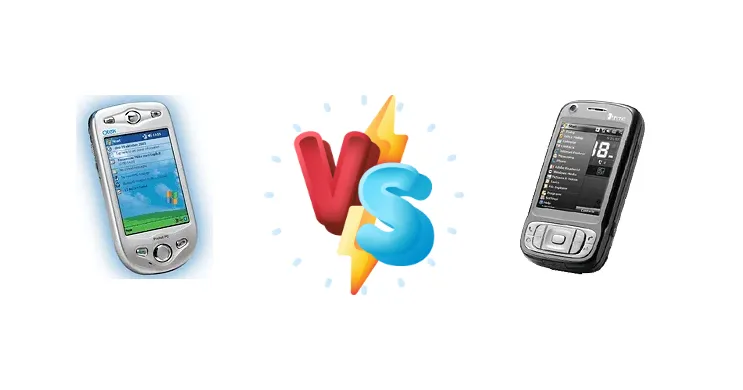
The Qtek 2020 and HTC TyTN II represent a pivotal era in Windows Mobile development, offering early smartphone functionality. Both devices aimed for business and power users, but diverged significantly in their core architecture. This comparison dissects the Intel PXA263-powered Qtek 2020 against the Qualcomm MSM7200-based HTC TyTN II, examining performance, usability, and long-term viability.
🏆 Quick Verdict
For the average user seeking a functional piece of Windows Mobile history, the HTC TyTN II is the better choice. The Qualcomm MSM7200 chipset generally provides a smoother user experience and better application compatibility compared to the Intel PXA263, despite both being clocked at 400MHz.
| Network |
|---|
| 2G bands | GSM 900 / 1800 / 1900 | GSM 850 / 900 / 1800 / 1900 |
| 3G bands | - | HSDPA 850 / 1900 / 2100 |
| EDGE | No | - |
| GPRS | Class 10 | - |
| Speed | - | HSPA 3.6/0.384 Mbps |
| Technology | GSM | GSM / HSPA |
| Launch |
|---|
| Announced | 2004, Q2 | 2007, July |
| Status | Discontinued | Discontinued |
| Body |
|---|
| Dimensions | 130 x 70 x 18 mm, 105 cc (5.12 x 2.76 x 0.71 in) | 112 x 59 x 19 mm (4.41 x 2.32 x 0.75 in) |
| Keyboard | - | QWERTY |
| SIM | Mini-SIM | Mini-SIM |
| Weight | 190 g (6.70 oz) | 190 g (6.70 oz) |
| Display |
|---|
| Resolution | 240 x 320 pixels, 4:3 ratio (~114 ppi density) | 240 x 320 pixels, 4:3 ratio (~143 ppi density) |
| Size | 3.5 inches, 53 x 71 mm, 37.9 cm2 (~41.7% screen-to-body ratio) | 2.8 inches, 24.3 cm2 (~36.7% screen-to-body ratio) |
| Type | TFT resistive touchscreen, 65K colors | TFT resistive touchscreen, 65K colors |
| | 5-way navigation button
Downloadable logos | Handwriting recognition
|
| Platform |
|---|
| CPU | Intel PXA263 400 MHz | 400 MHz ARM 11 |
| Chipset | - | Qualcomm MSM7200 |
| GPU | - | Adreno 130 |
| OS | Microsoft Windows Mobile 2003 PocketPC | Microsoft Windows Mobile 6.0 Professional |
| Memory |
|---|
| Card slot | SDIO/MMC | microSD (dedicated slot) |
| Internal | 64MB RAM (128MB optional) | 128MB RAM, 256MB ROM |
| Main Camera |
|---|
| Single | VGA | 3.15 MP, AF |
| Video | Yes | Yes |
| Selfie camera |
|---|
| Single | - | VGA videocall camera |
| | No | - |
| Sound |
|---|
| 3.5mm jack | No | No |
| 35mm jack | No | No |
| Alert types | Vibration; Downloadable polyphonic, MP3 ringtones | Vibration; Downloadable polyphonic, MP3 ringtones |
| Loudspeaker | Yes | Yes |
| Comms |
|---|
| Bluetooth | Yes | 2.0 |
| Infrared port | Yes | - |
| Positioning | No | GPS, A-GPS |
| Radio | No | No |
| USB | Proprietary | 2.0 |
| WLAN | No | Wi-Fi 802.11b/g |
| Features |
|---|
| Browser | HTML (Pocket IE) | WAP 2.0/xHTML, HTML (PocketIE) |
| Languages | 7 | - |
| | Microsoft ActiveSync
MP3 player
Predictive text input | Pocket Office
Voice memo
Media Player 10 |
| Battery |
|---|
| Stand-by | Up to 160 h | Up to 400 h |
| Talk time | Up to 3 h 30 min | Up to 6 h |
| Type | Removable Li-Ion 1200 mAh battery | Removable Li-Po 1350 mAh battery |
| Misc |
|---|
| Colors | Silver | Silver |
| Price | - | About 140 EUR |
| SAR | - | 0.39 W/kg (head) 1.66 W/kg (body) |
| Tests |
|---|
| Loudspeaker | - |
Voice 76dB / Noise 75dB / Ring 82dB
|
Qtek 2020
- Represents Intel's early mobile processor design.
- Potential collector's item for tech enthusiasts.
- May offer unique software compatibility for specific legacy applications.
- Intel PXA263 architecture can be less efficient than ARM.
- Potentially limited software support and compatibility.
- Likely slower performance compared to the TyTN II.
HTC TyTN II
- Qualcomm MSM7200 offers better power efficiency.
- Integrated GPU provides improved graphics performance.
- Wider software compatibility and support within the Windows Mobile ecosystem.
- ARM 11 architecture is dated by modern standards.
- Relies on resistive touchscreen technology.
- Limited camera capabilities.
Display Comparison
Detailed display specifications are unavailable for either device. However, both likely featured resistive touchscreens common to the era, impacting usability. The TyTN II’s slide-out keyboard suggests a focus on text input, potentially compensating for the less precise touchscreen. Given HTC’s later display expertise, it’s reasonable to assume the TyTN II may have had slightly better color reproduction, though this is speculative.
Camera Comparison
Camera specifications for both devices are largely unavailable. However, given the era, both likely featured low-resolution cameras (likely around 1-2 megapixels) primarily for basic photo capture. Image quality would have been limited by sensor size, lens quality, and processing power. The Qualcomm chipset in the TyTN II may have offered slightly better image processing capabilities due to its integrated signal processing unit, but the difference would be minimal.
Performance
The core difference lies in the CPU architecture. The Qtek 2020 utilizes an Intel PXA263, an XScale processor known for its decent performance in early smartphones but often hampered by software optimization. The HTC TyTN II employs a 400 MHz ARM 11 processor integrated into the Qualcomm MSM7200 chipset. ARM’s architecture generally offered better power efficiency and a more streamlined instruction set, leading to potentially smoother multitasking and application loading times. The MSM7200 also integrates a GPU, providing hardware acceleration for graphics, a feature likely absent or less capable in the Qtek 2020. This translates to a more responsive user interface on the TyTN II.
Battery Life
Battery capacity details are scarce. However, the ARM-based Qualcomm MSM7200 in the TyTN II is inherently more power-efficient than the Intel PXA263. This suggests the TyTN II would likely offer longer battery life under similar usage conditions. Charging times would have been slow by modern standards for both devices, relying on proprietary connectors and limited charging circuitry.
Buying Guide
Buy the Qtek 2020 if you are a collector specifically interested in Intel's early forays into the mobile space and are comfortable with potential software compatibility issues. Buy the HTC TyTN II if you prioritize a more stable and widely supported Windows Mobile experience, benefiting from Qualcomm's more mature ARM-based platform and broader software ecosystem.
Frequently Asked Questions
❓ Will modern apps run on either the Qtek 2020 or HTC TyTN II?
No. These devices run Windows Mobile, a discontinued operating system. Modern applications are designed for Android or iOS and are not compatible. You may find some legacy Windows Mobile applications still available, but compatibility is limited.
❓ Is it possible to upgrade the operating system on either device?
Officially, no. Microsoft no longer supports Windows Mobile. While unofficial ROMs and hacks may exist, attempting to upgrade the OS carries significant risk of bricking the device and is not recommended for casual users.
❓ Which device is better for playing emulators of older gaming consoles?
The HTC TyTN II is likely the better choice for emulation. The Qualcomm MSM7200’s integrated GPU provides hardware acceleration, which can improve performance when emulating older consoles like the Game Boy Advance or SNES. The Intel PXA263 in the Qtek 2020 lacks dedicated graphics processing.
❓ What kind of connectivity options do these devices offer?
Both devices likely support GPRS/EDGE for data connectivity and Bluetooth for wireless accessories. Wi-Fi support may be present on the TyTN II, but is less common on the Qtek 2020. Neither device supports 3G or later cellular technologies.