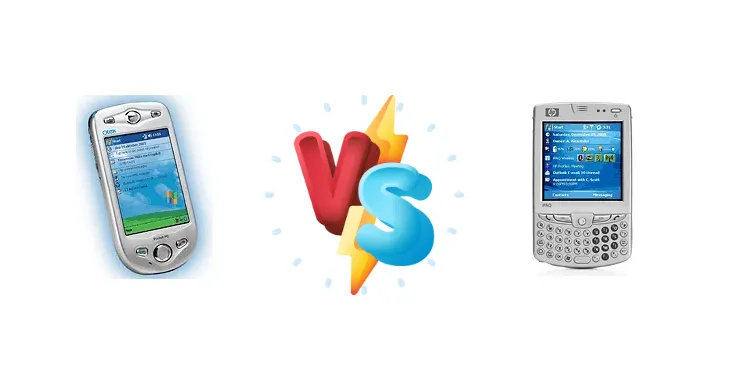
The Qtek 2020 and HP iPAQ hw6915 represent a pivotal era in mobile computing, when Pocket PCs and Windows Mobile were pushing the boundaries of what was possible in a handheld device. Both devices aimed to deliver smartphone functionality, but employed slightly different hardware approaches. This comparison dissects their core components to determine which device offered the superior experience for the early adopter.
🏆 Quick Verdict
For the average user seeking a functional early Windows Mobile device, the HP iPAQ hw6915 edges out the Qtek 2020. The slightly faster 416 MHz Intel PXA 270 processor provides a tangible, albeit modest, performance advantage, translating to snappier application loading and multitasking, crucial given the limited RAM of the era.
| Network |
|---|
| 2G bands | GSM 900 / 1800 / 1900 | GSM 850 / 900 / 1800 / 1900 |
| EDGE | No | Class 10 |
| GPRS | Class 10 | Class 10 |
| Technology | GSM | GSM |
| Launch |
|---|
| Announced | 2004, Q2 | 2006, February |
| Status | Discontinued | Discontinued |
| Body |
|---|
| Dimensions | 130 x 70 x 18 mm, 105 cc (5.12 x 2.76 x 0.71 in) | 118 x 71 x 18 mm (4.65 x 2.80 x 0.71 in) |
| Keyboard | - | QWERTY |
| SIM | Mini-SIM | Mini-SIM |
| Weight | 190 g (6.70 oz) | 179 g (6.31 oz) |
| Display |
|---|
| Resolution | 240 x 320 pixels, 4:3 ratio (~114 ppi density) | 240 x 240 pixels, 3 inch, 1:1 ratio |
| Size | 3.5 inches, 53 x 71 mm, 37.9 cm2 (~41.7% screen-to-body ratio) | - |
| Type | TFT resistive touchscreen, 65K colors | TFT resistive touchscreen, 65K colors |
| | 5-way navigation button
Downloadable logos | - |
| Platform |
|---|
| CPU | Intel PXA263 400 MHz | Intel PXA 270 416 MHz |
| OS | Microsoft Windows Mobile 2003 PocketPC | Microsoft Windows Mobile 2005 PocketPC |
| Memory |
|---|
| Card slot | SDIO/MMC | miniSD |
| Internal | 64MB RAM (128MB optional) | 64MB RAM, 45MB ROM |
| Main Camera |
|---|
| Features | - | LED flash |
| Single | VGA | 1.3 MP |
| Video | Yes | Yes |
| Sound |
|---|
| 3.5mm jack | No | No |
| 35mm jack | No | No |
| Alert types | Vibration; Downloadable polyphonic, MP3 ringtones | Vibration; Polyphonic ringtones |
| Loudspeaker | Yes | Yes |
| Comms |
|---|
| Bluetooth | Yes | 1.2 |
| Infrared port | Yes | Yes |
| Positioning | No | GPS |
| Radio | No | No |
| USB | Proprietary | Proprietary |
| WLAN | No | Wi-Fi 802.11b |
| Features |
|---|
| Browser | HTML (Pocket IE) | HTML (PocketIE) |
| Languages | 7 | - |
| | Microsoft ActiveSync
MP3 player
Predictive text input | Pocket Office
MP3/AAC/AAC+/WMA/OGG/AMR player
WMV/MP4 player
Organizer
Voice memo |
| Battery |
|---|
| Stand-by | Up to 160 h | - |
| Talk time | Up to 3 h 30 min | - |
| Type | Removable Li-Ion 1200 mAh battery | Removable Li-Ion 1200 mAh battery |
| Misc |
|---|
| Colors | Silver | Silver |
| Price | - | About 550 EUR |
Qtek 2020
- Potentially lower cost of entry
- Compact form factor (speculative)
- Represents a key moment in early smartphone development
- Slower processor (Intel PXA263)
- Likely less responsive user interface
- Limited RAM (common to both, but more impactful on slower hardware)
HP iPAQ hw6915
- Faster processor (Intel PXA270)
- Improved performance per clock cycle
- Potentially smoother multitasking experience
- Potentially higher acquisition cost
- May have a slightly larger form factor (speculative)
- Still limited by the constraints of early Windows Mobile
Display Comparison
Neither device boasts a particularly advanced display by modern standards. Details regarding screen resolution and panel technology are unavailable, but both likely utilized resistive touchscreens common to the period. The focus was on functionality over visual fidelity. The iPAQ's slightly larger form factor *may* have allowed for a marginally larger display, but this is speculative without further data.
Camera Comparison
Camera capabilities were rudimentary on both devices. Details regarding camera resolution are unavailable, but it's safe to assume they were low-resolution (likely VGA or below) and primarily intended for basic image capture. Image quality would have been poor by today's standards. The camera was more of a novelty feature than a core selling point.
Performance
The core difference lies in the CPUs: the Qtek 2020 features an Intel PXA263 running at 400 MHz, while the HP iPAQ hw6915 utilizes the Intel PXA 270 clocked at 416 MHz. While the difference of 16 MHz seems small, the PXA 270 incorporated architectural improvements over the PXA263, resulting in better performance per clock cycle. This translates to faster application launch times and improved multitasking capabilities. Both devices likely featured limited RAM, making efficient CPU performance even more critical. The PXA 270's improved cache also contributes to a more responsive experience.
Battery Life
Battery life on both devices would have been heavily dependent on usage patterns. Details regarding battery capacity are unavailable. However, the slightly more efficient PXA 270 in the iPAQ hw6915 *may* have resulted in marginally longer battery life under similar workloads. The resistive touchscreens and limited processing power were relatively power-efficient, but constant data connectivity (if available) would have significantly impacted battery drain.
Buying Guide
Buy the Qtek 2020 if you prioritize a potentially lower acquisition cost and are comfortable with a slightly less responsive user experience. It's a good entry point for exploring early Windows Mobile. Buy the HP iPAQ hw6915 if you value a smoother, more fluid experience, even if it comes at a premium. The extra processing power will be noticeable when running multiple applications or demanding tasks.
Frequently Asked Questions
❓ Will either of these devices work with modern cellular networks?
No. Both the Qtek 2020 and HP iPAQ hw6915 were designed for 2G and potentially early 3G networks. They will not be compatible with modern 4G or 5G networks. Their cellular radios are obsolete.
❓ Can I install modern apps on these devices?
No. These devices run Windows Mobile, a discontinued operating system. Modern apps are not compatible. While some enthusiasts have attempted to port alternative operating systems, it's a complex process with limited success.
❓ What kind of storage does each device use, and is it expandable?
Both devices likely used CompactFlash (CF) or Secure Digital (SD) cards for storage. Expandability would have been a key feature, as internal storage was limited. The specific card type and maximum capacity supported would vary by model.
❓ Is it easy to find replacement batteries for these devices?
Finding replacement batteries can be challenging. These devices are quite old, and original batteries may be difficult to locate. Third-party batteries may be available, but their quality and reliability can vary.