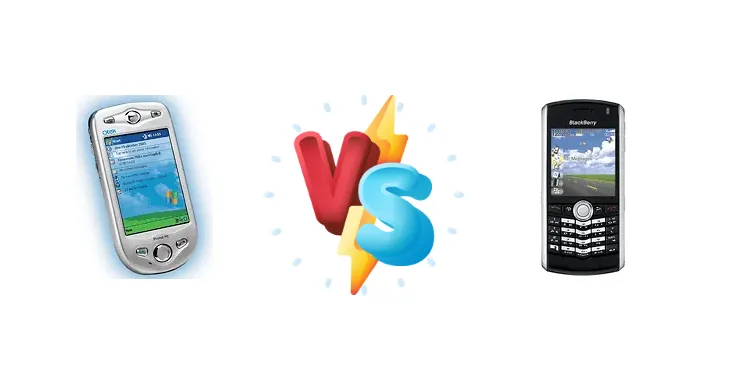
The early 2000s saw a fierce battle for smartphone dominance. The Qtek 2020, running Windows Mobile, represented a push towards Pocket PC functionality, while the BlackBerry Pearl 8100 solidified BlackBerry’s reputation for secure communication and efficient email. This comparison revisits these devices, analyzing their core strengths and weaknesses to determine which held the edge for the business professional of its time.
🏆 Quick Verdict
For the user prioritizing raw processing power and a more open operating system, the Qtek 2020 is the superior choice, thanks to its faster 400MHz Intel PXA263 processor. However, the BlackBerry Pearl 8100’s optimized BlackBerry OS and iconic SureType keyboard offer a more refined and efficient experience for email and messaging, making it ideal for communication-focused users.
| Network |
|---|
| 2G bands | GSM 900 / 1800 / 1900 | GSM 850 / 900 / 1800 / 1900 |
| EDGE | No | Yes |
| GPRS | Class 10 | Yes |
| Technology | GSM | GSM |
| Launch |
|---|
| Announced | 2004, Q2 | 2006, September |
| Status | Discontinued | Discontinued |
| Body |
|---|
| Dimensions | 130 x 70 x 18 mm, 105 cc (5.12 x 2.76 x 0.71 in) | 107 x 50 x 14.5 mm (4.21 x 1.97 x 0.57 in) |
| Keyboard | - | QWERTY |
| SIM | Mini-SIM | Mini-SIM |
| Weight | 190 g (6.70 oz) | 89.5 g (3.14 oz) |
| Display |
|---|
| Resolution | 240 x 320 pixels, 4:3 ratio (~114 ppi density) | 240 x 260 pixels (~161 ppi density) |
| Size | 3.5 inches, 53 x 71 mm, 37.9 cm2 (~41.7% screen-to-body ratio) | 2.2 inches, 15.6 cm2 (~29.1% screen-to-body ratio) |
| Type | TFT resistive touchscreen, 65K colors | 65K colors |
| | 5-way navigation button
Downloadable logos | Wallpapers |
| Platform |
|---|
| CPU | Intel PXA263 400 MHz | 32-bit Intel XScale PXA272 312 MHz |
| OS | Microsoft Windows Mobile 2003 PocketPC | BlackBerry OS |
| Memory |
|---|
| Card slot | SDIO/MMC | microSD (dedicated slot) |
| Internal | 64MB RAM (128MB optional) | 64MB |
| Main Camera |
|---|
| Features | - | LED flash |
| Single | VGA | 1.3 MP |
| Video | Yes | No |
| Sound |
|---|
| 3.5mm jack | No | No |
| 35mm jack | No | No |
| Alert types | Vibration; Downloadable polyphonic, MP3 ringtones | Vibration; Downloadable polyphonic, MP3 ringtones |
| Loudspeaker | Yes | Yes |
| Comms |
|---|
| Bluetooth | Yes | 2.0 |
| Infrared port | Yes | - |
| Positioning | No | No |
| Radio | No | No |
| USB | Proprietary | Proprietary |
| WLAN | No | No |
| Features |
|---|
| Browser | HTML (Pocket IE) | HTML |
| Languages | 7 | - |
| | Microsoft ActiveSync
MP3 player
Predictive text input | Document viewer (Word, Excel, PowerPoint, PDF)
Media player
SureType keyboard software
Organizer |
| Battery |
|---|
| Stand-by | Up to 160 h | Up to 360 h |
| Talk time | Up to 3 h 30 min | Up to 3 h 30 min |
| Type | Removable Li-Ion 1200 mAh battery | Removable Li-Ion 900 mAh battery |
| Misc |
|---|
| Colors | Silver | Black, White, Red |
| Price | - | About 200 EUR |
Qtek 2020
- Faster processor (400 MHz Intel PXA263)
- More flexible Windows Mobile OS
- Potentially larger screen size for better viewing
- Windows Mobile could be resource-intensive
- Likely shorter battery life due to processor demands
- Resistive touchscreen less responsive than capacitive
BlackBerry Pearl 8100
- Optimized BlackBerry OS for efficient communication
- Iconic SureType keyboard for comfortable typing
- Potentially longer battery life due to lower processor speed
- Slower processor (312 MHz Intel XScale PXA272)
- Less flexible operating system
- Limited application ecosystem compared to Windows Mobile
Display Comparison
Neither device boasts a particularly impressive display by modern standards. Both likely utilized resistive touchscreen technology, common for the era. Specifics regarding resolution and panel type are unavailable, but the focus was on functionality over visual fidelity. The Qtek 2020’s larger screen size (assumed, based on typical Windows Mobile devices) likely offered a slightly better experience for viewing documents and browsing the web, though both would have struggled in direct sunlight.
Camera Comparison
Camera capabilities were rudimentary on both devices. Details are scarce, but both likely featured low-resolution cameras (likely VGA or 1.3MP) primarily intended for basic photo capture and video calls. Image quality would have been poor by today’s standards. The focus wasn’t on photography; it was on communication and productivity. Comparing camera performance is largely irrelevant given the limitations of the technology at the time.
Performance
The core difference lies in the processors. The Qtek 2020’s Intel PXA263, clocked at 400 MHz, offers a 28.6% clock speed advantage over the BlackBerry Pearl 8100’s 312 MHz Intel XScale PXA272. While both are 32-bit processors, the higher clock speed of the PXA263 translates to faster application loading times and smoother multitasking within the limitations of Windows Mobile. However, the BlackBerry OS was highly optimized for the PXA272, potentially mitigating some of the performance gap in everyday tasks like email and contacts. The Qtek 2020, running Windows Mobile, would have been more susceptible to slowdowns with numerous applications open.
Battery Life
Battery life would have been heavily dependent on usage patterns. Both devices likely featured removable batteries, a common feature of the era. The Qtek 2020, with its more powerful processor, likely consumed more power, resulting in shorter battery life under heavy use. The BlackBerry Pearl 8100, with its optimized OS and lower clock speed, likely offered better battery endurance for typical email and messaging tasks. However, standby time would have been comparable, as both devices were designed for all-day use.
Buying Guide
Buy the Qtek 2020 if you need a device capable of running more demanding applications and appreciate the flexibility of the Windows Mobile platform. This is for the user who wanted a Pocket PC in their pocket. Buy the BlackBerry Pearl 8100 if you prioritize secure, reliable email communication, a comfortable typing experience, and a device optimized for productivity on the go. This is for the user who valued efficiency and a focused experience.
Frequently Asked Questions
❓ Was the Qtek 2020 capable of running third-party applications like modern smartphones?
Yes, the Qtek 2020, running Windows Mobile, supported the installation of third-party applications. However, the application ecosystem was far less mature than today’s Android or iOS, and application compatibility could be an issue. Performance would also be limited by the processor and available RAM.
❓ How did the BlackBerry Pearl 8100’s SureType keyboard compare to other keyboards of the time?
The BlackBerry Pearl 8100’s SureType keyboard was a significant innovation. It featured a unique layout where each key represented multiple letters, requiring users to press a single key and then select the desired letter using the trackball. This allowed for a more compact keyboard while maintaining a relatively comfortable typing experience, setting it apart from the Qtek 2020’s on-screen keyboard.
❓ Could either device be used for web browsing, and if so, how was the experience?
Both devices offered web browsing capabilities, but the experience was significantly slower and less user-friendly than modern smartphones. The Qtek 2020’s faster processor offered a slight advantage, but both devices struggled with complex websites and lacked features like pinch-to-zoom. Web browsing was primarily limited to text-based content.