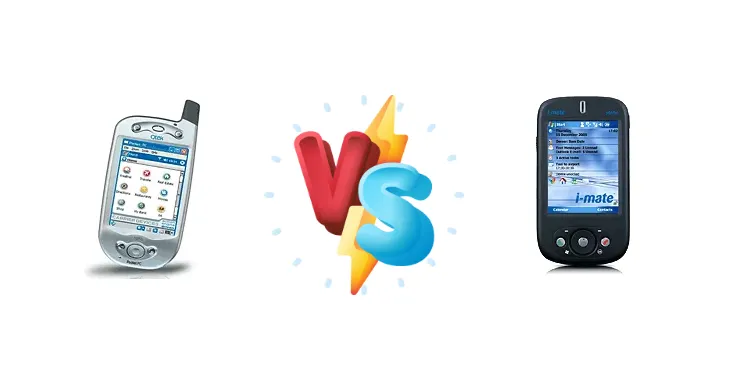
The Qtek 1010 and i-mate JAMin represent a pivotal moment in the evolution of smartphones, offering early adopters a glimpse into the potential of mobile Windows. While the Qtek 1010 remains largely shrouded in spec ambiguity, the i-mate JAMin, powered by the TI OMAP 850, provides a concrete baseline for comparison, allowing us to assess the trade-offs of these early Pocket PC devices.
🏆 Quick Verdict
For the user prioritizing demonstrable performance and a known quantity, the i-mate JAMin is the clear winner. Its 200MHz ARM926EJ-S processor offers a tangible advantage over the unknown internals of the Qtek 1010, making it more responsive for typical Windows Mobile tasks.
| Network |
|---|
| 2G bands | GSM 900 / 1800 | GSM 850 / 900 / 1800 / 1900 |
| EDGE | No | Class 10 |
| GPRS | Class 8 | Class 10 |
| Technology | GSM | GSM |
| Launch |
|---|
| Announced | 2003 | 2006, Q1 |
| Status | Discontinued | Discontinued |
| Body |
|---|
| Dimensions | 129 x 73 x 18 mm (5.08 x 2.87 x 0.71 in) | 108 x 58 x 18.2 mm (4.25 x 2.28 x 0.72 in) |
| SIM | Mini-SIM | Mini-SIM |
| Weight | 201 g (7.09 oz) | 150 g (5.29 oz) |
| Display |
|---|
| Resolution | 240 x 320 pixels, 4:3 ratio (~114 ppi density) | 240 x 320 pixels, 2.8 inches, 4:3 ratio (~143 ppi density) |
| Size | 3.5 inches, 53 x 71 mm, 37.9 cm2 (~40.3% screen-to-body ratio) | 2.8 inches, 42 x 57 mm, 24.3 cm2 (~38.8% screen-to-body ratio) |
| Type | TFT resistive resistive touchscreen, 4096 colors | TFT resistive touchscreen, 65K colors |
| | - | Handwriting recognition |
| Platform |
|---|
| CPU | - | 200 MHz ARM926EJ-S |
| Chipset | - | TI OMAP 850 |
| OS | Microsoft Windows Mobile 2002 PocketPC | Microsoft Windows Mobile 5.0 PocketPC |
| Memory |
|---|
| Card slot | MMC/SD | SD/MMC, up to 2 GB |
| Internal | 64MB RAM, 32MB ROM | 64MB RAM, 128MB ROM |
| Main Camera |
|---|
| Single | - | 2 MP |
| Video | - | CIF |
| Sound |
|---|
| 3.5mm jack | No | No |
| 35mm jack | No | No |
| Alert types | Vibration; Downloadable polyphonic, WAV ringtones | Vibration; Downloadable polyphonic ringtones |
| Loudspeaker | Yes | Yes |
| Comms |
|---|
| Bluetooth | No | 2.0 |
| Infrared port | Yes | Yes |
| Positioning | No | No |
| Radio | No | No |
| USB | Proprietary | miniUSB |
| WLAN | No | Wi-Fi 802.11b/g |
| Features |
|---|
| Browser | HTML (PocketIE) | WAP 2.0/xHTML, HTML (PocketIE) |
| | Pocket Office
Media player
Voice memo | Pocket Office
Voice memo
MP3/AAC player |
| Battery |
|---|
| Stand-by | Up to 150 h | - |
| Talk time | Up to 5 h | - |
| Type | Removable Li-Ion 1500 mAh battery | Removable Li-Po 1200 mAh battery |
| Misc |
|---|
| Colors | - | Stylish black |
| Price | - | About 220 EUR |
Qtek 1010
- Potential rarity for collectors
- Unknown features may offer unique benefits
- May have a more compact form factor (speculation)
- Lack of publicly available specifications
- Uncertain performance capabilities
- Limited support and documentation
i-mate JAMin
- Known and documented OMAP 850 chipset
- 200 MHz ARM926EJ-S processor provides reasonable performance
- Wider availability of support and resources
- Limited camera quality
- Short battery life with heavy use
- Outdated operating system (Windows Mobile)
Display Comparison
Without specific display details for the Qtek 1010, a direct comparison is impossible. The i-mate JAMin likely featured a standard QVGA (240x320) display common to devices of this era. The quality of these displays was generally limited by the technology of the time, with narrow viewing angles and moderate brightness. The absence of information on the Qtek 1010’s display makes it difficult to assess its potential advantages or disadvantages.
Camera Comparison
Neither device was known for its camera capabilities. Both likely featured basic VGA (0.3MP) cameras, sufficient for rudimentary photo capture but lacking in detail and low-light performance. Image quality would have been heavily reliant on the limited processing power available. Without specific details on the Qtek 1010’s camera, it’s impossible to determine if it offered any improvements over the i-mate JAMin’s.
Performance
The i-mate JAMin’s TI OMAP 850 chipset, featuring a 200 MHz ARM926EJ-S CPU, represents a significant step forward in mobile processing power for its time. The ARM926EJ-S architecture, while dated by modern standards, was capable of handling the demands of Windows Mobile 5.0 and 6.0. The Qtek 1010’s processor remains unknown, but given the market positioning of both devices, it’s reasonable to assume it utilized a similar ARM-based architecture, potentially at a lower clock speed. This would translate to slower application loading times and less fluid multitasking on the Qtek 1010.
Battery Life
Battery life on both devices would have been heavily dependent on usage patterns. The i-mate JAMin, with its more powerful OMAP 850 chipset, likely consumed more power during intensive tasks. However, the Qtek 1010’s unknown processor could have been less efficient overall. Both devices would have required daily charging with moderate use, typical for smartphones of this era.
Buying Guide
Buy the Qtek 1010 if you are a collector seeking a rare and potentially unique Windows Mobile device, and are comfortable with the uncertainty surrounding its specifications. Buy the i-mate JAMin if you want a functional, relatively well-documented early smartphone experience with a known chipset and a reasonable expectation of performance for its time.
Frequently Asked Questions
❓ Is the i-mate JAMin still usable with modern services?
While the i-mate JAMin runs an outdated version of Windows Mobile, limited functionality can be achieved through third-party applications and workarounds. However, compatibility with modern services like app stores and cloud storage is severely restricted.
❓ What kind of storage does the i-mate JAMin use, and is it expandable?
The i-mate JAMin typically featured a small amount of internal ROM storage, often around 64MB or 128MB. Storage expansion was commonly achieved through SD card slots, allowing users to add additional memory for applications and media.
❓ Given the Qtek 1010's unknown specs, is it worth purchasing solely as a collector's item?
If you are a dedicated collector of early Windows Mobile devices, the Qtek 1010's rarity may make it a worthwhile addition to your collection. However, be prepared for the challenges of finding information and potentially limited functionality.