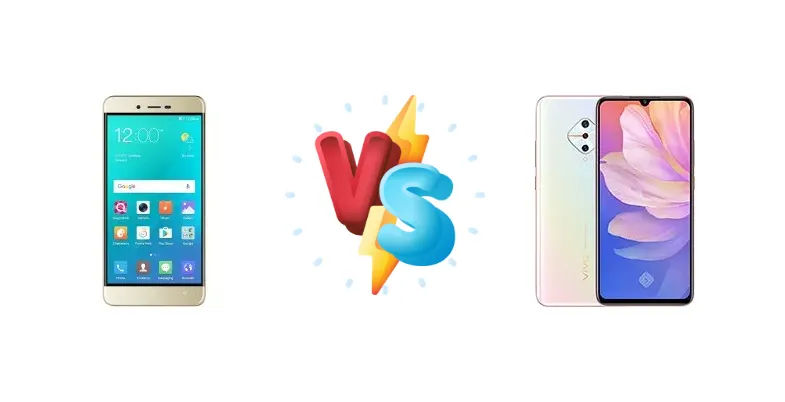
The QMobile J7 Pro and vivo S1 Pro represent distinct approaches to the budget smartphone market. The J7 Pro, leveraging Mediatek's MT6737T, aims for affordability, while the S1 Pro, powered by Qualcomm's Snapdragon 665, targets a more balanced experience with improved performance and faster charging. This comparison dissects their key differences to determine which device best suits your needs.
🏆 Quick Verdict
For the average user prioritizing responsiveness and future-proofing, the vivo S1 Pro is the clear winner. Its Snapdragon 665 chipset, built on an 11nm process, delivers significantly better performance than the QMobile J7 Pro’s older Mediatek MT6737T. While the J7 Pro offers a lower entry price, the S1 Pro’s enhanced capabilities justify the price difference.
| Network |
|---|
| 2G bands | GSM 850 / 900 / 1800 / 1900 - SIM 1 & SIM 2 | GSM 850 / 900 / 1800 / 1900 |
| 3G bands | HSDPA 850 / 1700(AWS) / 1900 / 2100 | HSDPA 850 / 900 / 2100 |
| 4G bands | 3, 5, 40, 41 | 1, 3, 5, 28, 38, 40, 41 |
| Speed | HSPA 42.2/11.5 Mbps, LTE Cat4 150/50 Mbps | HSPA, LTE |
| Technology | GSM / HSPA / LTE | GSM / HSPA / LTE |
| Launch |
|---|
| Announced | 2017, May. Released 2017, May | 2019, November 19. Released 2019, November |
| Status | Discontinued | Discontinued |
| Body |
|---|
| Build | - | Glass front, glass back, aluminum frame |
| Dimensions | 154 x 76.6 x 9.2 mm (6.06 x 3.02 x 0.36 in) | 159.3 x 75.2 x 8.7 mm (6.27 x 2.96 x 0.34 in) |
| SIM | Hybrid Dual SIM (Micro-SIM, dual stand-by) | · Nano-SIM· Nano-SIM + Nano-SIM |
| Weight | 175 g (6.17 oz) | 186.7 g (6.60 oz) |
| Display |
|---|
| Protection | Corning Gorilla Glass 3 | - |
| Resolution | 720 x 1280 pixels, 16:9 ratio (~267 ppi density) | 1080 x 2340 pixels, 19.5:9 ratio (~404 ppi density) |
| Size | 5.5 inches, 83.4 cm2 (~70.7% screen-to-body ratio) | 6.38 inches, 99.9 cm2 (~83.4% screen-to-body ratio) |
| Type | IPS LCD | Super AMOLED |
| Platform |
|---|
| CPU | Quad-core 1.4 GHz Cortex-A53 | Octa-core (4x2.0 GHz Kryo 260 Gold & 4x1.8 GHz Kryo 260 Silver) |
| Chipset | Mediatek MT6737T (28 nm) | Qualcomm SDM665 Snapdragon 665 (11 nm) |
| GPU | Mali-T720 | Adreno 610 |
| OS | Android 6.0 (Marshmallow) | Android 9.0 (Pie), Funtouch 9.2 |
| Memory |
|---|
| Card slot | microSDXC (uses shared SIM slot) | microSDXC (uses shared SIM slot) |
| Internal | 32GB 3GB RAM | 128GB 8GB RAM |
| | eMMC 5.0 | - |
| Main Camera |
|---|
| Features | LED flash, HDR, panorama | LED flash, HDR, panorama |
| Quad | - | 48 MP, f/1.8, (wide), 1/2.0", 0.8µm, PDAF
8 MP, f/2.2, 13mm (ultrawide), 1/4.0", 1.12µm
2 MP (macro)
Auxiliary lens |
| Single | 13 MP, PDAF | - |
| Video | 1080p@30fps | 1080p@30fps |
| Selfie camera |
|---|
| Features | - | HDR |
| Single | 8 MP | 32 MP, f/2.0, 26mm (wide), 1/2.8", 0.8µm |
| Video | - | 1080p@30fps |
| Sound |
|---|
| 3.5mm jack | Yes | Yes |
| 35mm jack | Yes | Yes |
| Loudspeaker | Yes | Yes |
| Comms |
|---|
| Bluetooth | 4.0, A2DP | 5.0, A2DP, LE |
| NFC | No | No |
| Positioning | GPS | GPS, GLONASS, GALILEO, BDS |
| Radio | FM radio | FM radio |
| USB | microUSB 2.0, OTG | USB Type-C 2.0, OTG |
| WLAN | Wi-Fi 802.11 b/g/n, Wi-Fi Direct | Wi-Fi 802.11 a/b/g/n/ac, dual-band, Wi-Fi Direct |
| Features |
|---|
| Sensors | Accelerometer, proximity, compass | Fingerprint (under display, optical), accelerometer, gyro, proximity, compass |
| Battery |
|---|
| Charging | - | 18W wired |
| Type | Li-Po 3150 mAh, non-removable | 4500 mAh, non-removable |
| Misc |
|---|
| Colors | Gold, Blue | Knight Black, Fancy Sky |
| Models | - | 1920, PD1945F_EX, 1920_20 |
| Price | About 18000 INR | About 150 EUR |
QMobile J7 Pro
- Lower price point makes it accessible to budget-conscious buyers.
- Functional for basic smartphone tasks.
- Potentially longer battery life due to less powerful processor (though charging is slower).
- Significantly slower performance compared to the vivo S1 Pro.
- Older chipset may struggle with modern apps and multitasking.
- Likely inferior camera performance.
vivo S1 Pro
- Faster and more responsive performance thanks to the Snapdragon 665.
- 18W fast charging for quicker battery replenishment.
- Improved image processing capabilities.
- Better long-term software support potential.
- Higher price compared to the QMobile J7 Pro.
- May not have a significantly larger battery capacity than the J7 Pro.
Display Comparison
Neither device's display specifications are provided, so a direct comparison is limited. However, given the market positioning, the QMobile J7 Pro likely features a standard LCD panel, while the vivo S1 Pro may incorporate a higher-quality IPS LCD. The S1 Pro’s slightly higher price point suggests a potentially better viewing experience with improved color accuracy and wider viewing angles. Bezels are likely comparable, reflecting the budget nature of both devices.
Camera Comparison
Without detailed camera specifications, a precise comparison is difficult. However, it’s reasonable to assume both phones feature basic camera setups geared towards casual photography. The Snapdragon 665’s image signal processor (ISP) in the S1 Pro likely offers superior image processing capabilities, resulting in better dynamic range and noise reduction compared to the J7 Pro’s Mediatek chipset. The S1 Pro is likely to handle low-light photography more effectively. The presence of a 2MP macro camera on either device is unlikely to significantly impact image quality.
Performance
The core difference lies in the chipsets. The vivo S1 Pro’s Qualcomm Snapdragon 665 (11nm) is a substantial upgrade over the QMobile J7 Pro’s Mediatek MT6737T (28nm). The Snapdragon 665’s octa-core configuration (4x2.0 GHz Kryo 260 Gold & 4x1.8 GHz Kryo 260 Silver) provides significantly more processing power than the J7 Pro’s quad-core 1.4 GHz Cortex-A53. The 11nm fabrication process of the Snapdragon 665 also translates to improved power efficiency and reduced thermal throttling, crucial for sustained performance during gaming or demanding applications. Users will experience noticeably faster app loading times and smoother multitasking on the S1 Pro.
Battery Life
Battery capacity isn’t specified for either device. However, the vivo S1 Pro’s 18W wired charging is a significant advantage. This faster charging speed will dramatically reduce the time required to replenish the battery compared to the J7 Pro, which likely supports standard 5W or 10W charging. Even if the J7 Pro has a slightly larger battery capacity, the S1 Pro’s faster charging will provide a more convenient user experience, especially for users who frequently use their phones throughout the day.
Buying Guide
Buy the QMobile J7 Pro if you need a functional smartphone for basic tasks like calls, messaging, and light social media use, and your budget is extremely limited. Buy the vivo S1 Pro if you prioritize smoother multitasking, occasional gaming, and faster charging, and are willing to spend a bit more for a more refined user experience. The S1 Pro is also the better choice for users who anticipate keeping their phone for several years.
Frequently Asked Questions
❓ Will the Snapdragon 665 in the vivo S1 Pro handle popular games like PUBG Mobile smoothly?
Yes, the Snapdragon 665 is capable of running PUBG Mobile at medium settings with a stable frame rate. While it won't deliver the highest graphical fidelity, it provides a playable and enjoyable gaming experience, unlike the Mediatek MT6737T which would likely struggle with consistent performance.
❓ Is the difference in performance between the two chipsets noticeable in everyday use?
Absolutely. The Snapdragon 665’s octa-core architecture and 11nm process provide a significant boost in responsiveness. You’ll notice faster app loading times, smoother scrolling, and less lag when switching between applications on the vivo S1 Pro compared to the QMobile J7 Pro.
❓ How much faster is the 18W charging on the vivo S1 Pro compared to a standard 5W charger?
18W charging can reduce charging times by over 50% compared to a 5W charger. While exact 0-100% times depend on battery capacity, you can expect the S1 Pro to charge significantly faster, getting you back up and running much quicker.