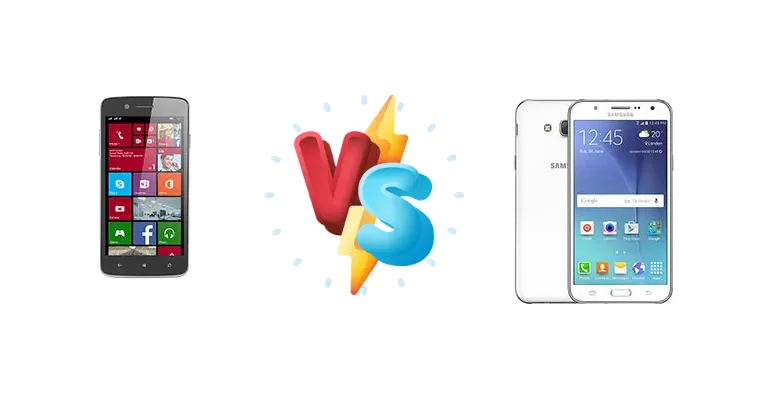
The Prestigio MultiPhone 8500 Duo and Samsung Galaxy J5 represent a segment of the market focused on affordability. Released in different eras, both devices aimed to deliver a smartphone experience to budget-conscious consumers. This comparison dissects the core differences between the Qualcomm Snapdragon 200 powering the Prestigio and the Snapdragon 410 in the Samsung, focusing on real-world performance implications.
🏆 Quick Verdict
For the average user, the Samsung Galaxy J5 emerges as the better choice. While both phones utilize a 28nm process, the Snapdragon 410’s Cortex-A53 cores offer a significant architectural advantage over the older Cortex-A7 in the 8500 Duo, translating to a smoother and more responsive user experience. The inclusion of 15W charging is also a practical benefit.
| Network |
|---|
| 2G bands | GSM 850 / 900 / 1800 / 1900 - SIM 1 & SIM 2 | GSM 850 / 900 / 1800 / 1900 - SIM 1 & SIM 2 (dual-SIM model only) |
| 3G bands | HSDPA 900 / 2100 | HSDPA 850 / 900 / 1900 / 2100 |
| 4G bands | - | 1, 3, 5, 7, 8, 20 |
| Speed | HSPA 21.1/5.76 Mbps | HSPA 21.1/5.76 Mbps, LTE Cat4 150/50 Mbps |
| Technology | GSM / HSPA | GSM / HSPA / LTE |
| Launch |
|---|
| Announced | 2014, July. Released 2014, August | 2015, June 19. Released 2015, July 28 |
| Status | Discontinued | Discontinued |
| Body |
|---|
| Build | - | Glass front, plastic back, plastic frame |
| Dimensions | 8.5 mm thickness | 142.1 x 71.8 x 7.9 mm (5.59 x 2.83 x 0.31 in) |
| SIM | Dual SIM | Single SIM (Micro-SIM) or Dual SIM (Micro-SIM, dual stand-by) |
| Weight | - | 146 g (5.15 oz) |
| Display |
|---|
| Protection | Corning Gorilla Glass | - |
| Resolution | 720 x 1280 pixels, 16:9 ratio (~294 ppi density) | 720 x 1280 pixels, 16:9 ratio (~294 ppi density) |
| Size | 5.0 inches, 68.9 cm2 | 5.0 inches, 68.9 cm2 (~67.5% screen-to-body ratio) |
| Type | IPS LCD | Super AMOLED |
| Platform |
|---|
| CPU | Quad-core 1.2 GHz Cortex-A7 | Quad-core 1.2 GHz Cortex-A53 |
| Chipset | Qualcomm MSM8212 Snapdragon 200 (28 nm) | Qualcomm MSM8916 Snapdragon 410 (28 nm) |
| GPU | Adreno 302 | Adreno 306 |
| OS | Microsoft Windows Phone 8.1 | Android 5.1 (Lollipop), upgradable to 6.0.1 (Marshmallow) |
| Memory |
|---|
| Card slot | microSDHC | microSDXC (dedicated slot) |
| Internal | 8GB 1GB RAM | 8GB 1.5GB RAM, 16GB 1.5GB RAM |
| | eMMC 4.5 | eMMC 4.5 |
| Main Camera |
|---|
| Dual | - | 13 MP, f/1.9, 27mm (wide), 1/3.1", 1.12µm, PDAF
5 MP, f/2.2, 12mm (ultrawide) |
| Features | LED flash, panorama | LED flash |
| Single | 8 MP, AF | 13 MP, f/1.9, 28mm (wide), AF |
| Video | Yes | 1080p@30fps |
| Selfie camera |
|---|
| Features | - | LED flash |
| Single | 2 MP | 5 MP, f/2.2, 23mm (wide) |
| Video | - | |
| Sound |
|---|
| 3.5mm jack | Yes | Yes |
| 35mm jack | Yes | Yes |
| Loudspeaker | Yes | Yes |
| Comms |
|---|
| Bluetooth | 4.0, A2DP | 4.1, A2DP |
| NFC | No | Yes (market dependent) |
| Positioning | GPS | GPS, GLONASS, BDS |
| Radio | FM radio | FM radio, RDS, recording |
| USB | microUSB 2.0 | microUSB 2.0, OTG |
| WLAN | Wi-Fi 802.11 b/g/n, hotspot | Wi-Fi 802.11 b/g/n, Wi-Fi Direct, hotspot |
| Features |
|---|
| Sensors | Accelerometer, proximity | Accelerometer, proximity |
| | - | ANT+ |
| Battery |
|---|
| Charging | - | 15W wired |
| Music play | Up to 176 h | Up to 62 h |
| Stand-by | Up to 984 h | - |
| Talk time | Up to 57 h | Up to 18 h (3G) |
| Type | Li-Ion 2000 mAh, removable | Li-Ion 2600 mAh, removable |
| Misc |
|---|
| Colors | Black, White | White, Black, Gold |
| Models | - | SM-J500F, SM-J500G, SM-J500FN, SM-J500Y, SM-J500M, J500S, SM-J500H, SM-J5007, J5, SM-J500N0, SM-J5008 |
| Price | About 170 EUR | About 160 EUR |
| SAR | - | 0.80 W/kg (head) 1.13 W/kg (body) |
| SAR EU | - | 0.61 W/kg (head) 0.48 W/kg (body) |
Prestigio MultiPhone 8500 Duo
- Potentially lower price point
- May offer expandable storage (market segment assumption)
- Simple and straightforward user experience
- Significantly weaker performance due to older chipset
- Likely limited software support
- Slower app loading times
Samsung Galaxy J5
- More powerful and efficient Snapdragon 410 chipset
- Faster 15W charging
- Better software support from Samsung
- Potentially higher price than the Prestigio
- May include bloatware (typical Samsung practice)
- Limited RAM (likely 1-2GB)
Display Comparison
Neither device’s display specifications are provided, so a direct comparison is limited. However, given the market positioning, both likely featured LCD panels with resolutions around 720p. Samsung, historically, has offered better color calibration and viewing angles even in its budget offerings, suggesting a slight advantage for the J5. The absence of information regarding PWM dimming rates prevents assessment of potential eye strain.
Camera Comparison
Without detailed camera specifications, a precise comparison is difficult. However, it’s reasonable to assume both phones featured basic camera setups geared towards casual photography. Samsung typically invests more in image signal processing (ISP) even in its budget devices, potentially resulting in better image quality in various lighting conditions. The absence of OIS or large sensors on either device suggests limited low-light performance. Any megapixel count differences are likely less impactful than the software processing capabilities.
Performance
The core difference lies in the chipsets. The Prestigio’s Qualcomm MSM8212 Snapdragon 200, with its quad-core 1.2 GHz Cortex-A7 CPU, is based on an older architecture. The Samsung Galaxy J5’s Qualcomm MSM8916 Snapdragon 410, also quad-core 1.2 GHz, utilizes the more efficient and powerful Cortex-A53 cores. This architectural shift provides a noticeable performance boost in the J5, particularly in multi-tasking and app loading times. While both are 28nm, the A53’s instruction set and improved branch prediction lead to better performance per clock cycle. The J5 will handle more demanding apps and web browsing with greater ease.
Battery Life
Battery capacity is not specified for either device. However, the Samsung Galaxy J5’s 15W wired charging is a significant advantage. This faster charging speed will reduce downtime and provide a more convenient user experience. While a larger battery capacity on the Prestigio could offset the slower charging, the Snapdragon 410’s improved power efficiency in the J5 likely results in comparable, if not better, real-world battery life despite potentially having a similar capacity.
Buying Guide
Buy the Prestigio MultiPhone 8500 Duo if you absolutely need the lowest possible price point and are willing to accept significant performance limitations for basic tasks like calls and messaging. Buy the Samsung Galaxy J5 if you prioritize a more fluid user experience, even for light multitasking, and appreciate the convenience of faster charging. The J5 is the better option for anyone planning to use apps beyond the most basic functionality.
Frequently Asked Questions
❓ Will the Snapdragon 410 in the Galaxy J5 handle basic games like Candy Crush or Subway Surfers without significant lag?
Yes, the Snapdragon 410’s Cortex-A53 cores are sufficiently capable of running less demanding games like Candy Crush and Subway Surfers without significant lag. While it won’t handle graphically intensive titles, it provides a much smoother experience than the Snapdragon 200 for casual gaming.
❓ Is the difference in performance between the Snapdragon 200 and 410 noticeable for everyday tasks like browsing the web and checking email?
Absolutely. The Snapdragon 410’s architectural improvements result in a noticeably faster and more responsive experience for everyday tasks. Web pages will load quicker, apps will open more rapidly, and multitasking will be less frustrating compared to the Snapdragon 200.
❓ Given the age of both devices, can I expect to receive software updates for either phone?
Software update support is limited for both devices due to their age. However, Samsung generally provides longer software support than smaller brands like Prestigio. While major Android version updates are unlikely, the Galaxy J5 may receive occasional security patches for a longer period.