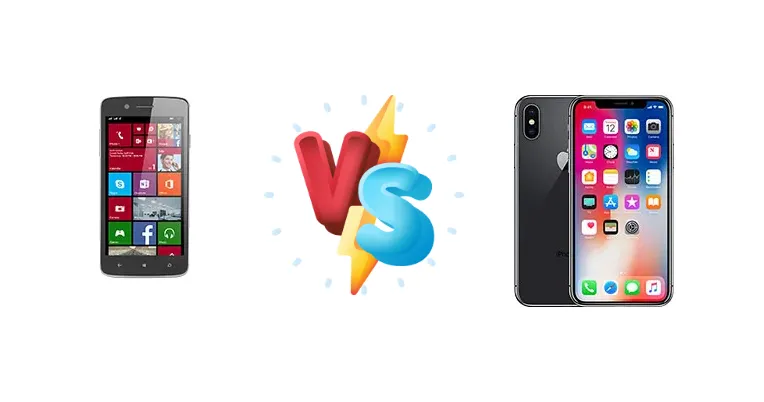
The Prestigio MultiPhone 8500 Duo and the Apple iPhone X represent vastly different eras and philosophies in smartphone design. The iPhone X, released in 2017, was a premium flagship, while the Prestigio 8500 Duo aimed for affordability. This comparison isn't about a direct contest, but rather illustrating the trade-offs between budget-conscious choices and high-end performance, even years after the iPhone X's initial release.
🏆 Quick Verdict
For the average user prioritizing performance, a smooth user experience, and long-term software support, the Apple iPhone X remains the clear winner. While the Prestigio 8500 Duo offers basic smartphone functionality, its Snapdragon 200 chipset is significantly outmatched by the A11 Bionic, resulting in a noticeably slower and less responsive experience.
| Network |
|---|
| 2G bands | GSM 850 / 900 / 1800 / 1900 - SIM 1 & SIM 2 | GSM 850 / 900 / 1800 / 1900 |
| 3G bands | HSDPA 900 / 2100 | HSDPA 850 / 900 / 1700(AWS) / 1900 / 2100 |
| 4G bands | - | 1, 2, 3, 4, 5, 7, 8, 12, 13, 17, 18, 19, 20, 25, 26, 28, 29, 30, 34, 38, 39, 40, 41, 66 |
| Speed | HSPA 21.1/5.76 Mbps | HSPA 42.2/5.76 Mbps, LTE (3CA) Cat12 600/150 Mbps, EV-DO Rev.A 3.1 Mbps |
| Technology | GSM / HSPA | GSM / HSPA / LTE |
| Launch |
|---|
| Announced | 2014, July. Released 2014, August | 2017, September 12. Released 2017, November 03 |
| Status | Discontinued | Discontinued |
| Body |
|---|
| Build | - | Glass front (Corning-made glass), glass back (Corning-made glass), stainless steel frame |
| Dimensions | 8.5 mm thickness | 143.6 x 70.9 x 7.7 mm (5.65 x 2.79 x 0.30 in) |
| SIM | Dual SIM | Nano-SIM |
| Weight | - | 174 g (6.14 oz) |
| | - | IP67 dust/water resistant (up to 1m for 30 mins)
Apple Pay (Visa, MasterCard, AMEX certified) |
| Display |
|---|
| Protection | Corning Gorilla Glass | Scratch-resistant glass |
| Resolution | 720 x 1280 pixels, 16:9 ratio (~294 ppi density) | 1125 x 2436 pixels, 19.5:9 ratio (~458 ppi density) |
| Size | 5.0 inches, 68.9 cm2 | 5.8 inches, 84.4 cm2 (~82.9% screen-to-body ratio) |
| Type | IPS LCD | Super Retina OLED, HDR10, Dolby Vision, 625 nits (HBM) |
| | - | 3D Touch |
| Platform |
|---|
| CPU | Quad-core 1.2 GHz Cortex-A7 | Hexa-core 2.39 GHz (2x Monsoon + 4x Mistral) |
| Chipset | Qualcomm MSM8212 Snapdragon 200 (28 nm) | Apple A11 Bionic (10 nm) |
| GPU | Adreno 302 | Apple GPU (three-core graphics) |
| OS | Microsoft Windows Phone 8.1 | iOS 11.1.1, up to iOS 16.7.12 |
| Memory |
|---|
| Card slot | microSDHC | No |
| Internal | 8GB 1GB RAM | 64GB 3GB RAM, 256GB 3GB RAM |
| | eMMC 4.5 | NVMe |
| Main Camera |
|---|
| Dual | - | 12 MP, f/1.8, 28mm (wide), 1/3.0", 1.22µm, dual pixel PDAF, OIS
12 MP, f/2.4, 52mm (telephoto), 1/3.4", 1.0µm, PDAF, OIS, 2x optical zoom |
| Features | LED flash, panorama | Quad-LED dual-tone flash, HDR (photo/panorama), panorama, HDR |
| Single | 8 MP, AF | - |
| Video | Yes | 4K@24/30/60fps, 1080p@30/60/120/240fps |
| Selfie camera |
|---|
| Features | - | HDR |
| Single | 2 MP | 7 MP, f/2.2, 32mm (standard)
SL 3D, (depth/biometrics sensor) |
| Video | - | 1080p@30fps |
| Sound |
|---|
| 3.5mm jack | Yes | No |
| 35mm jack | Yes | No |
| Loudspeaker | Yes | Yes, with stereo speakers |
| Comms |
|---|
| Bluetooth | 4.0, A2DP | 5.0, A2DP, LE |
| NFC | No | Yes |
| Positioning | GPS | GPS, GLONASS, GALILEO, QZSS |
| Radio | FM radio | No |
| USB | microUSB 2.0 | Lightning, USB 2.0 |
| WLAN | Wi-Fi 802.11 b/g/n, hotspot | Wi-Fi 802.11 a/b/g/n/ac, dual-band, hotspot |
| Features |
|---|
| Sensors | Accelerometer, proximity | Face ID, accelerometer, gyro, proximity, compass, barometer |
| Battery |
|---|
| Charging | - | 15W wired, PD2.0, 50% in 30 min
Wireless (Qi) |
| Music play | Up to 176 h | - |
| Stand-by | Up to 984 h | - |
| Talk time | Up to 57 h | Up to 21 h (3G) |
| Type | Li-Ion 2000 mAh, removable | Li-Ion 2716 mAh, non-removable (10.35 Wh) |
| Misc |
|---|
| Colors | Black, White | Space Gray, Silver |
| Models | - | A1865, A1901, A1902, A1903, iPhone10,3, iPhone10,6 |
| Price | About 170 EUR | About 100 EUR |
| SAR | - | 1.09 W/kg (head) 1.17 W/kg (body) |
| Tests |
|---|
| Audio quality | - |
Noise -93.7dB / Crosstalk -82.8dB |
| Battery life | - | Endurance rating 74h |
| Camera | - |
Photo / Video |
| Display | - |
Contrast ratio: Infinity (nominal), 5.013 (sunlight) |
| Loudspeaker | - |
Voice 68dB / Noise 74dB / Ring 76dB |
| Performance | - |
AnTuTu: 233100 (v7)
GeekBench: 10215 (v4.4)
GFXBench: 28fps (ES 3.1 onscreen) |
Prestigio MultiPhone 8500 Duo
- Extremely affordable price point
- Dual SIM support (implied by 'Duo' in the name)
- Basic smartphone functionality
- Significantly underpowered processor
- Likely low-quality display
- Poor camera performance
- Limited software support
Apple iPhone X
- Powerful A11 Bionic processor
- High-quality Super Retina OLED display
- Capable camera system with advanced image processing
- Wireless charging and fast wired charging
- Robust app ecosystem and software support (though aging)
- Higher price (even used)
- Battery health degradation due to age
- No longer the latest model
Display Comparison
Both devices share a similar contrast ratio of Infinity (nominal) and 5.013 in sunlight, suggesting comparable outdoor visibility. However, the iPhone X's display technology and calibration likely offer superior color accuracy and viewing angles. The Prestigio 8500 Duo's display specifications are not detailed enough to assess its panel type or resolution, but given its price point, it likely utilizes a lower-quality LCD panel compared to the iPhone X's Super Retina OLED.
Camera Comparison
While both devices feature photo and video capabilities, the iPhone X's camera system is expected to be far superior. Details regarding the Prestigio 8500 Duo's camera sensors and optics are unavailable, but its positioning in the market suggests a basic camera setup. The iPhone X, even with its age, benefits from Apple's advanced image signal processing and computational photography algorithms, delivering better image quality, dynamic range, and low-light performance. The absence of specific camera specs for the Prestigio makes a detailed comparison impossible beyond acknowledging the iPhone X's inherent advantage.
Performance
The performance disparity is the most significant difference. The Apple A11 Bionic, a hexa-core processor fabricated on a 10nm process, dwarfs the Qualcomm MSM8212 Snapdragon 200's quad-core 1.2 GHz Cortex-A7 processor built on a 28nm node. The A11 Bionic's architecture – featuring two high-performance Monsoon cores and four energy-efficient Mistral cores – allows for both speed and efficiency. The Snapdragon 200, designed for entry-level devices, struggles with demanding tasks and multitasking. The 10nm process of the A11 Bionic also contributes to better thermal management, preventing significant throttling under sustained load, a likely issue for the Snapdragon 200.
Battery Life
Both devices have an endurance rating of 74h, which is surprising. However, this rating doesn't tell the whole story. The iPhone X offers 15W wired charging with PD2.0 and Qi wireless charging, providing convenient and relatively fast charging options. The Prestigio 8500 Duo's charging capabilities are unknown, but likely slower and lack wireless charging support. The A11 Bionic's efficiency also contributes to better real-world battery life despite the similar endurance rating, as it consumes less power during typical usage.
Buying Guide
Buy the Prestigio MultiPhone 8500 Duo if you need a very basic smartphone for essential tasks like calls, texts, and light web browsing, and your budget is extremely limited. Buy the Apple iPhone X if you prioritize a fluid user experience, a capable camera, and access to a robust app ecosystem, even if it means spending more and potentially dealing with an older device's battery health.
Frequently Asked Questions
❓ Is the Prestigio MultiPhone 8500 Duo suitable for playing modern mobile games?
No. The Qualcomm Snapdragon 200 processor is severely underpowered for modern mobile games. Expect significant lag, low frame rates, and an overall frustrating gaming experience. It's best suited for simple 2D games or casual puzzle titles.
❓ How does the iPhone X's battery health hold up after several years of use?
The iPhone X's battery health will inevitably degrade over time. Apple provides a battery health indicator in the settings, and users can replace the battery for a fee to restore its capacity. While the battery life won't be as good as new, the iPhone X still offers acceptable battery performance even with some degradation.
❓ Can I expect software updates for the Prestigio MultiPhone 8500 Duo?
Software support for the Prestigio MultiPhone 8500 Duo is likely limited or non-existent at this point. Prestigio is not known for providing long-term software updates, meaning the device may be vulnerable to security risks and lack access to new features.
❓ What kind of storage options does the Prestigio MultiPhone 8500 Duo offer, and is it expandable?
The context data does not specify storage options. However, given its market segment, it likely has limited internal storage (e.g., 8GB or 16GB) and may offer microSD card expansion, though the speed of the card reader will likely be a bottleneck.