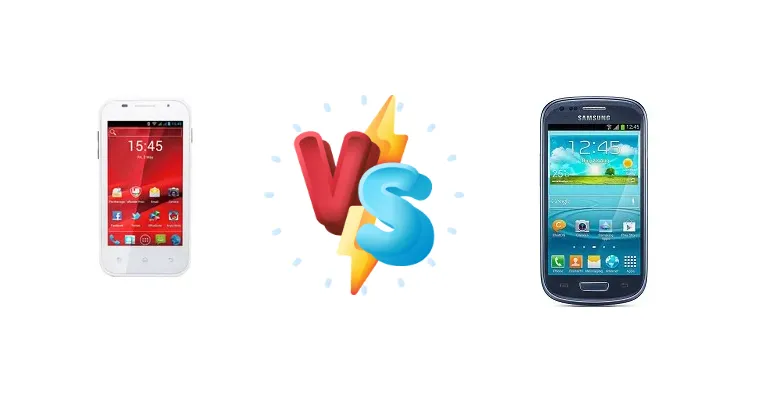
Released in different eras of the budget Android market, the Prestigio MultiPhone 4044 Duo and the Samsung Galaxy S III mini represent attempts to deliver a smartphone experience without breaking the bank. While both devices feature dual-core Cortex-A9 processors, key differences in chipset fabrication and Samsung’s established software ecosystem create a compelling comparison for users seeking a functional, affordable device.
🏆 Quick Verdict
For the average user prioritizing raw processing power and potentially longer software support (despite its age), the Prestigio MultiPhone 4044 Duo emerges as the slightly better choice. Its Mediatek MT6577T, built on a 40nm process, offers a higher clock speed than the Samsung’s NovaThor U8420, translating to a snappier experience in everyday tasks.
| Network |
|---|
| 2G bands | GSM 850 / 900 / 1800 / 1900 - SIM 1 & SIM 2 | GSM 850 / 900 / 1800 / 1900 |
| 3G bands | HSDPA 900 / 2100 | HSDPA 900 / 1900 / 2100 |
| Speed | HSPA | HSPA 14.4/5.76 Mbps |
| Technology | GSM / HSPA | GSM / HSPA |
| Launch |
|---|
| Announced | 2013. Released 2013 | 2012, October. Released 2012, November |
| Status | Discontinued | Discontinued |
| Body |
|---|
| Build | - | Glass front, plastic back, plastic frame |
| Dimensions | 125 x 64 x 10.4 mm (4.92 x 2.52 x 0.41 in) | 121.6 x 63 x 9.9 mm (4.79 x 2.48 x 0.39 in) |
| SIM | Dual SIM (Mini-SIM) | Mini-SIM |
| Weight | 124 g (4.37 oz) | 111.5 g (3.92 oz) |
| Display |
|---|
| Resolution | 480 x 800 pixels, 5:3 ratio (~233 ppi density) | 480 x 800 pixels, 5:3 ratio (~233 ppi density) |
| Size | 4.0 inches, 45.5 cm2 (~56.9% screen-to-body ratio) | 4.0 inches, 45.5 cm2 (~59.4% screen-to-body ratio) |
| Type | TFT | Super AMOLED |
| Platform |
|---|
| CPU | Dual-core 1.2 GHz Cortex-A9 | 1.0 GHz dual-core Cortex-A9 |
| Chipset | Mediatek MT6577T (40 nm) | NovaThor U8420 |
| GPU | PowerVR SGX531u | Mali-400 |
| OS | Android 4.1 (Jelly Bean) | Android 4.1 (Jelly Bean) |
| Memory |
|---|
| Card slot | microSDHC (dedicated slot) | microSDHC (dedicated slot) |
| Internal | 4GB 512MB RAM | 8GB 1GB RAM, 16GB 1GB RAM |
| Main Camera |
|---|
| Features | LED flash, panorama, HDR | LED flash, panorama |
| Single | 8 MP, AF | 5 MP, f/2.6, AF |
| Video | Yes | 720p@30fps |
| Selfie camera |
|---|
| Single | VGA | VGA |
| Sound |
|---|
| 3.5mm jack | Yes | Yes |
| 35mm jack | Yes | Yes |
| Loudspeaker | Yes | Yes |
| Comms |
|---|
| Bluetooth | 3.0, A2DP | 4.0, A2DP, EDR, LE, aptX |
| NFC | No | Yes (Market dependent) |
| Positioning | GPS | GPS, GLONASS |
| Radio | FM radio | Stereo FM radio, RDS |
| USB | microUSB 2.0 | microUSB 2.0 |
| WLAN | Wi-Fi 802.11 b/g/n, hotspot, Wi-Fi Direct | Wi-Fi 802.11 a/b/g/n, dual-band, Wi-Fi Direct, DLNA, hotspot |
| Features |
|---|
| Sensors | Accelerometer, proximity, compass | Accelerometer, gyro, proximity, compass |
| Battery |
|---|
| Music play | Up to 9 h | - |
| Stand-by | Up to 150 h | Up to 450 h (2G) / Up to 430 h (3G) |
| Talk time | Up to 11 h | Up to 14 h 10 min (2G) / Up to 7 h 10 min (3G) |
| Type | Li-Ion 1500 mAh, removable | Li-Ion 1500 mAh, removable |
| Misc |
|---|
| Colors | White | White, Blue, Titan Gray, Amber Brown, Garnet Red, Onyx Black |
| Models | - | GT-I8190, GT-I8190N, GT-I8190L, SM-G730A, SM-G730W8 |
| Price | About 100 EUR | About 130 EUR |
| SAR | - | 1.03 W/kg (head) 1.28 W/kg (body) |
| SAR EU | - | 0.52 W/kg (head) |
| Tests |
|---|
| Audio quality | - |
Noise -82.1dB / Crosstalk -80.7dB |
| Battery life | - |
Endurance rating 42h
|
| Camera | - |
Photo / Video |
| Display | - |
Contrast ratio: Infinite (nominal) / 2.422:1 (sunlight) |
| Loudspeaker | - |
Voice 66dB / Noise 63dB / Ring 76dB
|
Prestigio MultiPhone 4044 Duo
- Higher CPU clock speed for better performance.
- Potentially better power efficiency due to 40nm process.
- More modern chipset architecture (relatively speaking).
- Less established brand reputation.
- Limited software support and updates.
Samsung I8190 Galaxy S III mini
- Stronger brand recognition and software ecosystem (at the time).
- Potentially better display quality and color accuracy.
- More refined user interface (subjective).
- Lower CPU clock speed.
- Older chipset and software.
- Potential for battery degradation due to age.
Display Comparison
Both the Prestigio MultiPhone 4044 Duo and the Samsung I8190 Galaxy S III mini share an identical contrast ratio specification of infinite (nominal) and 2.422:1 in sunlight. This suggests similar panel technology and outdoor visibility. However, the actual display quality will likely vary due to differences in manufacturing and calibration. Given Samsung’s history, the S III mini likely benefits from better color accuracy and viewing angles, despite the lack of specific data. The resolution is not specified for the Prestigio, but the S III mini’s 4.0-inch display at a likely 480x800 resolution suggests a similar pixel density on the Prestigio.
Camera Comparison
Both devices are listed with 'Photo / Video' capabilities, offering minimal insight. Without sensor size, aperture, or megapixel counts, a detailed comparison is impossible. It’s reasonable to assume the Samsung, benefiting from Samsung’s image processing expertise, would deliver slightly more refined image quality, even with similar hardware. The lack of detail suggests both cameras are intended for casual snapshots rather than serious photography. Any mention of features like HDR or panorama is absent.
Performance
The core of this comparison lies in the chipsets. The Prestigio utilizes the Mediatek MT6577T, a dual-core 1.2 GHz Cortex-A9 processor fabricated on a 40nm node. The Samsung employs the NovaThor U8420, also a dual-core Cortex-A9, but clocked at 1.0 GHz. The 40nm process of the MT6577T generally translates to better power efficiency and potentially less thermal throttling under sustained load compared to the NovaThor. While both CPUs share the same architecture, the higher clock speed of the Prestigio’s processor provides a tangible performance advantage in CPU-bound tasks. RAM specifications are missing for both, but are likely limited, impacting multitasking capabilities.
Battery Life
Both the Prestigio MultiPhone 4044 Duo and the Samsung I8190 Galaxy S III mini boast an endurance rating of 42 hours. This suggests similar battery life under typical usage scenarios. However, the Mediatek MT6577T’s 40nm process could contribute to slightly better power efficiency, potentially extending the Prestigio’s battery life in certain situations. Charging wattage is not specified for either device, meaning 0-100% charge times are unknown, but likely to be several hours.
Buying Guide
Buy the Prestigio MultiPhone 4044 Duo if you need a device with a slightly more responsive processor for basic multitasking and app usage, and if you value the potential for a more modern (though still limited) Android experience through custom ROMs. Buy the Samsung I8190 Galaxy S III mini if you prefer a brand with a stronger reputation for software polish, even if it’s an older version, and if you appreciate Samsung’s design language and user interface from that era. Both are best suited for users with very basic smartphone needs.
Frequently Asked Questions
❓ Is the Mediatek MT6577T chipset in the Prestigio 4044 Duo prone to overheating?
While the 40nm process helps with thermal efficiency, the MT6577T is still a relatively old chipset. Prolonged, intensive tasks like gaming could lead to some throttling to prevent overheating, but it’s unlikely to be a major issue for typical usage scenarios.
❓ What version of Android does the Samsung Galaxy S III mini run, and is it upgradable?
The Samsung Galaxy S III mini originally shipped with Android 4.0 (Ice Cream Sandwich) and was later updated to Android 4.1.2 (Jelly Bean). Further official updates were not released. While custom ROMs may be available, they require advanced technical knowledge to install.
❓ Can the Prestigio MultiPhone 4044 Duo support modern apps from the Google Play Store?
The Prestigio 4044 Duo’s hardware is limited, and it likely shipped with an older version of Android. While many apps will still function, newer, more demanding apps may experience performance issues or compatibility problems. Installing a custom ROM could improve compatibility, but requires technical expertise.