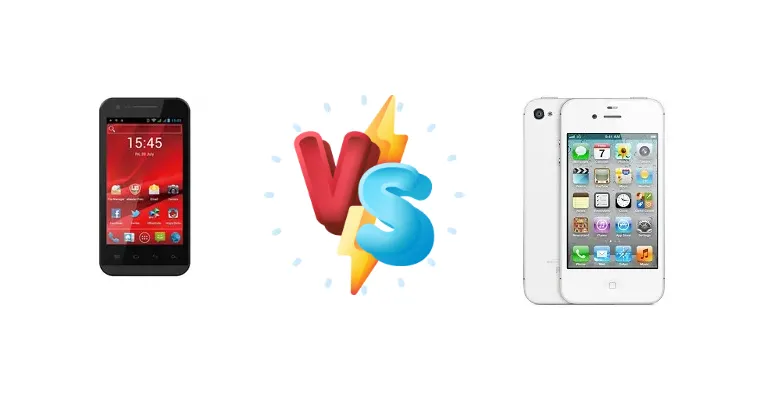
The Prestigio MultiPhone 4040 Duo and the Apple iPhone 4s represent vastly different approaches to the smartphone market. The 4040 Duo, released much later, aimed for affordability with a Mediatek chipset, while the iPhone 4s, a 2011 flagship, defined the early smartphone experience with its A5 processor and iOS ecosystem. This comparison examines how these devices stack up in a modern context, considering their original intent and current usability.
🏆 Quick Verdict
For the average user in 2024, the Apple iPhone 4s is the better choice, despite its age. While both devices feature a 1.0 GHz Cortex-A9 CPU, the A5's superior architecture and iOS optimization provide a smoother, more reliable experience. The identical 45-hour endurance rating suggests comparable battery life, but the iPhone's software support and ecosystem remain a significant advantage.
| Network |
|---|
| 2G bands | GSM 850 / 900 / 1800 / 1900 - SIM 1 & SIM 2 | GSM 850 / 900 / 1800 / 1900 |
| 3G bands | HSDPA 900 / 2100 | HSDPA 850 / 900 / 1900 / 2100 |
| Speed | HSPA | HSPA 14.4/5.76 Mbps |
| Technology | GSM / HSPA | GSM / CDMA / HSPA / EVDO |
| | - | CDMA2000 1xEV-DO |
| Launch |
|---|
| Announced | 2013. Released 2013 | 2011, October 04. Released 2011, October 14 |
| Status | Discontinued | Discontinued |
| Body |
|---|
| Build | - | Glass front (Corning-made glass), glass back, stainless steel frame |
| Dimensions | 124 x 64 x 11 mm (4.88 x 2.52 x 0.43 in) | 115.2 x 58.6 x 9.3 mm (4.54 x 2.31 x 0.37 in) |
| SIM | Dual SIM (Mini-SIM) | Micro-SIM |
| Weight | 180 g (6.35 oz) | 140 g (4.94 oz) |
| | - | Scratch-resistant glass back panel |
| Display |
|---|
| Protection | - | Corning Gorilla Glass, oleophobic coating |
| Resolution | 480 x 800 pixels, 5:3 ratio (~233 ppi density) | 640 x 960 pixels, 3:2 ratio (~330 ppi density) |
| Size | 4.0 inches, 45.5 cm2 (~57.4% screen-to-body ratio) | 3.5 inches, 36.5 cm2 (~54.0% screen-to-body ratio) |
| Type | TFT | IPS LCD |
| Platform |
|---|
| CPU | 1.0 GHz Cortex-A9 | Dual-core 1.0 GHz Cortex-A9 |
| Chipset | Mediatek MT6575 (40 nm) | Apple A5 (45 nm) |
| GPU | PowerVR SGX531 | PowerVR SGX543MP2 |
| OS | Android 4.0 (Ice Cream Sandwich) | iOS 5, upgradable to iOS 9.3.6 |
| Memory |
|---|
| Card slot | microSDHC (dedicated slot) | No |
| Internal | 4GB 512MB RAM | 8GB 512MB RAM, 16GB 512MB RAM, 32GB 512MB RAM, 64GB 512MB RAM |
| Main Camera |
|---|
| Features | LED flash, panorama, HDR | LED flash, panorama, HDR |
| Single | 5 MP, AF | 8 MP, f/2.4, 35mm (standard), 1/3.2", 1.4µm, AF |
| Video | Yes | 1080p@30fps |
| Selfie camera |
|---|
| Single | VGA | VGA, videocalling over Wi-Fi and 3G |
| Video | - | 480p@30fps |
| Sound |
|---|
| 3.5mm jack | Yes | Yes |
| 35mm jack | Yes | Yes |
| Loudspeaker | Yes | Yes |
| Comms |
|---|
| Bluetooth | 2.1 | 4.0, A2DP, LE |
| NFC | No | - |
| Positioning | GPS | GPS, A-GPS, GLONASS |
| Radio | FM radio | No |
| USB | microUSB 2.0 | 2.0 |
| WLAN | Wi-Fi 802.11 b/g/n, hotspot | Wi-Fi 802.11 b/g/n, hotspot |
| Features |
|---|
| Sensors | Accelerometer, proximity, compass | Accelerometer, gyro, proximity, compass |
| Battery |
|---|
| Music play | Up to 18 h | - |
| Stand-by | Up to 225 h | Up to 200 h (3G) |
| Talk time | Up to 10 h 30 min | Up to 8 h (3G) |
| Type | Li-Ion 1500 mAh, removable | Li-Po 1432 mAh, non-removable (5.3 Wh) |
| Misc |
|---|
| Colors | Black | Black, White |
| Models | - | A1431, A1387, iPhone4,1 |
| Price | About 100 EUR | About 190 EUR |
| SAR | - | 1.18 W/kg (head) 0.98 W/kg (body) |
| SAR EU | - | 0.99 W/kg (head) 0.99 W/kg (body) |
| Tests |
|---|
| Audio quality | - |
Noise -91.2dB / Crosstalk -93.0dB |
| Battery life | - |
Endurance rating 45h
|
| Camera | - |
Photo / Video |
| Display | - |
Contrast ratio: 1261:1 (nominal) / 2.269:1 (sunlight) |
| Loudspeaker | - |
Voice 65dB / Noise 64dB / Ring 74dB
|
Prestigio MultiPhone 4040 Duo
- Potentially lower purchase price
- More modern chipset manufacturing process (40nm)
- May support newer SIM card standards
- Unknown display quality
- Inferior chipset architecture compared to A5
- Limited software support and updates
Apple iPhone 4s
- Superior chipset architecture and optimization
- Mature iOS ecosystem (though limited by version)
- Higher resale value and brand recognition
- Aging battery
- Outdated iOS version
- Limited app compatibility
Display Comparison
Both devices share a contrast ratio of 1261:1 (nominal) and 2.269:1 (sunlight), suggesting similar outdoor visibility. However, the specific panel technology and resolution are unknown for the Prestigio. The iPhone 4s’ Retina display, while small by today’s standards, was groundbreaking for its pixel density at the time, offering a sharper image than many contemporaries. The lack of information on the Prestigio’s display makes a definitive quality assessment impossible, but it likely doesn’t match the iPhone’s clarity.
Camera Comparison
Both devices offer photo and video capabilities, but details are scarce. The iPhone 4s’ 8MP camera was highly regarded for its time, producing detailed images with accurate colors. The Prestigio’s camera specifications are unknown, making a direct comparison impossible. Given the 4040 Duo’s budget positioning, it’s likely to feature a lower-quality sensor and image processing pipeline. The iPhone 4s’ consistent image quality and video recording capabilities give it a clear advantage.
Performance
Both the Prestigio MultiPhone 4040 Duo and the Apple iPhone 4s utilize a 1.0 GHz dual-core Cortex-A9 CPU. However, the underlying architecture and manufacturing process differ significantly. The Apple A5 is built on a 45nm process, while the Mediatek MT6575 is on a more efficient 40nm node. While the 40nm process *should* offer better power efficiency, Apple’s chip design and iOS optimization likely result in superior real-world performance and responsiveness on the iPhone 4s. The A5’s GPU also surpasses the MT6575’s capabilities, offering a smoother experience for graphics-intensive tasks.
Battery Life
Interestingly, both devices are rated for an endurance of 45 hours. This suggests comparable battery life despite potential differences in battery capacity. The Mediatek MT6575’s 40nm process *could* contribute to slightly better efficiency, but Apple’s software optimization likely mitigates this advantage. The iPhone 4s’ battery is now likely degraded, impacting real-world performance, but the original endurance rating indicates a similar baseline to the Prestigio.
Buying Guide
Buy the Prestigio MultiPhone 4040 Duo if you need a functional, extremely budget-friendly device for basic tasks and are comfortable with a potentially limited software experience. Buy the Apple iPhone 4s if you prioritize a refined user experience, access to a mature app ecosystem (even if limited by iOS version), and a device with a stronger brand reputation for longevity and resale value.
Frequently Asked Questions
❓ Is the iPhone 4s still usable in 2024, and what are the limitations?
Yes, the iPhone 4s is still usable, but with significant limitations. You'll be restricted to an older version of iOS, meaning many modern apps won't be compatible. Battery life will likely be degraded, and finding replacement parts can be challenging. However, it can still handle basic tasks like calls, texts, and some older apps.
❓ Can I upgrade the iOS version on the iPhone 4s?
No, the iPhone 4s is limited to iOS 7.1.2. Apple no longer provides software updates for this device, meaning you won't be able to access newer features or security patches. This is a major drawback compared to more modern smartphones.
❓ What kind of SIM card does the Prestigio MultiPhone 4040 Duo support?
Given its later release date, the Prestigio MultiPhone 4040 Duo likely supports Micro-SIM cards, a more modern standard than the iPhone 4s' Nano-SIM. This could be a benefit for users upgrading from older devices.
❓ Is it worth buying the iPhone 4s for nostalgia purposes?
If you're a collector or have strong nostalgic ties to the iPhone 4s, it can be a worthwhile purchase. However, be prepared for its limitations and the potential cost of repairs. It's not a practical daily driver in 2024.