
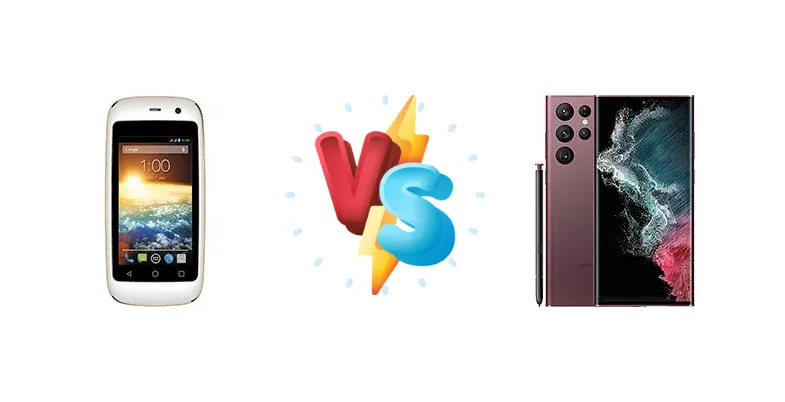
Posh Micro X S240 vs. Samsung Galaxy S22 Ultra: A Tale of Two Androids
| Phones Images | |||||
|---|---|---|---|---|---|
|
🏆 Quick Verdict
For the average user prioritizing a modern smartphone experience with a capable camera and long battery life, the Samsung Galaxy S22 Ultra 5G is the clear choice. However, the Posh Micro X S240 offers a functional Android experience at a fraction of the cost, making it ideal for basic communication and light tasks.
| PHONES | ||
|---|---|---|
| Phone Names | Posh Micro X S240 | Samsung Galaxy S22 Ultra 5G |
| Network | ||
|---|---|---|
| 2G bands | GSM 850 / 900 / 1800 / 1900 | GSM 850 / 900 / 1800 / 1900 |
| 3G bands | HSDPA 850 / 1700(AWS) / 1900 - S240A | HSDPA 850 / 900 / 1700(AWS) / 1900 / 2100 |
| 4G bands | - | 1, 2, 3, 4, 5, 7, 8, 12, 13, 17, 18, 19, 20, 25, 26, 28, 32, 38, 39, 40, 41, 66 - International |
| 5G bands | - | 1, 2, 3, 5, 7, 8, 12, 20, 25, 28, 38, 40, 41, 66, 75, 77, 78 SA/NSA/Sub6 - International |
| Speed | HSPA 21.1/5.76 Mbps | HSPA 42.2/5.76 Mbps, LTE (7CA) Cat20 2000/200 Mbps, 5G (5+ Gbps DL) |
| Technology | GSM / HSPA | GSM / CDMA / HSPA / EVDO / LTE / 5G |
| HSDPA 850 / 1900 / 2100 - S240B | 1, 3, 5, 7, 8, 20, 28, 38, 41, 66, 71, 260, 261 SA/NSA/Sub6/mmWave - USA | |
| Launch | ||
|---|---|---|
| Announced | 2015, July. Released 2015, July | 2022, February 09 |
| Status | Discontinued | Available. Released 2022, February 25 |
| Body | ||
|---|---|---|
| Build | - | Glass front (Gorilla Glass Victus+), glass back (Gorilla Glass Victus+), aluminum frame |
| Dimensions | 89.8 x 47.8 x 11.7 mm (3.54 x 1.88 x 0.46 in) | 163.3 x 77.9 x 8.9 mm (6.43 x 3.07 x 0.35 in) |
| SIM | Mini-SIM | · Nano-SIM + eSIM· Nano-SIM + Nano-SIM + eSIM (max 2 at a time) |
| Weight | 52.7 g (1.87 oz) | 228 g / 229 g (mmWave) (8.04 oz) |
| - | IP68 dust/water resistant (up to 1.5m for 30 min) Armor aluminum frame with tougher drop and scratch resistance (advertised) Stylus, 2.8ms latency (Bluetooth integration, accelerometer, gyro) | |
| Display | ||
|---|---|---|
| Protection | - | Corning Gorilla Glass Victus+ |
| Resolution | 240 x 432 pixels (~202 ppi density) | 1440 x 3088 pixels, 19.3:9 ratio (~500 ppi density) |
| Size | 2.45 inches, 16.4 cm2 (~38.3% screen-to-body ratio) | 6.8 inches, 114.7 cm2 (~90.2% screen-to-body ratio) |
| Type | TFT, 256K colors | Dynamic AMOLED 2X, 120Hz, HDR10+, 1750 nits (peak) |
| - | Always-on display | |
| Platform | ||
|---|---|---|
| CPU | Dual-core 1.0 GHz Cortex-A7 | Octa-core (1x2.8 GHz Cortex-X2 & 3x2.50 GHz Cortex-A710 & 4x1.8 GHz Cortex-A510) - EuropeOcta-core (1x3.00 GHz Cortex-X2 & 3x2.50 GHz Cortex-A710 & 4x1.80 GHz Cortex-A510) - ROW |
| Chipset | Mediatek MT6572 (28 nm) | Exynos 2200 (4 nm) - EuropeQualcomm SM8450 Snapdragon 8 Gen 1 (4 nm) - ROW |
| GPU | Mali-400 | Xclipse 920 - EuropeAdreno 730 - ROW |
| OS | Android 4.4.2 (KitKat) | Android 12, up to 4 major Android upgrades, One UI 8 |
| Memory | ||
|---|---|---|
| Card slot | microSDHC (dedicated slot) | No |
| Internal | 4GB 512MB RAM | 128GB 8GB RAM, 256GB 12GB RAM, 512GB 12GB RAM, 1TB 12GB RAM |
| - | UFS 3.1 | |
| Main Camera | ||
|---|---|---|
| Features | Panorama | Laser AF, LED flash, auto-HDR, panorama |
| Quad | - | 108 MP, f/1.8, 23mm (wide), 1/1.33", 0.8µm, PDAF, OIS 10 MP, f/2.4, 70mm (telephoto), 1/3.52", 1.12µm, PDAF, OIS, 3x optical zoom 10 MP, f/4.9, 230mm (periscope telephoto), 1/3.52", 1.12µm, PDAF, OIS, 10x optical zoom 12 MP, f/2.2, 13mm, 120˚ (ultrawide), 1/2.55", 1.4µm, dual pixel PDAF, Super Steady video |
| Single | 2 MP | - |
| Video | 720p@30fps | 8K@24fps, 4K@30/60fps, 1080p@30/60/120/240fps, HDR10+, stereo sound rec., gyro-EIS |
| Selfie camera | ||
|---|---|---|
| Features | - | HDR |
| Single | 1 MP | 40 MP, f/2.2, 26mm (wide), 1/2.82", 0.7µm, PDAF |
| Video | - | 4K@30/60fps, 1080p@30fps |
| Sound | ||
|---|---|---|
| 3.5mm jack | Yes | No |
| 35mm jack | Yes | No |
| Loudspeaker | Yes, with stereo speakers | Yes, with stereo speakers |
| - | 32-bit/384kHz audio Tuned by AKG | |
| Comms | ||
|---|---|---|
| Bluetooth | 4.0, A2DP, EDR | 5.2, A2DP, LE |
| NFC | No | Yes |
| Positioning | GPS | GPS, GLONASS, BDS, GALILEO |
| Radio | FM radio | No |
| USB | microUSB 2.0 | USB Type-C 3.2, OTG |
| WLAN | Wi-Fi 802.11 b/g/n, Wi-Fi Direct, DLNA, hotspot | Wi-Fi 802.11 a/b/g/n/ac/6e, dual-band, Wi-Fi Direct |
| Features | ||
|---|---|---|
| Sensors | Accelerometer | Fingerprint (under display, ultrasonic), accelerometer, gyro, proximity, compass, barometer |
| - | Samsung DeX, Samsung Wireless DeX (desktop experience support) Bixby natural language commands and dictation Samsung Pay (Visa, MasterCard certified) Ultra Wideband (UWB) support | |
| Battery | ||
|---|---|---|
| Charging | - | 45W wired, PD3.0 15W wireless (Qi) 4.5W reverse wireless |
| Stand-by | Up to 200 h (2G) / Up to 180 h (3G) | - |
| Talk time | Up to 7 h (2G) / Up to 4 h (3G) | - |
| Type | Li-Po 650 mAh, removable | Li-Ion 5000 mAh |
| Misc | ||
|---|---|---|
| Colors | Black, White, Blue, Pink | Phantom Black, White, Burgundy, Green, Graphite, Red, Sky Blue, Bora Purple |
| Models | - | SM-S908B, SM-S908B/DS, SM-S908U, SM-S908U1, SM-S908W, SM-S908N, SM-S9080, SM-S908E, SM-S908E/DS |
| Price | - | € 397.07 / $ 269.98 / £ 304.99 / ₹ 63,899 |
| SAR | - | 1.18 W/kg (head) 0.98 W/kg (body) |
| SAR EU | - | 1.05 W/kg (head) 1.58 W/kg (body) |
| Tests | ||
|---|---|---|
| Battery life | - | Endurance rating 108h |
| Camera | - | Photo / Video |
| Display | - | Contrast ratio: Infinite (nominal) |
| Loudspeaker | - | -27.3 LUFS (Good) |
| Performance | - | AnTuTu: 968359 (v9) GeekBench: 3657 (v5.1) GFXBench: 37fps (ES 3.1 onscreen) |
Posh Micro X S240
- Extremely affordable price point
- Functional Android experience
- Acceptable for basic communication
- Poor performance for demanding tasks
- Low-quality camera
- Outdated chipset and manufacturing process
Samsung Galaxy S22 Ultra 5G
- High-performance processor (Exynos 2200 or Snapdragon 8 Gen 1)
- Excellent camera system
- Bright and vibrant display
- High price
- Potential for thermal throttling under heavy load
- Large size and weight
Display Comparison
The Samsung Galaxy S22 Ultra boasts a significantly more advanced display, reaching a measured peak brightness of 1266 nits. This contrasts sharply with the Posh Micro X S240, which lacks detailed display specifications. The S22 Ultra’s infinite contrast ratio (nominal) suggests a superior viewing experience, particularly with HDR content. While the Posh Micro X S240 likely utilizes an IPS panel to keep costs down, the S22 Ultra’s potential for LTPO technology allows for dynamic refresh rate adjustments, conserving battery life and providing smoother scrolling.
Camera Comparison
Both devices feature a 'Photo / Video' camera, but the details are where the difference lies. The S22 Ultra’s camera system, while not detailed in the provided specs, is known for its advanced features and image processing. The Posh Micro X S240’s camera is likely a basic sensor, suitable for casual snapshots but lacking the dynamic range, detail, and low-light performance of the S22 Ultra. The S22 Ultra’s inclusion of Optical Image Stabilization (OIS) is another significant advantage, resulting in sharper images and smoother videos.
Performance
The performance gap is substantial. The Samsung Galaxy S22 Ultra, equipped with either the Exynos 2200 (Europe) or Snapdragon 8 Gen 1 (ROW) – both fabricated on a 4nm process – offers a multi-core CPU experience far exceeding the Posh Micro X S240’s dual-core 1.0 GHz Cortex-A7 processor built on a 28nm node. The S22 Ultra’s octa-core configuration, featuring Cortex-X2 and A710 cores, is designed for demanding tasks like gaming and video editing. The Posh Micro X S240 will struggle with anything beyond basic app usage, while the S22 Ultra benefits from faster LPDDR5X RAM, further enhancing responsiveness. Thermal management will also be vastly superior on the S22 Ultra due to the more efficient 4nm process.
Battery Life
Both phones share an endurance rating of 108 hours, but this metric doesn't tell the whole story. The S22 Ultra’s 45W wired charging with PD3.0 and 15W wireless charging provide significantly faster replenishment compared to the Posh Micro X S240, which lacks detailed charging specifications. The S22 Ultra’s larger battery capacity (not specified, but typically around 5000mAh in this class) combined with the efficient 4nm chipset contributes to its all-day battery life, while the Posh Micro X S240 will likely require more frequent charging.
Buying Guide
Buy the Posh Micro X S240 if you need a functional, ultra-affordable smartphone for essential tasks like calls, texts, and basic app usage, and are willing to compromise on performance and camera quality. Buy the Samsung Galaxy S22 Ultra 5G if you demand a premium experience with a high-performance processor, versatile camera system, bright display, and fast charging, and are prepared to pay a significant premium.