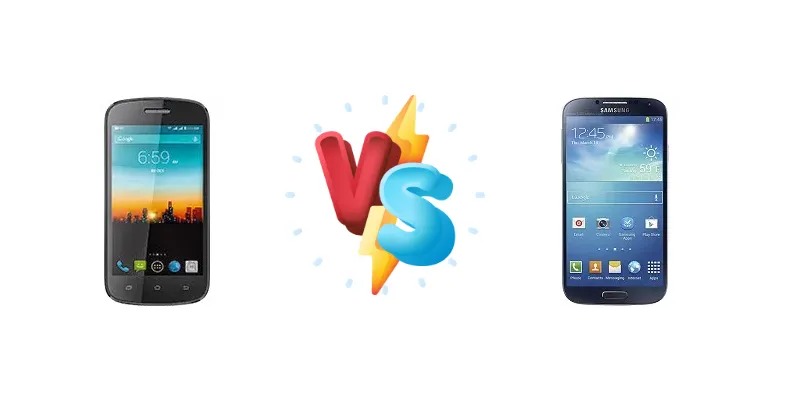
The Samsung Galaxy S4, released in 2013, represented a peak in Android flagship design. Now, years later, the Posh Kick Lite S410 emerges as a budget-friendly option. This comparison isn't about raw power; it's about understanding where each phone excels given its price point and the technological landscape of its time.
🏆 Quick Verdict
For the average user in 2024, the Samsung Galaxy S4 remains the better choice, despite its age. The Exynos 5410’s octa-core architecture provides a significantly more responsive experience than the Posh Kick Lite S410’s dual-core Mediatek processor, making everyday tasks and even light multitasking smoother.
| Network |
|---|
| 2G bands | GSM 850 / 900 / 1800 / 1900 - SIM 1 & SIM 2 | GSM 850 / 900 / 1800 / 1900 |
| 3G bands | HSDPA 850 / 1700(AWS) / 1900 - S410A | HSDPA 850 / 900 / 1900 / 2100 |
| EDGE | - | Yes |
| GPRS | - | Yes |
| Speed | HSPA 21.1/5.76 Mbps | HSPA 42.2/5.76 Mbps |
| Technology | GSM / HSPA | GSM / HSPA |
| | HSDPA 850 / 1900 / 2100 - X410B | - |
| Launch |
|---|
| Announced | 2015, May. Released 2015, August | 2013, March. Released 2013, April |
| Status | Discontinued | Discontinued |
| Body |
|---|
| Build | - | Glass front (Gorilla Glass 3), plastic back, plastic frame |
| Dimensions | 123.3 x 63.5 x 12.2 mm (4.85 x 2.5 x 0.48 in) | 136.6 x 69.8 x 7.9 mm (5.38 x 2.75 x 0.31 in) |
| SIM | Dual SIM (Mini-SIM/ Micro-SIM, dual stand-by) | Micro-SIM |
| Weight | 119 g (4.20 oz) | 130 g (4.59 oz) |
| Display |
|---|
| Protection | - | Corning Gorilla Glass 3 |
| Resolution | 480 x 800 pixels, 5:3 ratio (~233 ppi density) | 1080 x 1920 pixels, 16:9 ratio (~441 ppi density) |
| Size | 4.0 inches, 45.5 cm2 (~58.2% screen-to-body ratio) | 5.0 inches, 68.9 cm2 (~72.3% screen-to-body ratio) |
| Type | IPS LCD | Super AMOLED |
| Platform |
|---|
| CPU | Dual-core 1.0 GHz Cortex-A7 | Octa-core (4x1.6 GHz Cortex-A15 & 4x1.2 GHz Cortex-A7) |
| Chipset | Mediatek MT6572M (28 nm) | Exynos 5410 Octa (28 nm) |
| GPU | Mali-400 | PowerVR SGX544MP3 |
| OS | Android 4.4.2 (KitKat) | Android 4.2.2 (Jelly Bean), upgradable to 5.0.1 (Lollipop), TouchWiz UI |
| Memory |
|---|
| Call records | - | Yes |
| Card slot | microSDHC | microSDXC (dedicated slot) |
| Internal | 4GB 512MB RAM | 16GB 2GB RAM, 32GB 2GB RAM, 64GB 2GB RAM |
| Phonebook | - | 2000 entries |
| | - | eMMC 5.0 |
| Main Camera |
|---|
| Features | LED flash, panorama, HDR | LED flash, HDR |
| Single | 2 MP | 13 MP, f/2.2, 31mm (standard), 1/3.1", 1.14µm, AF |
| Video | 720p@30fps | 1080p@30fps |
| Selfie camera |
|---|
| Features | - | Dual video call |
| Single | VGA | 2 MP, f/2.4, 31mm (standard) |
| Video | - | 1080p@30fps |
| Sound |
|---|
| 3.5mm jack | Yes | Yes |
| 35mm jack | Yes | Yes |
| Loudspeaker | Yes, with stereo speakers | Yes |
| Comms |
|---|
| Bluetooth | 4.0, A2DP, EDR | 4.0, A2DP, EDR, LE, aptX |
| Infrared port | - | Yes |
| NFC | No | Yes |
| Positioning | GPS | GPS, GLONASS |
| Radio | FM radio | No |
| USB | microUSB 2.0 | microUSB 2.0 (MHL 2 TV-out), OTG |
| WLAN | Wi-Fi 802.11 b/g/n, Wi-Fi Direct, DLNA, hotspot | Wi-Fi 802.11 a/b/g/n/ac, dual-band, Wi-Fi Direct, DLNA, hotspot |
| Features |
|---|
| Games | - | Downloadable |
| Java | - | Yes |
| Messaging | - | SMS(threaded view), MMS, Email, IM |
| Sensors | Accelerometer | Accelerometer, gyro, proximity, compass, barometer, temperature, humidity, gesture |
| | - | ANT+
S-Voice natural language commands and dictation
Air gestures |
| Battery |
|---|
| Charging | - | Wireless (Qi) (market dependent) |
| Music play | - | Up to 62 h |
| Stand-by | Up to 400 h (2G) / Up to 240 h (3G) | Up to 370 h (3G) |
| Talk time | Up to 5 h (2G) / Up to 3 h (3G) | Up to 17 h (3G) |
| Type | Li-Po 1450 mAh battery | Li-Ion 2600 mAh, removable |
| Misc |
|---|
| Colors | Black, White, Pink, Blue | White Frost, Black Mist, Arctic Blue, Black Edition |
| Models | - | GT-I9500, SGH-I337M, SGH-M919, GT-I9507V, SHV-E330L, SPH-L720T, SHV-E300S, SHV-E300L, SHV-E300K, GT-I9507, SGH-M919N |
| Price | - | About 320 EUR |
| SAR | - | 0.85 W/kg (head) 1.55 W/kg (body) |
| SAR EU | - | 0.42 W/kg (head) 0.54 W/kg (body) |
| Tests |
|---|
| Audio quality | - |
Noise -95.9dB / Crosstalk -96.4dB |
| Battery life | - |
Endurance rating 65h
|
| Camera | - |
Photo / Video |
| Display | - |
Contrast ratio: Infinite (nominal) / 3.352:1 (sunlight) |
| Loudspeaker | - |
Voice 70dB / Noise 66dB / Ring 77dB
|
Posh Kick Lite S410
- Extremely affordable price point
- Functional for basic tasks
- Compact size (likely)
- Poor performance for modern apps
- Limited camera capabilities
- Potentially low-resolution display
Samsung I9500 Galaxy S4
- Significantly faster processor
- More capable camera system
- Wireless charging (market dependent)
- Older device with potential battery degradation
- May not receive software updates
- Larger size and weight
Display Comparison
Both devices share a similar contrast ratio specification – infinite (nominal) and 3.352:1 in sunlight – suggesting comparable outdoor visibility. However, the Galaxy S4’s original display technology, while excellent for its time, lacks the advancements found in modern budget displays. The Posh Kick Lite S410’s display resolution is not specified, but given its price point, it’s likely lower than the Galaxy S4’s, resulting in a less sharp image. The S4’s larger screen size also provides a more immersive viewing experience.
Camera Comparison
Both phones offer photo and video capabilities, but the specifics are limited. The Galaxy S4 likely boasts a superior camera system due to its higher-end origins, potentially including features like HDR and advanced image stabilization. The Posh Kick Lite S410’s camera is likely a basic sensor focused on functionality rather than image quality. Without detailed sensor information, it’s safe to assume the S4 captures more detailed and vibrant photos, especially in challenging lighting conditions.
Performance
The performance gap is substantial. The Samsung Galaxy S4’s Exynos 5410, with its octa-core configuration (4x1.6 GHz Cortex-A15 & 4x1.2 GHz Cortex-A7), dwarfs the Posh Kick Lite S410’s dual-core 1.0 GHz Cortex-A7. The Exynos utilizes big.LITTLE architecture, dynamically switching between the powerful Cortex-A15 cores for demanding tasks and the efficient Cortex-A7 cores for background processes. The Mediatek MT6572M in the Posh Kick Lite S410 will struggle with even moderate multitasking, while the S4 can handle more complex applications with relative ease. Both chipsets are fabricated on a 28nm process, but the architectural differences are key.
Battery Life
Interestingly, both devices share an endurance rating of 65 hours. However, this doesn’t tell the whole story. The Galaxy S4’s larger battery capacity (not specified, but typically around 2600mAh) combined with the Exynos 5410’s power efficiency features provides a more consistent experience. The Posh Kick Lite S410’s smaller battery (likely around 1500-2000mAh) will be drained more quickly under load due to the less efficient Mediatek chipset. The Galaxy S4 also benefits from wireless charging (Qi, market dependent), a feature absent on the Posh Kick Lite S410.
Buying Guide
Buy the Posh Kick Lite S410 if you need a functional, extremely affordable Android device for basic communication and light use, and are willing to accept significant performance limitations. Buy the Samsung I9500 Galaxy S4 if you prioritize a smoother user experience, a more capable camera, and features like wireless charging, even if it means dealing with an older device and potentially degraded battery health.
Frequently Asked Questions
❓ Is the Exynos 5410 in the Galaxy S4 prone to overheating during extended use?
While the Exynos 5410 is a powerful chip, it can exhibit some thermal throttling under sustained heavy load, particularly in warmer environments. However, this is less of a concern for typical daily usage and is unlikely to be a major issue for most users.
❓ Can the Posh Kick Lite S410 run popular modern apps like TikTok or Instagram smoothly?
The Posh Kick Lite S410’s dual-core processor and limited RAM will struggle with demanding apps like TikTok and Instagram. Expect significant lag, slow loading times, and potential crashes. These apps are optimized for more powerful hardware.
❓ Does the Samsung Galaxy S4 still receive security updates in 2024?
No, the Samsung Galaxy S4 is no longer officially supported with security updates. This poses a security risk, and users should exercise caution when using the device for sensitive tasks like online banking or shopping.
❓ What kind of storage options does the Posh Kick Lite S410 offer, and is it expandable?
The Posh Kick Lite S410 likely has limited internal storage (typically 8GB or 16GB) and supports microSD card expansion. This is crucial given the phone's limited capabilities and the need to store apps and media.