
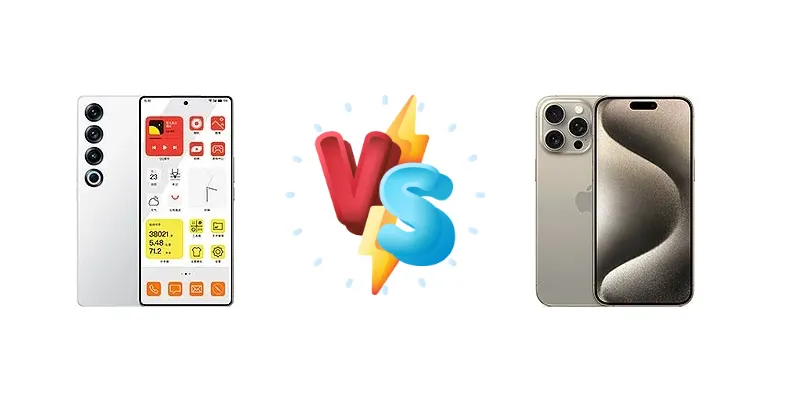
Polestar Phone vs. iPhone 15 Pro Max: A Head-to-Head Flagship Battle
| Phones Images | |||||
|---|---|---|---|---|---|
|
🏆 Quick Verdict
For the average user prioritizing all-day battery life and a refined ecosystem, the iPhone 15 Pro Max remains the superior choice. However, the Polestar Phone’s blistering 80W wired charging and potent Snapdragon 8 Gen 3 offer a compelling alternative for power users who prioritize speed and aren't locked into the Apple ecosystem.
| PHONES | ||
|---|---|---|
| Phone Names | Polestar Phone | Apple iPhone 15 Pro Max |
| Network | ||
|---|---|---|
| 2G bands | GSM 850 / 900 / 1800 / 1900 | GSM 850 / 900 / 1800 / 1900 |
| 3G bands | HSDPA 850 / 900 / 1900 / 2100 | HSDPA 850 / 900 / 1700(AWS) / 1900 / 2100 |
| 4G bands | LTE | 1, 2, 3, 4, 5, 7, 8, 12, 13, 17, 18, 19, 20, 25, 26, 28, 30, 32, 34, 38, 39, 40, 41, 42, 46, 48, 53, 66 - A3106 |
| 5G bands | SA/NSA | 1, 2, 3, 5, 7, 8, 12, 20, 25, 26, 28, 30, 38, 40, 41, 48, 53, 66, 70, 77, 78, 79 SA/NSA/Sub6 - A3106 |
| Speed | HSPA, LTE, 5G | HSPA, LTE, 5G, EV-DO Rev.A 3.1 Mbps |
| Technology | GSM / HSPA / LTE / 5G | GSM / CDMA / HSPA / EVDO / LTE / 5G |
| Launch | ||
|---|---|---|
| Announced | 2024, April 24 | 2023, September 12 |
| Status | Available. Released 2024, April 24 | Available. Released 2023, September 22 |
| Body | ||
|---|---|---|
| Build | - | Glass front, glass back, titanium frame (grade 5) |
| Dimensions | 165 x 74.4 x 8 mm (6.50 x 2.93 x 0.31 in) | 159.9 x 76.7 x 8.3 mm (6.30 x 3.02 x 0.33 in) |
| SIM | Nano-SIM + Nano-SIM | · Nano-SIM + eSIM + eSIM (max 2 at a time; International)· eSIM + eSIM (8 or more, max 2 at a time; USA)· Nano-SIM + Nano-SIM (China) |
| Weight | 214 g (7.55 oz) | 221 g (7.80 oz) |
| Display | ||
|---|---|---|
| Protection | Titan Glass 2.0 | Ceramic Shield glass |
| Resolution | 1368 x 3192 pixels, 21:9 ratio (~511 ppi density) | 1290 x 2796 pixels, 19.5:9 ratio (~460 ppi density) |
| Size | 6.79 inches, 107.7 cm2 (~87.7% screen-to-body ratio) | 6.7 inches, 110.2 cm2 (~89.8% screen-to-body ratio) |
| Type | LTPO AMOLED, 1B colors, 120Hz, HDR10+, 600 nits (typ), 1250 nits (HBM) | LTPO Super Retina XDR OLED, 120Hz, HDR10, Dolby Vision, 1000 nits (typ), 2000 nits (HBM) |
| Platform | ||
|---|---|---|
| CPU | Octa-core (1x3.3 GHz Cortex-X4 & 3x3.2 GHz Cortex-A720 & 2x3.0 GHz Cortex-A720 & 2x2.3 GHz Cortex-A520) | Hexa-core (2x3.78 GHz + 4x2.11 GHz) |
| Chipset | Qualcomm SM8650-AB Snapdragon 8 Gen 3 (4 nm) | Apple A17 Pro (3 nm) |
| GPU | Adreno 750 | Apple GPU (6-core graphics) |
| OS | Polestar OS | iOS 17, upgradable to iOS 26.1 |
| Memory | ||
|---|---|---|
| Card slot | No | No |
| Internal | 1TB 16GB RAM | 256GB 8GB RAM, 512GB 8GB RAM, 1TB 8GB RAM |
| Main Camera | ||
|---|---|---|
| Features | Ring-LED flash, panorama, HDR | Dual-LED dual-tone flash, HDR (photo/panorama) |
| Triple | 50 MP, f/1.9, 24mm (wide), 1/1.3", 1.2µm, PDAF, OIS 10 MP, f/2.1, 72mm (periscope telephoto), PDAF, OIS, 3x optical zoom 13 MP, f/2.4, 15mm, 122˚ (ultrawide) | 48 MP, f/1.8, 24mm (wide), 1/1.28", 1.22µm, dual pixel PDAF, sensor-shift OIS 12 MP, f/2.8, 120mm (periscope telephoto), 1/3.06", 1.12µm, dual pixel PDAF, 3D sensor‑shift OIS, 5x optical zoom 12 MP, f/2.2, 13mm, 120˚ (ultrawide), 1/2.55", 1.4µm, dual pixel PDAF TOF 3D LiDAR scanner (depth) |
| Video | 8K, 4K, 1080p; gyro-EIS | 4K@24/25/30/60fps, 1080p@25/30/60/120/240fps, 10-bit HDR, Dolby Vision HDR (up to 60fps), ProRes, 3D (spatial) video, stereo sound rec. |
| Selfie camera | ||
|---|---|---|
| Features | HDR | HDR, Dolby Vision HDR |
| Single | 32 MP, f/2.5, (wide), 1/3.14", 0.7µm | 12 MP, f/1.9, 23mm (wide), 1/3.6", 1.0µm, PDAF, OIS SL 3D, (depth/biometrics sensor) |
| Video | Yes | 4K@24/25/30/60fps, 1080p@25/30/60/120fps, gyro-EIS |
| Sound | ||
|---|---|---|
| 35mm jack | No | No |
| Loudspeaker | Yes, with stereo speakers | Yes, with stereo speakers |
| Comms | ||
|---|---|---|
| Bluetooth | 5.4, A2DP, LE | 5.3, A2DP, LE |
| Infrared port | Yes | - |
| NFC | Yes | Yes |
| Positioning | GPS (L1+L5), GLONASS (G1), BDS (B1I+B1c+B2a), GALILEO (E1+E5a), QZSS (L1+L5), NavIC (L5) | GPS (L1+L5), GLONASS, GALILEO, BDS, QZSS, NavIC |
| Radio | No | No |
| USB | USB Type-C, OTG | USB Type-C 3.2 Gen 2, DisplayPort |
| WLAN | Wi-Fi 802.11 а/b/g/n/ac/6e/7, dual-band | Wi-Fi 802.11 a/b/g/n/ac/6e, tri-band, hotspot |
| Features | ||
|---|---|---|
| Sensors | Fingerprint (under display, ultrasonic), accelerometer, gyro, proximity, compass, barometer | Face ID, accelerometer, gyro, proximity, compass, barometer |
| Battery | ||
|---|---|---|
| Charging | 80W wired, PD3 PPS, QC4+ 50W wireless 10W reverse wireless | Wired, PD2.0, 50% in 30 min 15W wireless (MagSafe) 15W wireless (Qi2) - requires iOS 17.2 update 4.5W reverse wired |
| Type | 5050 mAh | Li-Ion 4441 mAh |
| Misc | ||
|---|---|---|
| Colors | White | Black Titanium, White Titanium, Blue Titanium, Natural Titanium |
| Models | - | A2849, A3105, A3106, A3108, iPhone16,2 |
| Price | - | € 758.79 / $ 579.87 / £ 628.29 |
| SAR | - | 1.07 W/kg (head) 1.11 W/kg (body) |
| SAR EU | - | 0.98 W/kg (head) 0.98 W/kg (body) |
Polestar Phone
- Blazing-fast 80W wired charging
- Powerful Snapdragon 8 Gen 3 processor
- 50W wireless charging and 10W reverse wireless
- Camera specs currently unknown
- Ecosystem less mature than Apple's
Apple iPhone 15 Pro Max
- Exceptional battery life (16+ hours)
- Industry-leading A17 Pro performance
- Mature and seamless iOS ecosystem
- Slower charging speeds
- Less customization options compared to Android
Display Comparison
The iPhone 15 Pro Max boasts a peak brightness of 1787 nits, ensuring excellent visibility even in direct sunlight. While the Polestar Phone’s display specs are not provided, it’s reasonable to assume it will be competitive, but likely won’t surpass the iPhone’s peak output. The iPhone’s ProMotion technology (LTPO) dynamically adjusts the refresh rate up to 120Hz, optimizing for both smoothness and power efficiency, a feature likely present on the Polestar Phone as well given its flagship status. The iPhone’s color accuracy is renowned, and the Polestar Phone will need to demonstrate comparable calibration to compete.
Camera Comparison
Detailed camera specs for the Polestar Phone are unavailable, making a direct comparison challenging. However, the iPhone 15 Pro Max is known for its exceptional photo and video capabilities, leveraging advanced computational photography and sensor-shift optical image stabilization. The iPhone’s larger sensor size (assumed, based on previous models) captures more light, resulting in better low-light performance. The Polestar Phone will need to offer a similarly sophisticated camera system to compete, focusing on sensor size, aperture, and image processing algorithms. Without specific details, it’s difficult to assess the Polestar Phone’s video recording capabilities against the iPhone’s ProRes support.
Performance
The core of this battle lies in the chipsets. Apple’s A17 Pro, fabricated on a 3nm process, delivers a hexa-core CPU configuration with a peak clock speed of 3.78 GHz. This contrasts with the Polestar Phone’s Qualcomm Snapdragon 8 Gen 3 (4nm), an octa-core processor. While core count differs, the A17 Pro’s architectural advantages and smaller node size likely translate to superior single-core performance and efficiency. The Snapdragon 8 Gen 3’s Cortex-X4 prime core at 3.3 GHz will provide strong performance, but the iPhone’s GPU is expected to hold a significant lead in graphics-intensive tasks. The Polestar Phone will likely benefit from ample LPDDR5x RAM, but Apple’s tight hardware-software integration gives the A17 Pro an edge in real-world responsiveness.
Battery Life
The iPhone 15 Pro Max shines in battery endurance, achieving an active use score of 16:01 hours and an endurance rating of 118 hours. This demonstrates exceptional power efficiency. The Polestar Phone compensates with significantly faster charging: 80W wired (PD3 PPS, QC4+), 50W wireless, and 10W reverse wireless. The iPhone 15 Pro Max offers slower wired charging (PD2.0, 50% in 30 min) and 15W wireless charging (MagSafe/Qi2). While the Polestar Phone’s battery capacity is unknown, its charging speed allows for a full charge in a fraction of the time, mitigating any potential capacity disadvantage. The 10W reverse wireless charging on the Polestar Phone is also significantly more useful than the iPhone’s 4.5W offering.
Buying Guide
Buy the Polestar Phone if you need exceptionally fast charging, prioritize Android customization, and value raw processing power for demanding tasks. Buy the Apple iPhone 15 Pro Max if you prefer a seamless user experience, industry-leading battery endurance, and a mature app ecosystem, even if it means sacrificing charging speed.