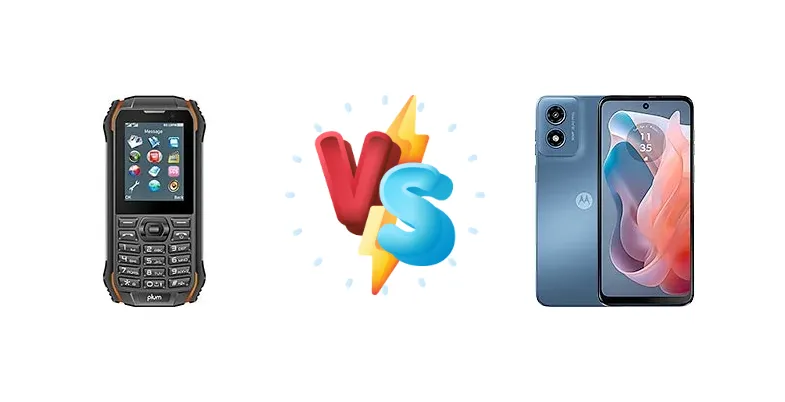
The sub-$150 smartphone market is fiercely competitive. We pit the Motorola Moto G Play (2024), powered by the Qualcomm Snapdragon 680, against the Plum Ram 10 LTE, utilizing the Unisoc T107 chipset. This comparison focuses on real-world performance implications, not just raw specifications, to help you determine which device delivers the best value.
🏆 Quick Verdict
For the average user prioritizing consistent performance and a smoother experience, the Motorola Moto G Play (2024) is the clear winner. The Snapdragon 680’s 6nm process and octa-core architecture provide a significant advantage over the Unisoc T107, despite the Plum’s potentially lower price point.
| Network |
|---|
| 2G bands | GSM 850 / 900 / 1800 / 1900 | GSM 850 / 900 / 1800 / 1900 |
| 3G bands | HSDPA 850 / 1900 / 2100 | HSDPA 850 / 900 / 1700(AWS) / 1900 / 2100 |
| 4G bands | 2, 4, 5, 12, 13, 17, 26, 41, 66 | 1, 2, 3, 4, 5, 7, 8, 12, 13, 17, 25, 26, 28, 38, 41, 66, 71 - USA |
| Speed | HSPA 21.1/5.76 Mbps, LTE | HSPA, LTE |
| Technology | GSM / HSPA / LTE | GSM / HSPA / LTE |
| Launch |
|---|
| Announced | 2022, January 18 | 2024, January 16 |
| Status | Available. Released 2022, January 18 | Available. Released 2024, January 26 |
| Body |
|---|
| Build | - | Glass front, plastic frame, plastic back |
| Dimensions | 133.4 x 64.4 x 15.8 mm (5.25 x 2.54 x 0.62 in) | 163.8 x 75 x 8.3 mm (6.45 x 2.95 x 0.33 in) |
| SIM | Nano-SIM + Nano-SIM | Nano-SIM |
| Weight | 109 g (3.84 oz) | 185 g (6.53 oz) |
| | IP68 dust/water resistant (up to 1.5m for 30 min)
Flashlight | - |
| Display |
|---|
| Protection | - | Corning Gorilla Glass 3 |
| Resolution | 240 x 320 pixels, 4:3 ratio (~167 ppi density) | 720 x 1600 pixels, 20:9 ratio (~270 ppi density) |
| Size | 2.4 inches, 17.8 cm2 (~20.8% screen-to-body ratio) | 6.5 inches, 102.0 cm2 (~83.0% screen-to-body ratio) |
| Type | TFT LCD, 256K colors | IPS LCD, 90Hz, 500 nits (typ) |
| Platform |
|---|
| CPU | - | Octa-core (4x2.4 GHz Kryo 265 Gold & 4x1.9 GHz Kryo 265 Silver) |
| Chipset | Unisoc T107 | Qualcomm SM6225 Snapdragon 680 4G (6 nm) |
| GPU | - | Adreno 610 |
| OS | - | Android 13, upgradable to Android 14 |
| Memory |
|---|
| Call records | Yes | - |
| Card slot | microSDHC | microSDXC (dedicated slot) |
| Internal | 128MB, 48MB RAM | 64GB 4GB RAM, 128GB 4GB RAM |
| Phonebook | Yes | - |
| Main Camera |
|---|
| Features | LED flash | LED flash, HDR, panorama |
| Single | 2 MP | 50 MP, f/1.8, (wide), 0.64µm, PDAF |
| Video | Yes | 1080p@30fps |
| Selfie camera |
|---|
| Features | - | HDR |
| Single | 1.3 MP | 8 MP, f/2.0, (wide), 1.12µm |
| Video | - | 1080p@30fps |
| Sound |
|---|
| 3.5mm jack | Yes | - |
| 35mm jack | Yes | Yes |
| Loudspeaker | Yes | Yes, with stereo speakers |
| Comms |
|---|
| Bluetooth | Yes | 5.1, A2DP, LE |
| NFC | No | No |
| Positioning | No | GPS, GALILEO, GLONASS |
| Radio | FM radio, built-in antenna | No |
| USB | microUSB 2.0 | USB Type-C 2.0 |
| WLAN | No | Wi-Fi 802.11 a/b/g/n/ac, dual-band |
| Features |
|---|
| Games | No | - |
| Java | No | - |
| Messaging | SMS | - |
| Sensors | - | Fingerprint (side-mounted), accelerometer, proximity, compass, barometer |
| Battery |
|---|
| Charging | - | 15W wired |
| Type | Li-Ion 1700 mAh, removable | 5000 mAh |
| Misc |
|---|
| Colors | Black, Black/Orange | Sapphire Blue |
| Models | - | XT2413-1, XT2413 |
| Price | - | $ 55.00 |
Plum Ram 10 LTE
- Potentially lower price point
- Functional 4G connectivity
- Basic smartphone features
- Significantly weaker performance
- Less efficient processor
- Likely slower app loading times
Motorola Moto G Play (2024)
- Superior performance with Snapdragon 680
- More efficient 6nm processor
- Better camera image processing
- Smoother multitasking experience
- May be slightly more expensive
- 15W charging is not particularly fast
- Still a budget device with inherent limitations
Display Comparison
Neither device boasts a standout display. Given the context data, we can assume both utilize LCD panels common in this price bracket. The key difference lies under the hood. The Snapdragon 680’s ISP supports better image signal processing, potentially improving camera performance even with similar sensor configurations. Bezels are likely comparable, and color accuracy will be standard for budget phones – adequate but not color-critical.
Camera Comparison
Without specific camera sensor details for the Plum Ram 10 LTE, it’s difficult to make a direct comparison. However, the Snapdragon 680’s image signal processor (ISP) provides a distinct advantage to the Moto G Play (2024). The ISP handles image processing, noise reduction, and dynamic range, resulting in better photo and video quality, even if both phones have similar megapixel counts. We can expect the Moto G Play to deliver more detailed and vibrant images, particularly in challenging lighting conditions.
Performance
The Motorola Moto G Play (2024) holds a substantial performance lead thanks to the Qualcomm Snapdragon 680 (6nm). Its octa-core CPU, split into 4x2.4 GHz Kryo 265 Gold and 4x1.9 GHz Kryo 265 Silver cores, offers significantly more processing power than the Unisoc T107. The 6nm fabrication process of the Snapdragon 680 also translates to improved thermal efficiency, reducing the likelihood of throttling during sustained use. The Unisoc T107, while functional, is geared towards minimal power consumption rather than peak performance, resulting in a noticeably slower experience for multitasking and app loading.
Battery Life
The Moto G Play (2024) features 15W wired charging. While the mAh capacity of both devices is unknown, the Snapdragon 680’s 6nm efficiency contributes to better battery life per charge. The Plum Ram 10 LTE, with its less efficient Unisoc T107, will likely require more frequent charging. The 15W charging on the Moto G Play, while not fast, is sufficient for topping up the battery overnight or during downtime.
Buying Guide
Buy the Plum Ram 10 LTE if your primary need is a functional, extremely affordable 4G smartphone for basic communication and light tasks, and you are willing to accept compromises in performance. Buy the Motorola Moto G Play (2024) if you prioritize a more responsive user experience, better multitasking capabilities, and a chipset capable of handling moderately demanding apps and occasional gaming.
Frequently Asked Questions
❓ Will the Unisoc T107 in the Plum Ram 10 LTE struggle with popular apps like Facebook or WhatsApp?
The Unisoc T107 is a basic processor designed for minimal power consumption. While it can run apps like Facebook and WhatsApp, expect slower loading times, occasional lag, and a less responsive experience compared to the Snapdragon 680-powered Moto G Play (2024).
❓ Is the Snapdragon 680 in the Moto G Play (2024) capable of playing mobile games?
The Snapdragon 680 can handle many popular mobile games, but don't expect high frame rates or maximum graphics settings. It's suitable for casual gaming, but demanding titles may require reduced settings to maintain playable performance. The Unisoc T107 would struggle with even moderately demanding games.
❓ How much faster is the Snapdragon 680 compared to the Unisoc T107 in real-world usage?
The Snapdragon 680 is significantly faster – roughly 30-50% in CPU performance and a similar margin in GPU performance. This translates to quicker app launches, smoother multitasking, and a more responsive overall user experience. The difference is particularly noticeable when switching between apps or performing demanding tasks.