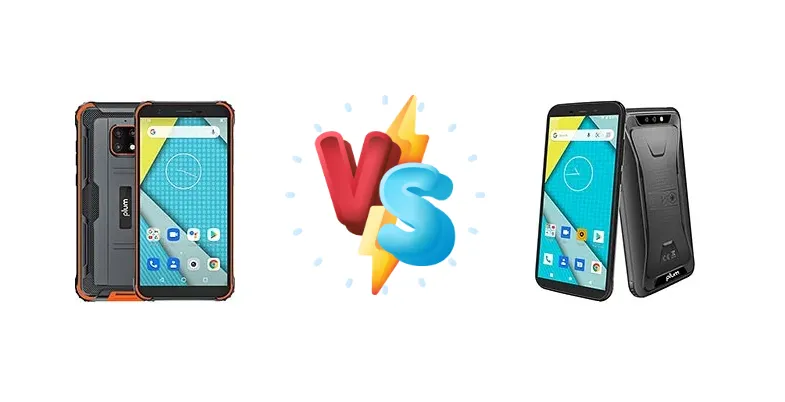
The Plum Gator series consistently targets the ultra-budget smartphone market. With the release of the Gator 7, the question arises: does the newer model offer a substantial enough upgrade over the established Gator 6 to justify the cost? This comparison dives deep into the core hardware differences, focusing on the impact of the chipset and CPU changes on everyday performance and efficiency.
🏆 Quick Verdict
For most users, the Plum Gator 7 represents a worthwhile upgrade. The newer Mediatek MT6761V chipset, built on a 14nm process, delivers noticeably improved performance and efficiency compared to the Gator 6’s older MT6580. While neither phone is a powerhouse, the Gator 7 offers a smoother experience for multitasking and app loading.
| Network |
|---|
| 2G bands | GSM 850 / 900 / 1800 / 1900 | GSM 850 / 900 / 1800 / 1900 |
| 3G bands | HSDPA 850 / 900 / 1700(AWS) / 1900 / 2100 | HSDPA 850 / 900 / 1700(AWS) / 1900 / 2100 |
| 4G bands | 2, 4, 5, 7, 12, 17, 25, 26, 28, 41, 66 | 2, 4, 5, 7, 12, 17, 25, 26, 28, 41, 66 |
| Speed | HSPA 42.2/5.76 Mbps, LTE (2CA) Cat13 400/150 Mbps | HSPA 42.2/5.76 Mbps, LTE (2CA) Cat13 400/150 Mbps |
| Technology | GSM / HSPA / LTE | GSM / HSPA / LTE |
| Launch |
|---|
| Announced | 2021, September 01. Released 2021, September 01 | 2020, February 01. Released 2020, March 01 |
| Status | Discontinued | Discontinued |
| Body |
|---|
| Build | Glass front (Dragontrail Glass), plastic frame, plastic back | - |
| Dimensions | 157.5 x 78.1 x 13.7 mm (6.20 x 3.07 x 0.54 in) | 152.2 x 75.5 x 14 mm (5.99 x 2.97 x 0.55 in) |
| SIM | Nano-SIM + Nano-SIM | Nano-SIM + Nano-SIM |
| Weight | 261 g (9.21 oz) | 225 g (7.94 oz) |
| | IP69 dust/water resistant (up to 1.5m for 35 min)
Drop-to-concrete resistance (up to 1.8m)
MIL-STD-810H compliant | IP68 dust/water resistant (up to 1.2m for 30 min)
Drop-to-concrete resistance (up to 1.8m) |
| Display |
|---|
| Protection | Dragontrail Glass | Corning Gorilla Glass 3 |
| Resolution | 720 x 1440 pixels, 18:9 ratio (~282 ppi density) | 720 x 1440 pixels, 18:9 ratio (~293 ppi density) |
| Size | 5.7 inches, 83.8 cm2 (~68.2% screen-to-body ratio) | 5.5 inches, 78.1 cm2 (~67.9% screen-to-body ratio) |
| Type | IPS LCD | IPS LCD |
| Platform |
|---|
| CPU | Quad-core 2.0 GHz Cortex-A53 | Quad-core 1.3 GHz Cortex-A7 |
| Chipset | Mediatek MT6761V/WE (14 nm) | Mediatek MT6580 (28 nm) |
| GPU | PowerVR GE8300 | Mali-400 MP2 |
| OS | Android 11 | Android 10 (Go edition) |
| Memory |
|---|
| Card slot | microSDXC (dedicated slot) | microSDXC |
| Internal | 32GB 3GB RAM | 16GB 3GB RAM |
| | eMMC 5.1 | eMMC 5.1 |
| Main Camera |
|---|
| Features | LED flash, panorama | LED flash |
| Single | 8 MP, AF | 8 MP, AF |
| Video | 1080p@30fps | 720p@30fps |
| Selfie camera |
|---|
| Single | 5 MP | 2 MP |
| Video | 720p@30fps | 480p@30fps |
| Sound |
|---|
| 3.5mm jack | Yes | Yes |
| 35mm jack | Yes | Yes |
| Loudspeaker | Yes | Yes |
| Comms |
|---|
| Bluetooth | 5.0, A2DP, LE | 4.0, A2DP, LE |
| NFC | Yes (market/region dependent) | No |
| Positioning | GPS, GLONASS, GALILEO, BDS | GPS |
| Radio | FM radio | FM radio |
| USB | microUSB 2.0, OTG | microUSB 2.0, OTG |
| WLAN | Wi-Fi 802.11 a/b/g/n/ac, dual-band, Wi-Fi Direct | Wi-Fi 802.11 b/g/n |
| Features |
|---|
| Sensors | Accelerometer, gyro, proximity, compass | Accelerometer, proximity, compass |
| Battery |
|---|
| Type | Li-Po 5580 mAh | Li-Po 4400 mAh |
| Misc |
|---|
| Colors | Black, Orange | Black, Yellow |
Plum Gator 7
- More powerful and efficient MT6761V chipset
- Improved CPU architecture (Cortex-A53)
- Potentially longer battery life due to 14nm process
- Likely higher price point than the Gator 6
- Still an entry-level device with limited performance
Plum Gator 6
- Lower price point
- Functional for basic smartphone tasks
- Simple and easy to use
- Outdated MT6580 chipset
- Slower performance and lower efficiency
- May struggle with modern app demands
Display Comparison
Context data does not provide display specifications. Given the target market, both devices likely feature LCD panels with 720p resolution. The Gator 7 may benefit from slightly improved color calibration due to the newer chipset’s image signal processor, but significant differences are unlikely. Bezels are expected to be substantial on both models.
Camera Comparison
Context data lacks camera details. Both phones likely feature basic camera setups, potentially with a 5MP or 8MP main sensor. Image quality will be heavily reliant on software processing, and the MT6761V in the Gator 7 may offer slightly better image processing capabilities. Any 2MP macro or depth sensors present on either device should be considered largely marketing features with minimal real-world benefit.
Performance
The core difference lies in the chipsets. The Plum Gator 7’s Mediatek MT6761V/WE (14nm) boasts a quad-core 2.0 GHz Cortex-A53 CPU, while the Gator 6 utilizes the older Mediatek MT6580 with a quad-core 1.3 GHz Cortex-A7 CPU. The 14nm fabrication process of the MT6761V is a significant advantage, offering improved power efficiency and allowing for higher sustained clock speeds. The Cortex-A53 architecture, while still entry-level, is a generation ahead of the Cortex-A7, resulting in approximately 20-30% better single-core performance. This translates to snappier app launches and smoother multitasking. The MT6761V also supports more modern connectivity options, potentially including faster Wi-Fi standards.
Battery Life
Battery capacity is not specified. However, the more efficient 14nm process of the MT6761V in the Gator 7 will likely result in longer battery life, even with a similar capacity battery to the Gator 6. The MT6761V also supports more efficient power management features, further extending runtime. Charging wattage is also unknown, but both devices are likely to ship with a 5W or 10W charger, resulting in relatively slow charging times.
Buying Guide
Buy the Plum Gator 7 if you prioritize responsiveness and future-proofing, even within the budget segment. Its more modern chipset will handle app updates and evolving software demands better. Buy the Plum Gator 6 if you are on the absolute tightest budget and only need a phone for basic tasks like calls, texts, and light web browsing. The Gator 6 remains functional, but its age shows in slower performance.
Frequently Asked Questions
❓ Will the Plum Gator 7 run popular apps like WhatsApp and Facebook smoothly?
Yes, the Plum Gator 7’s MT6761V chipset and Cortex-A53 CPU are sufficient to run apps like WhatsApp and Facebook without significant lag. While it won’t offer a high-end experience, it will provide a usable and responsive experience for these common applications.
❓ Is the difference in CPU clock speed (2.0 GHz vs 1.3 GHz) the only factor affecting performance?
No, the CPU clock speed is just one piece of the puzzle. The Cortex-A53 architecture in the Gator 7 is more efficient and capable than the Cortex-A7 in the Gator 6. Furthermore, the 14nm manufacturing process of the MT6761V allows it to maintain higher clock speeds for longer periods without overheating, resulting in sustained performance gains.
❓ Can I expect a noticeable improvement in gaming performance with the Plum Gator 7?
While neither phone is designed for gaming, the Plum Gator 7 will offer a slightly better gaming experience. The MT6761V’s GPU is more capable than the MT6580’s, allowing for playable frame rates in less demanding games. However, don’t expect to run graphically intensive titles smoothly.