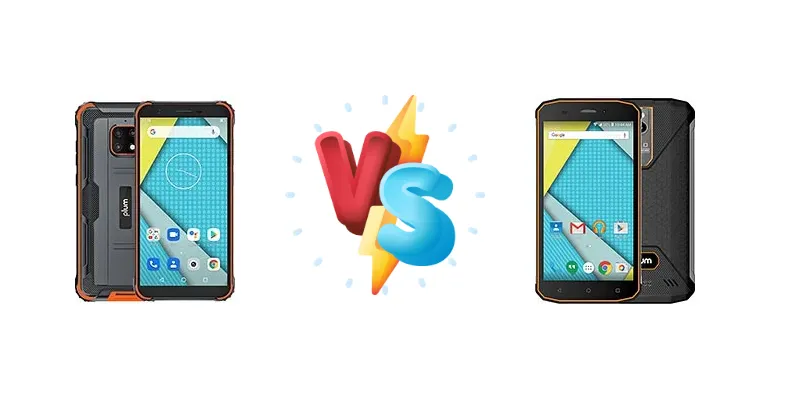
The Plum Gator series consistently targets the ultra-budget smartphone market. With the Gator 7 now available, the question arises: does the newer model offer a substantial enough upgrade over the established Gator 5 to justify the cost? This comparison dissects the key differences between these two devices, focusing on their chipsets and the resulting impact on user experience.
🏆 Quick Verdict
For most users, the Plum Gator 7 is the better choice. Its Mediatek MT6761V chipset, built on a 14nm process, provides a noticeable performance boost over the Gator 5’s older 28nm MT6580, translating to smoother multitasking and app loading. While neither phone is a powerhouse, the Gator 7 offers a more future-proof experience.
| Network |
|---|
| 2G bands | GSM 850 / 900 / 1800 / 1900 | GSM 850 / 900 / 1800 / 1900 |
| 3G bands | HSDPA 850 / 900 / 1700(AWS) / 1900 / 2100 | HSDPA 850 / 1900 / 2100 |
| 4G bands | 2, 4, 5, 7, 12, 17, 25, 26, 28, 41, 66 | - |
| Speed | HSPA 42.2/5.76 Mbps, LTE (2CA) Cat13 400/150 Mbps | HSPA 21.1/5.76 Mbps |
| Technology | GSM / HSPA / LTE | GSM / HSPA |
| Launch |
|---|
| Announced | 2021, September 01. Released 2021, September 01 | 2018, October. Released 2018, November |
| Status | Discontinued | Discontinued |
| Body |
|---|
| Build | Glass front (Dragontrail Glass), plastic frame, plastic back | - |
| Dimensions | 157.5 x 78.1 x 13.7 mm (6.20 x 3.07 x 0.54 in) | 148 x 76.3 x 12 mm (5.83 x 3.00 x 0.47 in) |
| SIM | Nano-SIM + Nano-SIM | Nano-SIM + Nano-SIM |
| Weight | 261 g (9.21 oz) | 210 g (7.41 oz) |
| | IP69 dust/water resistant (up to 1.5m for 35 min)
Drop-to-concrete resistance (up to 1.8m)
MIL-STD-810H compliant | IP68 dust/water resistant (up to 1.2m for 30 mins)
Drop-to-concrete resistance (up to 1.8m) |
| Display |
|---|
| Protection | Dragontrail Glass | Panda Glass |
| Resolution | 720 x 1440 pixels, 18:9 ratio (~282 ppi density) | 720 x 1280 pixels, 16:9 ratio (~282 ppi density) |
| Size | 5.7 inches, 83.8 cm2 (~68.2% screen-to-body ratio) | 5.2 inches, 74.5 cm2 (~66.0% screen-to-body ratio) |
| Type | IPS LCD | IPS LCD |
| Platform |
|---|
| CPU | Quad-core 2.0 GHz Cortex-A53 | Quad-core 1.3 GHz Cortex-A7 |
| Chipset | Mediatek MT6761V/WE (14 nm) | Mediatek MT6580 (28 nm) |
| GPU | PowerVR GE8300 | Mali-400MP2 |
| OS | Android 11 | Android 8.1 (Oreo) |
| Memory |
|---|
| Card slot | microSDXC (dedicated slot) | microSDXC |
| Internal | 32GB 3GB RAM | 16GB 2GB RAM |
| | eMMC 5.1 | - |
| Main Camera |
|---|
| Features | LED flash, panorama | LED flash |
| Single | 8 MP, AF | 13 MP, AF |
| Video | 1080p@30fps | 720p@30fps |
| Selfie camera |
|---|
| Single | 5 MP | 5 MP |
| Video | 720p@30fps | 480p@30fps |
| Sound |
|---|
| 3.5mm jack | Yes | Yes |
| 35mm jack | Yes | Yes |
| Loudspeaker | Yes | Yes |
| Comms |
|---|
| Bluetooth | 5.0, A2DP, LE | 4.0, A2DP |
| NFC | Yes (market/region dependent) | No |
| Positioning | GPS, GLONASS, GALILEO, BDS | GPS |
| Radio | FM radio | FM radio |
| USB | microUSB 2.0, OTG | microUSB 2.0 |
| WLAN | Wi-Fi 802.11 a/b/g/n/ac, dual-band, Wi-Fi Direct | Wi-Fi 802.11 b/g/n, Wi-Fi Direct |
| Features |
|---|
| Sensors | Accelerometer, gyro, proximity, compass | Accelerometer, proximity |
| Battery |
|---|
| Stand-by | - | Up to 528 h (3G) |
| Talk time | - | Up to 46 h (3G) |
| Type | Li-Po 5580 mAh | Li-Ion 3700 mAh, non-removable |
| Misc |
|---|
| Colors | Black, Orange | Black, Orange |
Plum Gator 7
- More powerful and efficient processor (MT6761V)
- Improved multitasking capabilities
- Potentially longer battery life
- Likely a slightly higher price point
- Still an entry-level device with limited overall performance
Plum Gator 5
- Lower price point
- Functional for basic tasks (calls, texts)
- Simple and straightforward user experience
- Older and less efficient processor (MT6580)
- Slower app loading and multitasking
- Limited future-proofing
Display Comparison
Both devices likely feature similar low-resolution displays typical of this price bracket, but the chipset differences don't directly impact display quality. We can assume both will be LCD panels. The focus here is on the processing power needed to drive the UI and apps *displayed* on those screens, where the Gator 7 has a clear advantage.
Camera Comparison
Given the price point, camera performance is unlikely to be a differentiating factor. Both phones likely feature basic camera sensors. Without specific sensor details, it’s safe to assume image quality will be similar, with limited low-light performance and detail. The MT6761V’s image signal processor (ISP) *may* offer slightly better noise reduction, but this is speculative without further data.
Performance
The core difference lies in the chipsets. The Plum Gator 7’s Mediatek MT6761V/WE (14nm) features a quad-core 2.0 GHz Cortex-A53 CPU, while the Gator 5 utilizes the older Mediatek MT6580 (28nm) with a quad-core 1.3 GHz Cortex-A7 CPU. The 14nm process node of the MT6761V is significantly more efficient than the 28nm node of the MT6580, meaning the Gator 7 will generate less heat and potentially sustain higher performance for longer periods. Furthermore, the Cortex-A53 cores in the Gator 7 are architecturally more advanced than the Cortex-A7 cores in the Gator 5, offering improved instructions per clock cycle. This translates to faster app launches, smoother scrolling, and a more responsive overall experience.
Battery Life
While battery capacity isn't specified, the MT6761V’s improved power efficiency on a 14nm process will likely result in longer battery life for the Plum Gator 7, even if both phones have similar battery sizes. The Gator 7’s more efficient chipset means less power is consumed during everyday tasks, extending usage between charges. Charging speeds are also likely to be similar, given the budget nature of both devices.
Buying Guide
Buy the Plum Gator 7 if you prioritize responsiveness and a slightly more modern software experience, even if it means spending a bit more. It’s ideal for users who occasionally use social media, browse the web, and need a phone that won’t struggle with basic tasks. Buy the Plum Gator 5 if your needs are extremely basic – calls, texts, and very light app usage – and you’re looking for the absolute cheapest possible option. It’s a functional device for those on the tightest of budgets.
Frequently Asked Questions
❓ Will the Plum Gator 7 handle popular social media apps like Facebook and Instagram without significant lag?
Yes, the Plum Gator 7’s MT6761V chipset is significantly more capable than the Gator 5’s MT6580. While it won’t offer a flagship-level experience, it should handle Facebook, Instagram, and similar apps with acceptable performance, especially with a limited number of apps open simultaneously.
❓ Is the performance difference between the two phones noticeable for everyday tasks like making calls and sending texts?
For basic tasks like calls and texts, the difference will be minimal. However, the Gator 7 will feel more responsive when switching between apps or opening new ones. The MT6761V’s faster processor and more efficient architecture provide a smoother overall experience, even for simple tasks.
❓ Can the Plum Gator 7 run any modern mobile games?
The Plum Gator 7 can run some less demanding mobile games, but don't expect high frame rates or detailed graphics. The MT6761V is not a gaming chipset. Expect to play simpler titles or older games at lower settings. The Gator 5 would struggle even more with gaming.