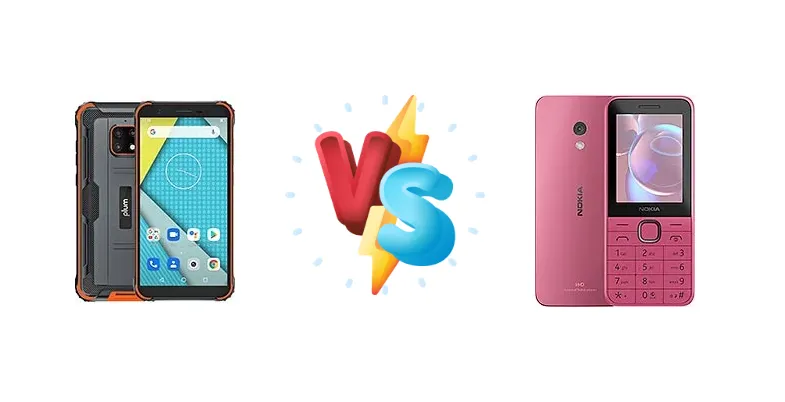
The Plum Gator 7 and Nokia 225 4G (2024) represent opposite ends of the entry-level smartphone spectrum. The Gator 7 aims to deliver a smartphone experience at a minimal cost, while the Nokia 225 4G leans towards a more traditional feature phone experience with 4G connectivity. This comparison dissects their core hardware to determine which device best suits users prioritizing performance versus simplicity and battery life.
🏆 Quick Verdict
For users needing basic smartphone functionality like app usage and occasional web browsing, the Plum Gator 7 is the clear winner. Its Mediatek MT6761V chipset, despite being older, offers significantly more processing power than the Unisoc T107 in the Nokia 225 4G, making it a more versatile device.
| Network |
|---|
| 2G bands | GSM 850 / 900 / 1800 / 1900 | GSM 850 / 900 / 1800 / 1900 |
| 3G bands | HSDPA 850 / 900 / 1700(AWS) / 1900 / 2100 | HSDPA 850 / 900 / 2100 |
| 4G bands | 2, 4, 5, 7, 12, 17, 25, 26, 28, 41, 66 | 1, 3, 5, 7, 8, 20, 28, 38, 40, 41 - EU, EMEA, APAC |
| Speed | HSPA 42.2/5.76 Mbps, LTE (2CA) Cat13 400/150 Mbps | HSPA, LTE |
| Technology | GSM / HSPA / LTE | GSM / HSPA / LTE |
| Launch |
|---|
| Announced | 2021, September 01. Released 2021, September 01 | 2024, April 30 |
| Status | Discontinued | Available. Released 2024, May |
| Body |
|---|
| Build | Glass front (Dragontrail Glass), plastic frame, plastic back | - |
| Dimensions | 157.5 x 78.1 x 13.7 mm (6.20 x 3.07 x 0.54 in) | 121.5 x 52 x 11.6 mm (4.78 x 2.05 x 0.46 in) |
| SIM | Nano-SIM + Nano-SIM | Nano-SIM + Nano-SIM |
| Weight | 261 g (9.21 oz) | - |
| | IP69 dust/water resistant (up to 1.5m for 35 min)
Drop-to-concrete resistance (up to 1.8m)
MIL-STD-810H compliant | - |
| Display |
|---|
| Protection | Dragontrail Glass | - |
| Resolution | 720 x 1440 pixels, 18:9 ratio (~282 ppi density) | 240 x 320 pixels, 4:3 ratio (~167 ppi density) |
| Size | 5.7 inches, 83.8 cm2 (~68.2% screen-to-body ratio) | 2.4 inches, 17.8 cm2 (~28.2% screen-to-body ratio) |
| Type | IPS LCD | TFT LCD |
| Platform |
|---|
| CPU | Quad-core 2.0 GHz Cortex-A53 | 1.0 GHz Cortex-A7 |
| Chipset | Mediatek MT6761V/WE (14 nm) | Unisoc T107 (22 nm) |
| GPU | PowerVR GE8300 | - |
| OS | Android 11 | - |
| Memory |
|---|
| Call records | - | Yes |
| Card slot | microSDXC (dedicated slot) | microSDHC |
| Internal | 32GB 3GB RAM | 128MB 64MB RAM |
| Phonebook | - | Yes |
| | eMMC 5.1 | - |
| Main Camera |
|---|
| Features | LED flash, panorama | LED flash |
| Single | 8 MP, AF | 0.3 MP |
| Video | 1080p@30fps | Yes |
| Selfie camera |
|---|
| Single | 5 MP | - |
| Video | 720p@30fps | - |
| Sound |
|---|
| 3.5mm jack | Yes | - |
| 35mm jack | Yes | Yes |
| Loudspeaker | Yes | Yes |
| Comms |
|---|
| Bluetooth | 5.0, A2DP, LE | 5.0, A2DP, LE |
| NFC | Yes (market/region dependent) | No |
| Positioning | GPS, GLONASS, GALILEO, BDS | No |
| Radio | FM radio | Wireless FM radio |
| USB | microUSB 2.0, OTG | USB Type-C |
| WLAN | Wi-Fi 802.11 a/b/g/n/ac, dual-band, Wi-Fi Direct | No |
| Features |
|---|
| Games | - | Yes |
| Java | - | No |
| Messaging | - | SMS |
| Sensors | Accelerometer, gyro, proximity, compass | No |
| Battery |
|---|
| Type | Li-Po 5580 mAh | Li-Ion 1450 mAh, removable |
| Misc |
|---|
| Colors | Black, Orange | Pink, Dark Blue |
Plum Gator 7
- Significantly more powerful processor for app usage.
- Larger display for better usability.
- Smartphone functionality with access to apps.
- Likely shorter battery life.
- Potentially lower build quality due to price point.
Nokia 225 4G (2024)
- Exceptional battery life.
- Simple and easy-to-use interface.
- Durable and reliable for basic communication.
- Very limited processing power.
- Limited functionality – not a full smartphone experience.
Display Comparison
Neither device boasts a standout display. Given the context data focuses on processing power, we can infer both likely utilize basic LCD panels. The Nokia 225 4G, being a feature phone hybrid, will likely have a smaller screen with lower resolution. The Gator 7, aiming for smartphone functionality, will likely have a larger display, but neither is expected to offer high brightness or color accuracy. The difference will be in usability for app interfaces, favoring the Gator 7.
Camera Comparison
Without specific camera specs, it’s safe to assume both devices feature basic cameras suitable for casual snapshots. Given the price point, image quality will likely be limited, especially in low-light conditions. The Gator 7, as a smartphone, is more likely to have a rear camera with at least 5MP resolution, while the Nokia 225 4G may have a VGA or 2MP sensor. Image processing capabilities will be minimal on both devices.
Performance
The core difference lies in the chipsets. The Plum Gator 7’s Mediatek MT6761V/WE (14nm) features a quad-core 2.0 GHz Cortex-A53 CPU. This is a significantly more powerful configuration than the Nokia 225 4G’s Unisoc T107 (22nm) with its single-core 1.0 GHz Cortex-A7 CPU. The 14nm process node of the MT6761V is more efficient than the 22nm node of the T107, suggesting better thermal management and potentially longer sustained performance. The Cortex-A53 cores are also architecturally superior to the Cortex-A7, offering better instruction throughput. This translates to faster app loading times, smoother multitasking, and a more responsive user experience on the Gator 7.
Battery Life
The Unisoc T107’s lower power consumption, coupled with a likely smaller display, will give the Nokia 225 4G a significant battery life advantage. While the Gator 7’s 14nm chipset is more efficient than the T107’s 22nm, the higher processing power demands will drain the battery faster. The Nokia 225 4G is likely to offer days of standby time and several hours of talk time, while the Gator 7 will likely require daily charging with moderate use. Charging wattage is unknown for both, but likely to be slow.
Buying Guide
Buy the Plum Gator 7 if you need a device capable of running apps, browsing the internet, and handling light multitasking. It’s suited for users who want a smartphone experience, even on a tight budget. Buy the Nokia 225 4G (2024) if you prioritize long battery life, a simple user interface, and reliable call quality, and primarily need a device for communication and minimal data usage. It’s ideal for those seeking a durable and easy-to-use phone.
Frequently Asked Questions
❓ Will the Plum Gator 7 be able to run popular social media apps like Facebook and WhatsApp smoothly?
The Mediatek MT6761V chipset should be capable of running Facebook and WhatsApp, but performance may be sluggish with multiple apps open or during heavy usage. Expect some loading times and occasional lag. It's sufficient for basic social media interaction, but not ideal for intensive use.
❓ Is the Nokia 225 4G (2024) a good option for someone who primarily needs a phone for calls and texts?
Absolutely. The Nokia 225 4G excels as a communication device. Its long battery life and reliable call quality make it an excellent choice for users who prioritize these features over smartphone functionality. The 4G connectivity ensures clear voice calls and basic data access.
❓ Can I play games on the Plum Gator 7?
Simple, less demanding games are playable on the Plum Gator 7, but don't expect a smooth experience with graphically intensive titles. The MT6761V's GPU is entry-level and will struggle with modern games. Stick to older or simpler games for the best results.
❓ Does the Nokia 225 4G support Wi-Fi?
Yes, the Nokia 225 4G (2024) does support Wi-Fi, allowing you to connect to wireless networks for data access, even without a SIM card. This is a useful feature for conserving mobile data.