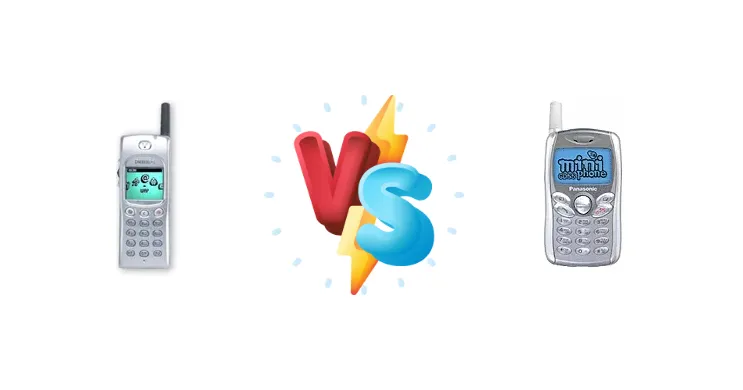
The late 1990s marked a pivotal moment in mobile communication. The Philips Xenium 9@9 and Panasonic GD55 represent two distinct approaches to this burgeoning technology, both aiming to deliver functionality and portability in a rapidly evolving market. This comparison examines these early digital cellular phones, focusing on their design, features, and lasting impact.
🏆 Quick Verdict
For the collector or enthusiast interested in early GSM technology, the Panasonic GD55 edges out the Philips Xenium 9@9 due to its more compact design and innovative features for its time. However, both phones are significant artifacts of mobile history.
| Network |
|---|
| 2G bands | GSM 900 / 1800 | GSM 900 / 1800 / 1900 |
| EDGE | No | No |
| GPRS | No | No |
| Technology | GSM | GSM |
| Launch |
|---|
| Announced | 2000 | 2002, Oct |
| Status | Discontinued | Discontinued |
| Body |
|---|
| Dimensions | 109 x 41 x 22 mm, 85 cc (4.29 x 1.61 x 0.87 in) | 77 x 43 x 17 mm, 51 cc (3.03 x 1.69 x 0.67 in) |
| SIM | Mini-SIM | Mini-SIM |
| Weight | 95 g (3.35 oz) | 65 g (2.29 oz) |
| Display |
|---|
| Resolution | 5 lines | 112 x 64 pixels, 16:9 ratio |
| Type | Monochrome graphic | Graphics |
| | - | Blue backlight
20 wallpapers
CallerID graphics |
| Memory |
|---|
| Call records | 10 dialed, 10 received, 10 missed calls | 20 dialed, 10 received, 10 missed calls |
| Card slot | No | No |
| Phonebook | - | 250 |
| | - | Message templates
100 calendar events |
| Sound |
|---|
| 3.5mm jack | - | No |
| 35mm jack | No | No |
| Alert types | Vibration; Monophonic ringtones, composer | Vibration; Polyphonic ringtones, composer |
| Loudspeaker | No | No |
| Comms |
|---|
| Bluetooth | No | No |
| Positioning | No | No |
| Radio | No | No |
| WLAN | No | No |
| Features |
|---|
| Alarm | Yes | Yes |
| Browser | WAP | WAP 1.2.1 |
| Clock | Yes | Yes |
| Games | Bricks | 1 |
| Java | No | No |
| Messaging | SMS | SMS, EMS |
| | - | Predictive text input
Organizer |
| Battery |
|---|
| Stand-by | up to 600 h | Up to 230 h |
| Talk time | 3 - 7 h | Up to 8 h |
| Type | Removable Li-Ion battery | Removable Li-Ion 720 mAh battery |
| Misc |
|---|
| Colors | 4 | 3 - Silver, Red, Pink |
Philips Xenium 9@9
- Potentially longer battery life due to Xenium branding.
- Larger form factor may be easier to handle for some users.
- Represents Philips' commitment to mobile endurance.
- Larger size makes it less pocketable.
- Likely heavier than the GD55.
- Limited features compared to later models.
Panasonic GD55
- More compact and pocketable design.
- Early adoption of data capabilities (CSD).
- Innovative design for its time.
- Potentially shorter battery life.
- Smaller screen may be less comfortable for some users.
- Limited feature set.
Display Comparison
Given the era, both the Philips Xenium 9@9 and Panasonic GD55 utilized monochrome LCD screens. The GD55, being a more compact device, likely featured a smaller screen size, potentially around 1.5-2 inches, while the Xenium 9@9 may have had a slightly larger display. Resolution would have been limited, likely to around 100x64 pixels. The GD55’s smaller size suggests a higher pixel density, potentially offering a marginally sharper image, though the difference would be minimal to the human eye. Backlighting technology would have been crucial, and the efficiency of this backlighting would have directly impacted battery life.
Camera Comparison
Neither the Philips Xenium 9@9 nor the Panasonic GD55 featured a built-in camera. Cameras in mobile phones were still several years away. The focus was entirely on voice communication and basic data services. Any image capture would have required external accessories, which were uncommon at the time.
Performance
Both phones operated on the 900/1800 MHz GSM bands, representing the standard for Europe and many other regions at the time. Processing power was limited to handling basic call functions, SMS messaging, and rudimentary contact management. The GD55’s inclusion of data capabilities (likely CSD) suggests a slightly more advanced chipset capable of handling basic data transmission, though speeds would have been extremely slow by modern standards. The Xenium 9@9, focusing on talk time, likely prioritized power efficiency over data processing capabilities.
Battery Life
The Philips Xenium line was known for its extended battery life. While specific mAh ratings are unavailable, the Xenium 9@9 likely featured a larger battery capacity than the GD55 to support its branding. The GD55, prioritizing compactness, would have had a smaller battery. However, the GD55’s potentially more efficient chipset and smaller screen could partially offset the capacity difference. Charging times would have been significant, likely several hours, using a proprietary charger.
Buying Guide
Buy the Philips Xenium 9@9 if you prioritize a larger form factor and potentially longer battery life (given Philips' Xenium branding focused on endurance). Buy the Panasonic GD55 if you prefer a more pocketable design and appreciate early attempts at miniaturization and feature integration in a mobile phone.
Frequently Asked Questions
❓ What kind of network connectivity did the Panasonic GD55 offer beyond standard GSM voice calls?
The Panasonic GD55 supported CSD (Circuit Switched Data), allowing for very slow data transmission for services like SMS and basic internet access. This was a relatively advanced feature for a phone of its era, but speeds were significantly slower than modern mobile data connections.
❓ How did the Philips Xenium 9@9 live up to its 'Xenium' branding regarding battery life?
Philips' Xenium line focused on maximizing talk time and standby time. The 9@9 likely achieved this through a larger battery capacity and potentially a more power-efficient chipset, prioritizing voice communication over advanced features. While specific numbers are unavailable, it would have offered a competitive battery life for its time.
❓ Are these phones still functional on modern cellular networks?
No. These phones operate on 900/1800 MHz GSM, and many modern networks have been upgraded to 3G, 4G, or 5G, rendering them incompatible. Even if a 2G network is still active, compatibility isn't guaranteed due to evolving security protocols.