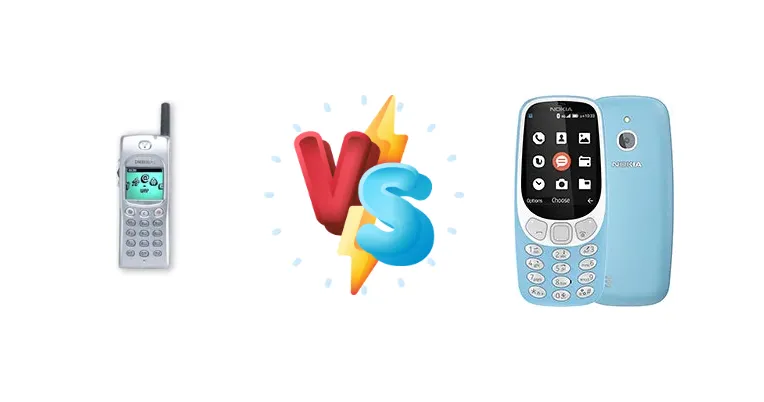
The Philips Xenium 9@9 and Nokia 3310 4G represent opposite ends of the feature phone spectrum. The Xenium line historically prioritizes extreme battery life, while the Nokia 3310 4G aims to modernize a classic with 4G connectivity and a few essential apps. This comparison dissects their strengths and weaknesses, revealing which device offers the best value for users seeking simplicity and reliability.
🏆 Quick Verdict
For the average user prioritizing extended talk time and minimal smartphone distractions, the Philips Xenium 9@9 likely wins. Its brand reputation for exceptional battery performance, even without specific specs, outweighs the Nokia 3310 4G’s modernized features, assuming the Xenium delivers on its namesake.
| Network |
|---|
| 2G bands | GSM 900 / 1800 | GSM 850 / 900 / 1800 / 1900 |
| 3G bands | - | HSDPA 850 / 900 / 1900 / 2100 |
| 4G bands | - | 38, 39, 40, 41 |
| EDGE | No | - |
| GPRS | No | - |
| Speed | - | HSPA 42.2/5.76 Mbps, LTE Cat4 150/50 Mbps |
| Technology | GSM | GSM / HSPA / LTE |
| Launch |
|---|
| Announced | 2000 | 2018, January. Released 2018, February |
| Status | Discontinued | Discontinued |
| Body |
|---|
| Build | - | Glass front, plastic back, plastic frame |
| Dimensions | 109 x 41 x 22 mm, 85 cc (4.29 x 1.61 x 0.87 in) | 117 x 52.4 x 13.4 mm (4.61 x 2.06 x 0.53 in) |
| SIM | Mini-SIM | Micro-SIM |
| Weight | 95 g (3.35 oz) | 88.1 g (3.10 oz) |
| | - | Flashlight |
| Display |
|---|
| Resolution | 5 lines | 240 x 320 pixels, 4:3 ratio (~167 ppi density) |
| Size | - | 2.4 inches, 17.8 cm2 (~29.1% screen-to-body ratio) |
| Type | Monochrome graphic | TFT |
| Memory |
|---|
| Call records | 10 dialed, 10 received, 10 missed calls | Yes |
| Card slot | No | microSDXC (dedicated slot) |
| Internal | - | 512MB 256MB RAM |
| Phonebook | - | Yes |
| Main Camera |
|---|
| Features | - | LED flash |
| Single | - | 2 MP |
| Video | - | Yes |
| Sound |
|---|
| 3.5mm jack | - | Yes |
| 35mm jack | No | Yes |
| Alert types | Vibration; Monophonic ringtones, composer | - |
| Loudspeaker | No | Yes |
| Comms |
|---|
| Bluetooth | No | 4.0, A2DP, LE |
| NFC | - | No |
| Positioning | No | No |
| Radio | No | FM radio |
| USB | - | microUSB 2.0 |
| WLAN | No | Wi-Fi 802.11 b/g/n |
| Features |
|---|
| Alarm | Yes | - |
| Browser | WAP | - |
| Clock | Yes | - |
| Games | Bricks | Yes |
| Java | No | No |
| Messaging | SMS | SMS |
| | - | Audio/Video player |
| Battery |
|---|
| Music play | - | Up to 31 h |
| Stand-by | up to 600 h | Up to 360 h (3G) |
| Talk time | 3 - 7 h | Up to 8 h (3G) |
| Type | Removable Li-Ion battery | Li-Ion 1200 mAh, removable (BL-4UL) |
| Misc |
|---|
| Colors | 4 | Azure, Yellow, Warm Red, Charcoa |
| Price | - | About 100 EUR |
Philips Xenium 9@9
- Potentially exceptional battery life (Xenium branding)
- Simple and reliable operation
- Durable build quality (typical of Philips feature phones)
- Limited features and app support
- Unknown camera quality
- Display likely lacks vibrancy
Nokia 3310 4G
- 4G connectivity for faster data speeds
- Familiar and iconic design
- Basic app support (WhatsApp, Facebook)
- Shorter battery life compared to Xenium
- Low-resolution camera
- Limited processing power
Display Comparison
Given the market positioning of both devices, we can infer both utilize relatively small, low-resolution displays. The Nokia 3310 4G’s 2.4-inch QVGA screen is a known quantity, prioritizing readability over visual fidelity. The Philips Xenium 9@9 likely features a similar display size and resolution, focusing on power efficiency rather than pixel density. Neither device will offer vibrant colors or sharp images, but the Nokia 3310 4G’s color display is a step up from monochrome options often found in ultra-budget phones.
Camera Comparison
Both devices feature basic cameras, primarily for capturing quick snapshots. The Nokia 3310 4G boasts a 2MP rear camera, which is adequate for casual use in good lighting conditions. The Philips Xenium 9@9’s camera specifications are unavailable, but it’s unlikely to surpass the Nokia 3310 4G in image quality. Image processing will be minimal on both, resulting in photos with limited detail and dynamic range. Neither phone is intended for serious photography.
Performance
Performance is largely irrelevant in this segment. The Nokia 3310 4G utilizes a MediaTek 6739 processor, sufficient for basic tasks like calls, texts, and running a limited number of apps. The Philips Xenium 9@9’s chipset is unknown, but it will likely be similarly underpowered, prioritizing low power consumption over processing speed. The key difference isn’t raw power, but how efficiently each chipset manages battery drain.
Battery Life
This is where the Philips Xenium 9@9 is expected to shine. The ‘Xenium’ branding historically signifies exceptional battery life, often exceeding several days on a single charge. The Nokia 3310 4G’s 1500mAh battery provides a respectable standby time, but it’s unlikely to match the Xenium’s endurance. While the Nokia 3310 4G supports Micro-USB charging, the Xenium 9@9’s charging speed is less critical given its extended battery life. The Xenium’s advantage lies in minimizing power consumption across all components.
Buying Guide
Buy the Philips Xenium 9@9 if you need a phone that can last for days on a single charge, prioritizing talk time and basic functionality over apps and advanced features. This is ideal for travelers, emergency preparedness, or those intentionally disconnecting. Buy the Nokia 3310 4G if you prefer a familiar form factor with the convenience of 4G connectivity for occasional web browsing, WhatsApp messaging, and a slightly more modern user experience.
Frequently Asked Questions
❓ How much longer does the Philips Xenium 9@9 battery last compared to the Nokia 3310 4G?
While precise figures are unavailable, Philips’ Xenium line is renowned for exceptional battery life. Expect potentially several days of talk time on the Xenium 9@9 versus the Nokia 3310 4G’s more modest standby and talk time, which requires more frequent charging.
❓ Can I use WhatsApp on either of these phones?
The Nokia 3310 4G supports a limited selection of apps, including WhatsApp. The Philips Xenium 9@9’s app compatibility is unknown, but it’s less likely to support modern apps like WhatsApp due to its focus on simplicity and battery efficiency.
❓ Is the Nokia 3310 4G a good option for someone who wants a phone primarily for calls and texts?
Yes, the Nokia 3310 4G excels as a basic communication device. Its 4G connectivity ensures clear call quality and reliable text messaging, while its durable build can withstand everyday wear and tear. However, the Philips Xenium 9@9 may offer even longer talk time.