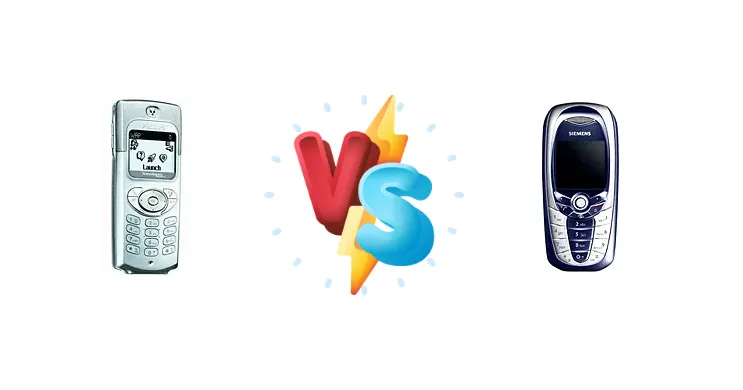
Comparing the Philips Xenium 9@9 ++ and the Siemens C65 isn't about raw specs; it's about contrasting philosophies. The Xenium prioritized extreme battery life, a response to limited infrastructure, while the Siemens C65 represented a more refined, early digital experience focused on usability and a premium feel. Both phones emerged during a pivotal time in mobile technology, before smartphones dominated the landscape.
🏆 Quick Verdict
For the collector or someone seeking a truly long-lasting, no-frills device, the Philips Xenium 9@9 ++ likely wins. Its legendary battery life overshadows the Siemens C65’s more polished user experience. However, the C65’s build quality and early adoption of digital features make it a more desirable piece of mobile history for many.
| Network |
|---|
| 2G bands | GSM 900 / 1800 | GSM 900 / 1800 / 1900 |
| EDGE | No | No |
| GPRS | Class 10 | Class 10 |
| Technology | GSM | GSM |
| | - | GSM 850 / 1800 / 1900 - Siemens C66 |
| Launch |
|---|
| Announced | 2003, Q2 | 2004, March |
| Status | Discontinued | Discontinued |
| Body |
|---|
| Dimensions | 108 x 44 x 20 mm, 82 cc (4.25 x 1.73 x 0.79 in) | 105 x 45 x 16 mm, 76 cc (4.13 x 1.77 x 0.63 in) |
| SIM | Mini-SIM | Mini-SIM |
| Weight | 93 g (3.28 oz) | 86 g (3.03 oz) |
| Display |
|---|
| Resolution | 101 x 80 pixels, 8 lines | 130 x 130 pixels, 1:1 ratio |
| Type | Monochrome graphic | CSTN, 65K colors |
| | - | Download assistant for logos |
| Memory |
|---|
| Call records | 30 received, dialed and missed calls | 100 dialed, 100 received, 100 missed calls |
| Card slot | No | No |
| Internal | - | 10MB |
| Phonebook | 500 x 5 fields, Photo call | 14 fields, in shared memory |
| Main Camera |
|---|
| Single | - | CIF |
| Video | - | No |
| Sound |
|---|
| 3.5mm jack | - | No |
| 35mm jack | No | No |
| Alert types | Vibration; Downloadable polyphonic ringtones | Vibration; Downloadable polyphonic ringtones |
| Loudspeaker | Yes | Yes |
| Comms |
|---|
| Bluetooth | No | No |
| Infrared port | - | Yes |
| Positioning | No | No |
| Radio | No | No |
| USB | Proprietary | Proprietary |
| WLAN | No | No |
| Features |
|---|
| Alarm | Yes | - |
| Browser | WAP 1.2.1 | WAP 2.0/xHTML |
| Clock | Yes | - |
| Games | Yes | Photopet + downloadable |
| Java | No | Yes, MIDP 2.0 |
| Languages | English, Bahasa, Chinese, Thai | - |
| Messaging | SMS, EMS 4.0, Email | SMS, EMS, MMS |
| | - | Predictive text input
Stopwatch
Organizer
SyncML
Clip-it covers |
| Battery |
|---|
| Stand-by | Up to 810 h | Up to 250 h |
| Talk time | Up to 7 h 30 min | Up to 6 h |
| Type | Removable Li-Ion 850 mAh battery | Removable Li-Ion 600 mAh battery (EBA-670) |
| Misc |
|---|
| Colors | Graphite and Silver | Blue Shadow |
Philips Xenium 9@9 ++
- Unrivaled battery life – potentially weeks on a single charge.
- Robust and durable construction, designed for longevity.
- Simple and reliable operation, focused on core functionality.
- Limited features compared to contemporary devices.
- Basic display with low resolution.
- Bulky and heavy design due to large battery.
Siemens C65
- More refined user interface and menu system.
- Sleek and aesthetically pleasing design.
- Early adoption of digital features like customizable ringtones.
- Significantly shorter battery life than the Xenium 9@9 ++.
- Less durable construction compared to the Xenium.
- Limited storage capacity for contacts and messages.
Display Comparison
Given the era, both phones feature small, monochrome displays. The Philips Xenium 9@9 ++ likely prioritized maximizing battery life, potentially resulting in a dimmer display compared to the Siemens C65. The C65, being a slightly more premium offering, may have employed a higher-contrast display for improved readability, though resolution would have been limited on both. Bezels were substantial on both devices, dictated by the technology of the time.
Camera Comparison
Neither phone features a camera. Cameras were still a luxury feature in the early 2000s, reserved for higher-end devices. The absence of a camera contributes to the exceptional battery life of the Xenium 9@9 ++, as image sensors and processing consume significant power.
Performance
Performance is a misnomer here. Both phones rely on basic chipsets designed for voice calls and SMS. The Siemens C65, however, likely benefited from slightly more processing power to handle its more advanced menu system and features like rudimentary games. The Xenium’s chipset was optimized for power efficiency, sacrificing processing speed. RAM capacity would have been minimal on both, sufficient only for basic operation.
Battery Life
This is where the Philips Xenium 9@9 ++ truly shines. The '9@9' designation hints at an extraordinary battery capacity, likely significantly larger than the Siemens C65’s. The Xenium was specifically engineered for extended standby and talk time, potentially lasting for weeks on a single charge. The C65, while offering respectable battery life for its time, would have required charging every few days with moderate use. Charging times would have been slow on both, utilizing proprietary chargers.
Buying Guide
Buy the Philips Xenium 9@9 ++ if you need a phone that can genuinely last for days on a single charge, prioritizing longevity and basic communication above all else. It’s ideal for emergency use or situations where access to power is limited. Buy the Siemens C65 if you prefer a more refined, aesthetically pleasing device with early digital features like a customizable interface and a more robust build, representing a step up from basic Nokia models of the time.
Frequently Asked Questions
❓ Is the Philips Xenium 9@9 ++ still functional with modern networks?
The Philips Xenium 9@9 ++ was designed for 2G networks. While 2G is still active in some regions, compatibility is diminishing. It may not function reliably, or at all, in areas where 2G has been decommissioned. The Siemens C65 faces the same limitations.
❓ Can I find replacement batteries for either the Philips Xenium 9@9 ++ or the Siemens C65?
Finding original replacement batteries can be challenging. Third-party batteries may be available, but their quality and performance are often inconsistent. The Xenium’s unique battery size makes finding a suitable replacement particularly difficult.
❓ What kind of connectivity options did the Siemens C65 offer beyond basic cellular?
The Siemens C65 primarily relied on SMS messaging. It may have included basic data capabilities via CSD (Circuit Switched Data), but speeds were extremely slow and limited to text-based services. It lacked Bluetooth or infrared connectivity found on some contemporary devices.
❓ How does the build quality of the Siemens C65 compare to other phones of its era, like early Nokia models?
The Siemens C65 generally offered a more premium build quality than many early Nokia models. It utilized more robust plastics and a more refined design aesthetic, reflecting Siemens’ focus on engineering and quality. However, it still couldn't match the tank-like durability of some later Nokia devices.