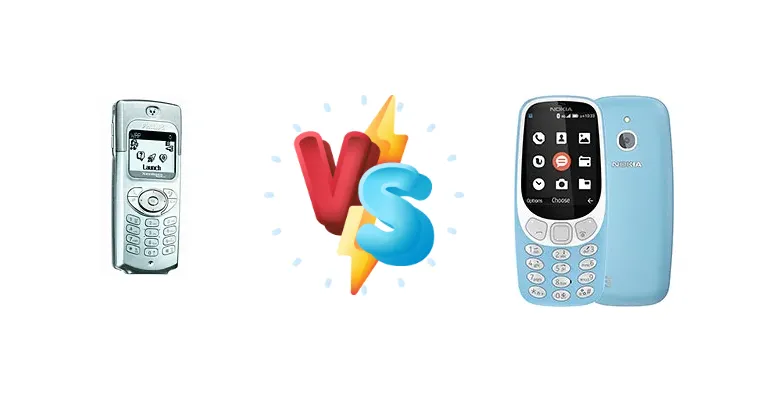
The Philips Xenium 9@9 ++ and Nokia 3310 4G represent opposite ends of the mobile phone spectrum. The Xenium, historically, focuses on extreme battery life, while the Nokia 3310 4G aims to modernize a classic with essential 4G connectivity. This comparison dissects their strengths and weaknesses, acknowledging the limited publicly available specifications for the Xenium model.
🏆 Quick Verdict
For the average user prioritizing simplicity and reliable connectivity, the Nokia 3310 4G emerges as the more practical choice. While the Philips Xenium 9@9 ++ likely excels in battery longevity – a hallmark of the Xenium line – the Nokia 3310 4G offers a functional smartphone-lite experience with readily available information.
| Network |
|---|
| 2G bands | GSM 900 / 1800 | GSM 850 / 900 / 1800 / 1900 |
| 3G bands | - | HSDPA 850 / 900 / 1900 / 2100 |
| 4G bands | - | 38, 39, 40, 41 |
| EDGE | No | - |
| GPRS | Class 10 | - |
| Speed | - | HSPA 42.2/5.76 Mbps, LTE Cat4 150/50 Mbps |
| Technology | GSM | GSM / HSPA / LTE |
| Launch |
|---|
| Announced | 2003, Q2 | 2018, January. Released 2018, February |
| Status | Discontinued | Discontinued |
| Body |
|---|
| Build | - | Glass front, plastic back, plastic frame |
| Dimensions | 108 x 44 x 20 mm, 82 cc (4.25 x 1.73 x 0.79 in) | 117 x 52.4 x 13.4 mm (4.61 x 2.06 x 0.53 in) |
| SIM | Mini-SIM | Micro-SIM |
| Weight | 93 g (3.28 oz) | 88.1 g (3.10 oz) |
| | - | Flashlight |
| Display |
|---|
| Resolution | 101 x 80 pixels, 8 lines | 240 x 320 pixels, 4:3 ratio (~167 ppi density) |
| Size | - | 2.4 inches, 17.8 cm2 (~29.1% screen-to-body ratio) |
| Type | Monochrome graphic | TFT |
| Memory |
|---|
| Call records | 30 received, dialed and missed calls | Yes |
| Card slot | No | microSDXC (dedicated slot) |
| Internal | - | 512MB 256MB RAM |
| Phonebook | 500 x 5 fields, Photo call | Yes |
| Main Camera |
|---|
| Features | - | LED flash |
| Single | - | 2 MP |
| Video | - | Yes |
| Sound |
|---|
| 3.5mm jack | - | Yes |
| 35mm jack | No | Yes |
| Alert types | Vibration; Downloadable polyphonic ringtones | - |
| Loudspeaker | Yes | Yes |
| Comms |
|---|
| Bluetooth | No | 4.0, A2DP, LE |
| NFC | - | No |
| Positioning | No | No |
| Radio | No | FM radio |
| USB | Proprietary | microUSB 2.0 |
| WLAN | No | Wi-Fi 802.11 b/g/n |
| Features |
|---|
| Alarm | Yes | - |
| Browser | WAP 1.2.1 | - |
| Clock | Yes | - |
| Games | Yes | Yes |
| Java | No | No |
| Languages | English, Bahasa, Chinese, Thai | - |
| Messaging | SMS, EMS 4.0, Email | SMS |
| | - | Audio/Video player |
| Battery |
|---|
| Music play | - | Up to 31 h |
| Stand-by | Up to 810 h | Up to 360 h (3G) |
| Talk time | Up to 7 h 30 min | Up to 8 h (3G) |
| Type | Removable Li-Ion 850 mAh battery | Li-Ion 1200 mAh, removable (BL-4UL) |
| Misc |
|---|
| Colors | Graphite and Silver | Azure, Yellow, Warm Red, Charcoa |
| Price | - | About 100 EUR |
Philips Xenium 9@9 ++
- Potentially exceptional battery life (Xenium hallmark)
- Durable build quality (typical of Philips Xenium)
- Minimalist user experience
- Limited feature set
- Unknown specifications
- Potentially limited app support
Nokia 3310 4G
- 4G connectivity for reliable calls and texts
- Familiar and user-friendly interface
- Durable and iconic design
- Limited processing power
- Low-resolution camera
- Modest battery life compared to Xenium
Display Comparison
Given the historical positioning of both devices, we can infer significant differences in display technology. The Nokia 3310 4G features a 2.4-inch QVGA display, prioritizing readability over resolution. The Philips Xenium 9@9 ++, while likely also employing a small display to conserve power, may utilize a slightly higher resolution panel to balance clarity and battery consumption. Neither device is expected to offer features like high refresh rates or OLED technology, focusing instead on energy efficiency. Bezels are likely substantial on both models, reflecting their focus on durability and cost-effectiveness.
Camera Comparison
The Nokia 3310 4G includes a 2MP rear camera, suitable for basic snapshots. The Philips Xenium 9@9 ++’s camera specifications are unavailable, but it’s reasonable to assume a similar, low-resolution sensor. Image processing capabilities will be minimal on both devices, focusing on basic color correction and contrast adjustment. Neither phone is intended for serious photography.
Performance
The Nokia 3310 4G is powered by a Unisoc 6531F processor, sufficient for basic tasks like calls, texts, and FM radio. The Philips Xenium 9@9 ++’s chipset remains unknown, but given its battery-centric design, it likely prioritizes power efficiency over raw processing power. RAM capacity is expected to be limited on both devices – likely under 1GB – sufficient for their intended use cases. Thermal management is not a concern for either phone due to their low-power components.
Battery Life
This is where the Philips Xenium 9@9 ++ is expected to shine. The Xenium line is renowned for its exceptional battery life, potentially offering weeks of standby time and days of talk time. The Nokia 3310 4G, with its 1500mAh battery, provides a more modest but still respectable battery life of several days. While the Nokia 3310 4G supports Micro-USB charging, the Xenium model may utilize a proprietary charging solution optimized for its battery chemistry. 0-100% charge times will likely be significantly longer on the Xenium due to its larger battery capacity.
Buying Guide
Buy the Philips Xenium 9@9 ++ if you absolutely require the longest possible battery life between charges and prioritize a minimalist experience, accepting limited smart features. Buy the Nokia 3310 4G if you need a durable, reliable phone with 4G connectivity for calls, texts, and basic internet access, and value a familiar user interface.
Frequently Asked Questions
❓ How does the Nokia 3310 4G handle modern apps like WhatsApp or Facebook?
The Nokia 3310 4G supports limited versions of apps like WhatsApp and Facebook, optimized for feature phones. These versions offer basic functionality and are less resource-intensive than their smartphone counterparts. Expect a simplified user experience and limited features compared to the full smartphone apps.
❓ Is the Philips Xenium 9@9 ++ suitable for someone who frequently uses mobile data?
While the Xenium 9@9 ++ likely boasts exceptional standby time, its data connectivity capabilities are unknown. If frequent mobile data usage is a priority, the Nokia 3310 4G’s 4G connectivity provides a more reliable and faster experience, despite its shorter battery life.
❓ What kind of storage options are available on the Nokia 3310 4G?
The Nokia 3310 4G typically offers 8MB of internal storage, expandable via a microSD card up to 32GB. This allows users to store a reasonable amount of contacts, messages, and media files.