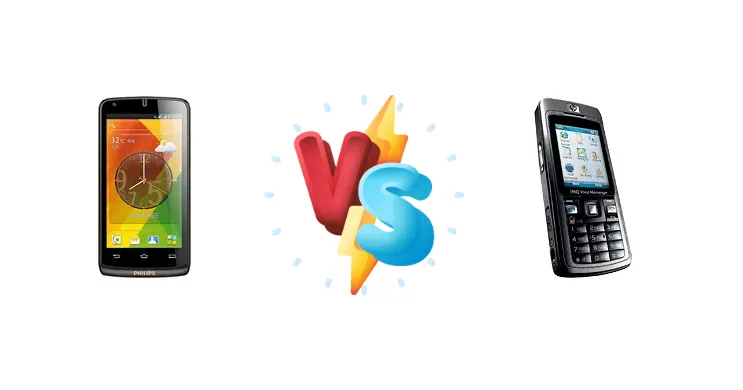
The Philips W7376 and HP iPAQ 514 represent distinct eras in mobile computing. The iPAQ, a staple of the early Pocket PC scene, relied on the TI OMAP 850 platform. The W7376, arriving later, boasts a dual-core 1.2 GHz processor, signaling a significant shift towards more powerful, multi-tasking capable devices. This comparison dissects the architectural differences and performance implications of these two platforms.
🏆 Quick Verdict
For the average user seeking even basic responsiveness in modern applications, the Philips W7376 is the clear winner. Its dual-core 1.2 GHz processor provides a substantial performance advantage over the HP iPAQ 514’s 200 MHz ARM926EJ-S, making it capable of handling tasks the iPAQ would struggle with.
| Network |
|---|
| 2G bands | GSM 850 / 900 / 1800 / 1900 - SIM 1 & SIM 2 | GSM 850 / 900 / 1800 / 1900 |
| 3G bands | HSDPA 850 / 2100 | - |
| EDGE | - | Class 10 |
| GPRS | - | Class 10 |
| Speed | HSPA 7.2/5.76 Mbps | - |
| Technology | GSM / HSPA | GSM |
| Launch |
|---|
| Announced | 2013, October. Released 2013, October | 2007, February |
| Status | Discontinued | Discontinued |
| Body |
|---|
| Dimensions | 129 x 66.7 x 9.9 mm (5.08 x 2.63 x 0.39 in) | 107 x 48.6 x 16.3 mm (4.21 x 1.91 x 0.64 in) |
| SIM | Dual SIM (Mini-SIM, dual stand-by) | Mini-SIM |
| Weight | 172 g (6.07 oz) | 102 g (3.60 oz) |
| Display |
|---|
| Resolution | 540 x 960 pixels, 16:9 ratio (~256 ppi density) | 176 x 220 pixels (~141 ppi density) |
| Size | 4.3 inches, 51.0 cm2 (~59.2% screen-to-body ratio) | 2.0 inches, 12.6 cm2 (~24.2% screen-to-body ratio) |
| Type | TFT | TFT, 65K colors |
| Platform |
|---|
| CPU | Dual-core 1.2 GHz | 200 MHz ARM926EJ-S |
| Chipset | - | TI OMAP 850 |
| OS | Android 4.0.4 (Ice Cream Sandwich) | Microsoft Windows Mobile 6.0 Standard |
| Memory |
|---|
| Card slot | microSDHC (dedicated slot) | microSD (dedicated slot) |
| Internal | 4GB | 64MB RAM, 128MB ROM |
| Main Camera |
|---|
| Features | LED flash | - |
| Single | 5 MP, AF | 1.3 MP |
| Video | Yes | Yes |
| Selfie camera |
|---|
| Single | Yes | - |
| | - | No |
| Sound |
|---|
| 3.5mm jack | Yes | No |
| 35mm jack | Yes | No |
| Alert types | - | Vibration; Downloadable polyphonic, MP3, AAC ringtones |
| Loudspeaker | Yes | Yes |
| Comms |
|---|
| Bluetooth | 3.0, A2DP | 1.2 |
| NFC | No | - |
| Positioning | GPS | No |
| Radio | No | No |
| USB | microUSB 2.0 | miniUSB |
| WLAN | Wi-Fi 802.11 b/g | Wi-Fi 802.11b/g |
| Features |
|---|
| Browser | - | WAP 2.0/xHTML, HTML (PocketIE) |
| Sensors | Accelerometer | - |
| | - | Pocket Office
MP3/AAC/AAC+/WMA/OGG/AMR player
WMV/MP4 player
Predictive text input
Voice memo |
| Battery |
|---|
| Stand-by | - | Up to 188 h |
| Talk time | Up to 10 h | Up to 6 h 30 min |
| Type | Li-Ion 2400 mAh, removable | Removable Li-Ion 1100 mAh battery |
| Misc |
|---|
| Colors | Black/Silver | Black |
| Price | - | About 90 EUR |
Philips W7376
- Significantly faster processor for improved responsiveness.
- Dual-core architecture enables better multitasking.
- Likely benefits from advancements in display technology.
- Potentially higher power consumption.
- May run newer applications that the iPAQ cannot.
HP iPAQ 514
- Excellent battery life due to efficient processor.
- Historical significance as a classic Pocket PC.
- Compact and lightweight design.
- Extremely limited processing power for modern tasks.
- Slow application loading times and sluggish performance.
- Limited software compatibility.
Display Comparison
Information regarding display specifications for both devices is unavailable. However, given the iPAQ 514’s era, it likely features a resistive touchscreen with a lower resolution and color depth compared to what the W7376 would have offered. The W7376, being a later model, likely benefited from advancements in LCD technology, potentially offering wider viewing angles and improved color accuracy, though specifics remain unknown.
Camera Comparison
Camera specifications for both devices are unavailable. However, given the iPAQ 514’s focus on productivity and the era in which it was released, any camera included would likely be of very low resolution and image quality. The W7376, being a later device, likely featured a more capable camera, though it’s unlikely to compete with modern smartphone cameras. The processing power of the W7376 would also allow for more sophisticated image processing algorithms.
Performance
The core difference lies in the processors. The HP iPAQ 514’s TI OMAP 850, featuring a 200 MHz ARM926EJ-S CPU, was a capable processor for its time, primarily focused on efficient power consumption. However, the Philips W7376’s dual-core 1.2 GHz processor represents a massive leap in processing power. The dual-core architecture allows for true parallel processing, significantly improving performance in multi-threaded applications. The higher clock speed further amplifies this advantage. The OMAP 850’s ARM9 architecture is fundamentally less efficient than the architecture used in the W7376’s processor, resulting in lower instructions per clock cycle. This translates to slower application loading times and a less responsive user interface on the iPAQ.
Battery Life
Battery capacity information is unavailable for both devices. However, the Philips W7376’s more powerful processor would likely consume more power than the HP iPAQ 514’s OMAP 850. The iPAQ’s focus on efficiency would have prioritized battery life, while the W7376 likely balanced performance with battery endurance. Without specific mAh ratings and usage scenarios, it’s difficult to definitively state which device offers better battery life.
Buying Guide
Buy the Philips W7376 if you need a device capable of running more demanding applications, even if those applications are older. Its processing power allows for smoother multitasking and a more responsive user experience. Buy the HP iPAQ 514 if you are a collector of vintage PDAs, appreciate its historical significance, or require a device specifically for legacy applications designed for the Windows Mobile platform and are willing to accept significant performance limitations.
Frequently Asked Questions
❓ Can the HP iPAQ 514 run modern apps like email clients or web browsers?
The HP iPAQ 514’s 200 MHz ARM926EJ-S processor and limited memory make it extremely difficult to run modern applications. Even lightweight email clients or web browsers would likely be unusable due to slow loading times and frequent crashes. It is best suited for legacy applications designed for Windows Mobile.
❓ Is the Philips W7376 capable of running current smartphone operating systems?
No, the Philips W7376 is unlikely to be compatible with current smartphone operating systems like Android or iOS. It likely runs an older version of Windows Mobile, and the hardware is not powerful enough to support the demands of modern operating systems. Attempts to install custom ROMs would likely be unsuccessful.
❓ What kind of storage does the HP iPAQ 514 use, and is it expandable?
The HP iPAQ 514 typically used CompactFlash (CF) cards for storage, which were expandable. However, CF cards are now largely obsolete and can be difficult to find. The capacity of CF cards available at the time was significantly lower than modern storage solutions.
❓ How does the dual-core processor in the Philips W7376 improve multitasking compared to the iPAQ 514?
The dual-core processor in the Philips W7376 allows it to handle multiple tasks simultaneously without significant performance degradation. The iPAQ 514, with its single-core processor, struggles with multitasking, often becoming unresponsive when running multiple applications. The W7376 can dedicate one core to a foreground task while the other handles background processes.