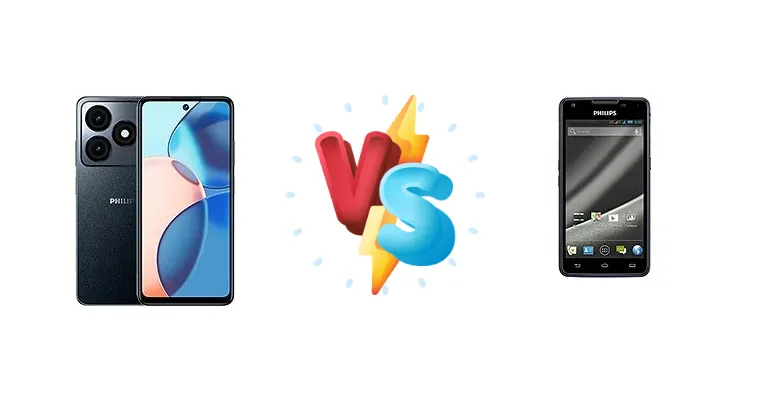
The Philips S6310 Essence 20 and W6610 represent Philips' entry into the highly competitive budget smartphone market. While both aim to provide essential smartphone functionality at an accessible price point, they differ significantly in their internal hardware. This comparison dissects those differences, focusing on how the Unisoc T606 in the S6310 stacks up against the quad-core processor in the W6610, and who each phone best serves.
🏆 Quick Verdict
For the average user needing more than basic functionality, the Philips S6310 Essence 20 is the clear winner. Its Unisoc T606 chipset offers a substantial performance advantage over the W6610’s quad-core processor, enabling smoother multitasking and a more responsive user experience, despite the slower 10W charging.
| Network |
|---|
| 2G bands | GSM 850 / 900 / 1800 / 1900 | GSM 900 / 1800 / 1900 - SIM 1 & SIM 2 |
| 3G bands | HSDPA 900 / 2100 | HSDPA 900 / 2100 |
| 4G bands | 1, 3, 7, 8, 20, 28, 40 | - |
| Speed | HSPA, LTE | HSPA 21.1/5.76 Mbps |
| Technology | GSM / HSPA / LTE | GSM / HSPA |
| Launch |
|---|
| Announced | 2024, Q4 | 2014, May. Released 2014, May |
| Status | Available. Released 2024, Q4 | Discontinued |
| Body |
|---|
| Dimensions | 163.5 x 76 x 8.6 mm (6.44 x 2.99 x 0.34 in) | 145.4 x 74.1 x 11.4 mm (5.72 x 2.92 x 0.45 in) |
| SIM | Nano-SIM + Nano-SIM | Dual SIM, (Mini-SIM, dual stand-by) |
| Weight | - | 200 g (7.05 oz) |
| Display |
|---|
| Resolution | 720 x 1612 pixels, 20:9 ratio (~269 ppi density) | 540 x 960 pixels, 16:9 ratio (~220 ppi density) |
| Size | 6.56 inches, 103.4 cm2 (~83.2% screen-to-body ratio) | 5.0 inches, 68.9 cm2 (~64.0% screen-to-body ratio) |
| Type | IPS LCD, 90Hz | IPS LCD |
| Platform |
|---|
| CPU | Octa-core (2x1.6 GHz Cortex-A75 & 6x1.6 GHz Cortex-A55) | Quad-core 1.3 GHz |
| Chipset | Unisoc T606 (12 nm) | - |
| GPU | Mali-G57 MP1 | - |
| OS | Android 14 | Android 4.2 (Jelly Bean) |
| Memory |
|---|
| Card slot | microSDXC | microSDHC (dedicated slot) |
| Internal | 128GB 4GB RAM, 256GB 8GB RAM | 4GB 1GB RAM |
| Main Camera |
|---|
| Dual | 50 MP, (wide), AF
Auxiliary lens | - |
| Features | Dual-LED flash | LED flash |
| Single | - | 8 MP, AF |
| Video | Yes | Yes |
| Selfie camera |
|---|
| Features | LED flash | - |
| Single | 8 MP | 1.2 MP |
| Video | Yes | - |
| Sound |
|---|
| 3.5mm jack | - | Yes |
| 35mm jack | Yes | Yes |
| Loudspeaker | Yes | Yes |
| Comms |
|---|
| Bluetooth | Yes | 4.0, A2DP |
| NFC | No | No |
| Positioning | GPS | GPS |
| Radio | Unspecified | FM radio |
| USB | USB Type-C | microUSB 2.0 |
| WLAN | Wi-Fi 802.11 a/b/g/n, dual-band | Wi-Fi 802.11 b/g |
| Features |
|---|
| Sensors | Fingerprint (side-mounted); unspecified sensors | Accelerometer, proximity |
| Battery |
|---|
| Charging | 10W wired | - |
| Stand-by | - | Up to 1604 h |
| Talk time | - | Up to 33 h |
| Type | Li-Po 5000 mAh | Li-Ion 5300 mAh, removable |
| Misc |
|---|
| Colors | Black, Blue | Black |
| Models | CTS6310BKL/40 | - |
| Price | About 90 EUR | - |
Philips S6310 Essence 20
- Significantly faster processor for smoother multitasking.
- Octa-core architecture handles demanding apps better.
- Potentially better camera processing due to processor power.
- Slow 10W charging.
- Battery life may be shorter due to higher power consumption.
Philips W6610
- Potentially longer battery life due to lower power processor.
- Simpler user experience for basic tasks.
- Likely more affordable.
- Slow and limited performance.
- Struggles with multitasking and demanding apps.
- Outdated processor architecture.
Display Comparison
Neither Philips provides detailed display specifications beyond the basic panel type. However, given the price points, it’s safe to assume both utilize LCD panels. The lack of information regarding resolution, brightness, or refresh rate suggests neither phone prioritizes display quality. The S6310’s more powerful processor *could* allow for more efficient rendering of UI elements, potentially resulting in a slightly smoother visual experience, but this is speculative without further data.
Camera Comparison
Both phones likely feature basic camera setups, but specific details are absent. Given the market segment, image quality will be heavily reliant on software processing. Without sensor size or aperture information, it’s difficult to make a direct comparison. However, the S6310’s more powerful processor *could* facilitate faster image processing and potentially better low-light performance, assuming similar sensor hardware. It's reasonable to expect both phones to include a primary camera and potentially a secondary depth or macro sensor, but these are unlikely to be high-resolution or offer advanced features.
Performance
The core difference lies in the processors. The Philips S6310 boasts a Unisoc T606, an octa-core chip built on a 12nm process, featuring two Cortex-A75 cores clocked at 1.6 GHz and six Cortex-A55 cores, also at 1.6 GHz. This architecture provides a significant performance boost over the Philips W6610’s quad-core 1.3 GHz processor. The T606’s octa-core configuration allows for better multitasking and handling of more demanding applications. The Cortex-A75 cores offer a substantial improvement in single-core performance, crucial for responsive app launches and general UI navigation. The W6610, while adequate for basic tasks, will likely struggle with anything beyond simple operations.
Battery Life
Battery capacity is not specified for either device. However, the S6310’s 10W wired charging is a notable limitation. The W6610’s power draw will be lower due to its less powerful processor, potentially resulting in longer battery life despite a potentially smaller capacity. The 10W charging on the S6310 will require a significantly longer time to reach a full charge, making it less convenient for users who need quick top-ups. The W6610, while slower overall, may offer a more consistent experience for users who prioritize longevity over speed.
Buying Guide
Buy the Philips S6310 Essence 20 if you need a phone capable of handling everyday tasks like social media, light gaming, and streaming video without significant lag. It’s ideal for users who value a more fluid experience. Buy the Philips W6610 if your primary needs are limited to calls, texts, and very basic app usage, and you prioritize simplicity and potentially longer battery life due to lower power consumption.
Frequently Asked Questions
❓ Will the Philips S6310 be able to run popular social media apps like Facebook and Instagram smoothly?
Yes, the Unisoc T606 processor in the S6310 is more than capable of running popular social media apps without significant lag. The octa-core architecture and Cortex-A75 cores provide sufficient processing power for a smooth user experience, even with multiple apps open.
❓ Is the Philips W6610 suitable for someone who primarily uses their phone for calls and texts?
Absolutely. The Philips W6610 is perfectly adequate for basic communication tasks like calls and texts. Its quad-core processor is sufficient for these functions, and its lower power consumption may result in longer battery life for essential use.
❓ Can the Philips S6310 handle light gaming, like casual puzzle games?
The S6310 can handle light gaming, such as puzzle games or simple arcade titles. However, it's not designed for graphically intensive games. Expect lower frame rates and potentially some lag in more demanding titles.
❓ How long will it take to fully charge the Philips S6310 with its 10W charger?
Given the 10W charging rate, expect a full charge to take approximately 3-4 hours, depending on the battery capacity (which is not specified). This is significantly slower than phones with fast charging capabilities.