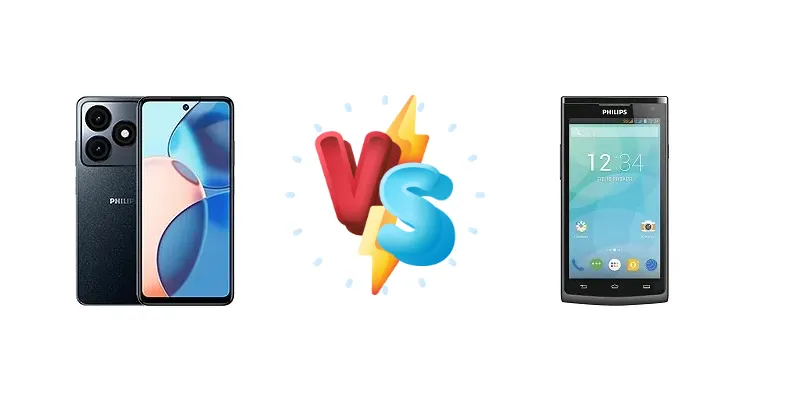
The Philips S6310 Essence 20 and S388 represent distinct approaches to the ultra-budget smartphone market. The S388 aims for extreme affordability, while the S6310 attempts to deliver a more modern experience with a more powerful chipset. This comparison dissects the key differences to determine which device offers the best value for your money.
🏆 Quick Verdict
For the average user, the Philips S6310 Essence 20 is the clear winner. Its Unisoc T606 chipset provides a substantially more responsive experience for everyday tasks and even light gaming, justifying the likely price difference over the S388. The S388 is only suitable for the most basic users.
| Network |
|---|
| 2G bands | GSM 850 / 900 / 1800 / 1900 | GSM 900 / 1800 / 1900 - SIM 1 & SIM 2 |
| 3G bands | HSDPA 900 / 2100 | HSDPA 900 / 2100 |
| 4G bands | 1, 3, 7, 8, 20, 28, 40 | - |
| Speed | HSPA, LTE | HSPA |
| Technology | GSM / HSPA / LTE | GSM / HSPA |
| Launch |
|---|
| Announced | 2024, Q4 | 2014, Q3. Released 2014, Q3 |
| Status | Available. Released 2024, Q4 | Discontinued |
| Body |
|---|
| Dimensions | 163.5 x 76 x 8.6 mm (6.44 x 2.99 x 0.34 in) | 131 x 67.1 x 9.1 mm (5.16 x 2.64 x 0.36 in) |
| SIM | Nano-SIM + Nano-SIM | Dual SIM |
| Weight | - | 136.5 g (4.83 oz) |
| Display |
|---|
| Resolution | 720 x 1612 pixels, 20:9 ratio (~269 ppi density) | 540 x 960 pixels, 16:9 ratio (~245 ppi density) |
| Size | 6.56 inches, 103.4 cm2 (~83.2% screen-to-body ratio) | 4.5 inches, 55.8 cm2 (~63.5% screen-to-body ratio) |
| Type | IPS LCD, 90Hz | IPS LCD |
| Platform |
|---|
| CPU | Octa-core (2x1.6 GHz Cortex-A75 & 6x1.6 GHz Cortex-A55) | Quad-core 1.3 GHz |
| Chipset | Unisoc T606 (12 nm) | - |
| GPU | Mali-G57 MP1 | - |
| OS | Android 14 | Android 4.2 (Jelly Bean) |
| Memory |
|---|
| Card slot | microSDXC | microSDHC (dedicated slot) |
| Internal | 128GB 4GB RAM, 256GB 8GB RAM | - |
| Main Camera |
|---|
| Dual | 50 MP, (wide), AF
Auxiliary lens | - |
| Features | Dual-LED flash | LED flash |
| Single | - | 5 MP, AF |
| Video | Yes | Yes |
| Selfie camera |
|---|
| Features | LED flash | - |
| Single | 8 MP | - |
| Video | Yes | - |
| | - | No |
| Sound |
|---|
| 3.5mm jack | - | Yes |
| 35mm jack | Yes | Yes |
| Loudspeaker | Yes | Yes |
| Comms |
|---|
| Bluetooth | Yes | 3.0, A2DP |
| NFC | No | No |
| Positioning | GPS | GPS |
| Radio | Unspecified | FM radio |
| USB | USB Type-C | microUSB 2.0 |
| WLAN | Wi-Fi 802.11 a/b/g/n, dual-band | Wi-Fi 802.11 b/g |
| Features |
|---|
| Sensors | Fingerprint (side-mounted); unspecified sensors | Accelerometer |
| Battery |
|---|
| Charging | 10W wired | - |
| Type | Li-Po 5000 mAh | Li-Ion 1700 mAh, removable |
| Misc |
|---|
| Colors | Black, Blue | Black |
| Models | CTS6310BKL/40 | - |
| Price | About 90 EUR | - |
Philips S6310 Essence 20
- Significantly faster processor for smoother performance
- More efficient chipset potentially leading to better battery life
- 10W charging offers a standardized charging experience
- 10W charging is relatively slow
- Display details are unknown, potentially basic
Philips S388
- Extremely affordable price point
- Simple and easy to use for basic tasks
- Likely very lightweight
- Very slow processor resulting in laggy performance
- Limited multitasking capabilities
- Poor gaming performance
Display Comparison
Details regarding the displays of both devices are unavailable. However, given the market segment, it's reasonable to assume both utilize LCD panels. The S6310's more powerful chipset suggests a potentially higher resolution or refresh rate, though this is speculative. Bezels are likely to be substantial on both devices, prioritizing cost reduction over premium aesthetics.
Camera Comparison
Camera specifications beyond the presence of cameras are unavailable for either device. Given the price point, image quality will likely be basic on both. The S6310’s more powerful ISP (Image Signal Processor) integrated into the Unisoc T606 chipset *could* translate to slightly better image processing, particularly in low-light conditions, but this is not guaranteed. It's safe to assume both devices will feature limited camera features and image quality.
Performance
The core difference lies in the processors. The Philips S6310 boasts a Unisoc T606, an octa-core chip built on a 12nm process, featuring two Cortex-A75 cores clocked at 1.6 GHz and six Cortex-A55 cores also at 1.6 GHz. This architecture provides a significant performance advantage over the Philips S388’s quad-core 1.3 GHz processor. The A75 cores in the S6310 offer substantially higher single-core performance, crucial for app launch speeds and responsiveness. The S388’s older, less efficient architecture will struggle with even moderate multitasking. The S6310’s 12nm process, while not cutting-edge, is more efficient than what’s likely used in the S388, potentially leading to better battery life under load.
Battery Life
Battery capacity is not specified for either device. However, the S6310’s 10W wired charging is a notable detail. While slow by modern standards, it suggests a more standardized charging implementation. The S388’s charging capabilities are unknown. The S6310’s more efficient chipset could offset a potentially smaller battery capacity, providing comparable or even better real-world battery life, especially during moderate usage. The S388’s less efficient processor will likely drain the battery faster under similar conditions.
Buying Guide
Buy the Philips S6310 Essence 20 if you need a smartphone capable of handling multitasking, social media, and occasional gaming without significant lag. It's ideal for users who want a smoother, more future-proof experience. Buy the Philips S388 if your needs are extremely limited to calls, texts, and very basic app usage, and price is the absolute primary concern.
Frequently Asked Questions
❓ Will the Philips S6310 handle popular social media apps like Facebook and Instagram without lagging?
Yes, the Unisoc T606 chipset in the S6310 is powerful enough to run social media apps smoothly. The octa-core architecture and Cortex-A75 cores provide the necessary processing power for a responsive experience, unlike the S388 which will likely struggle.
❓ Is the Philips S388 suitable for someone who primarily uses their phone for calls and texts?
The Philips S388 is best suited for users with extremely basic needs – primarily making calls and sending texts. Its quad-core processor is sufficient for these tasks, but it will struggle with anything more demanding. If you plan to use any apps beyond the basics, the S6310 is a better choice.
❓ Can I play games on the Philips S6310 Essence 20?
While not a gaming phone, the S6310 can handle light gaming. Less demanding titles will be playable at lower settings. The S388’s processor is unlikely to provide a satisfactory gaming experience, even with simple games.