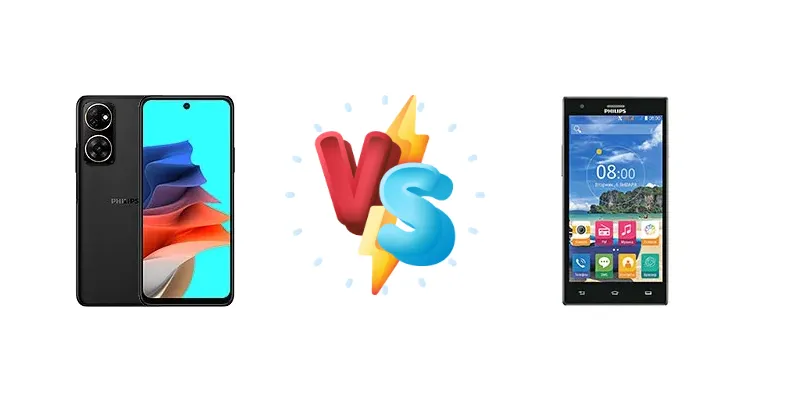
The Philips S6206 and S616 represent Philips' entry into the highly competitive budget smartphone market. While both aim to provide essential smartphone functionality at an affordable price, a key difference lies in their processing power. This comparison dissects the specifications of each device to determine which offers the best value for users prioritizing performance and responsiveness.
🏆 Quick Verdict
For the average user, the Philips S6206 is the clear winner. Its Unisoc T606 chipset, featuring Cortex-A75 cores, provides a noticeable performance uplift over the S616’s unspecified octa-core CPU, making it better suited for multitasking, app loading, and overall system fluidity. The S616 remains a viable option for extremely basic use cases.
| Network |
|---|
| 2G bands | GSM 850 / 900 / 1800 / 1900 | GSM 850 / 900 / 1800 / 1900 - SIM 1 & SIM 2 |
| 3G bands | HSDPA 850 / 900 / 1900 / 2100 | HSDPA 850 / 1900 / 2100 |
| 4G bands | LTE | 1, 3, 7, 8, 20, 38, 39, 40, 41 |
| Speed | HSPA, LTE | HSPA 42.2/5.76 Mbps, LTE Cat4 150/50 Mbps |
| Technology | GSM / HSPA / LTE | GSM / HSPA / LTE |
| Launch |
|---|
| Announced | 2024, September | 2015, November. Released 2015, November |
| Status | Available. Released 2024, September | Discontinued |
| Body |
|---|
| Dimensions | 169.5 x 76.5 x 8.5 mm (6.67 x 3.01 x 0.33 in) | 143 x 71.6 x 9.8 mm (5.63 x 2.82 x 0.39 in) |
| SIM | Nano-SIM + Nano-SIM | Dual SIM |
| Weight | - | 164 g (5.78 oz) |
| Display |
|---|
| Resolution | 720 x 1640 pixels (~264 ppi density) | 1080 x 1920 pixels, 16:9 ratio (~401 ppi density) |
| Size | 6.79 inches, 109.5 cm2 (~84.4% screen-to-body ratio) | 5.5 inches, 83.4 cm2 (~81.4% screen-to-body ratio) |
| Type | IPS LCD, 90Hz | IPS LCD |
| Platform |
|---|
| CPU | Octa-core (2x1.6 GHz Cortex-A75 & 6x1.6 GHz Cortex-A55) | Octa-core 1.3 GHz |
| Chipset | Unisoc T606 (12 nm) | - |
| GPU | Mali-G57 MP1 | - |
| OS | Android 14 | Android 5.1 (Lollipop) |
| Memory |
|---|
| Card slot | microSDXC (uses shared SIM slot) | microSDXC (dedicated slot) |
| Internal | 128GB 6GB RAM, 256GB 8GB RAM | 16GB 2GB RAM |
| Main Camera |
|---|
| Dual | 48 MP, (wide), PDAF
2 MP (macro)
Auxiliary lens | - |
| Features | LED flash | LED flash |
| Single | - | 13 MP, AF |
| Video | Yes | 1080p@30fps |
| Selfie camera |
|---|
| Single | 8 MP | Yes |
| Video | Yes | - |
| Sound |
|---|
| 3.5mm jack | - | Yes |
| 35mm jack | Yes | Yes |
| Loudspeaker | Yes | Yes |
| Comms |
|---|
| Bluetooth | Yes | 4.0, A2DP |
| NFC | No | No |
| Positioning | GPS | GPS |
| Radio | Unspecified | FM radio |
| USB | USB Type-C | microUSB 2.0 |
| WLAN | Wi-Fi 802.11 a/b/g/n, dual-band | Wi-Fi 802.11 b/g/n, hotspot |
| Features |
|---|
| Sensors | Fingerprint (side-mounted); unspecified sensors | Accelerometer, proximity, compass |
| Battery |
|---|
| Type | Li-Po 4920 mAh | Li-Ion 3000 mAh battery |
| Misc |
|---|
| Colors | Black | Black |
| Models | CTS6206BKM/85 | - |
| Price | About 90 EUR | - |
Philips S6206
- Significantly faster processor with Cortex-A75 cores
- More efficient 12nm chipset
- Potentially better camera image processing
- Likely similar display quality to the S616
- May be slightly more expensive than the S616
Philips S616
- Lower price point
- Sufficient for basic smartphone tasks
- Potentially longer battery life due to less demanding processor (though less efficient)
- Noticeably slower processor
- Less responsive user experience
- Limited multitasking capabilities
Display Comparison
Unfortunately, display specifications are absent from the provided data. However, given the market segment, both devices likely feature LCD panels with 720p+ resolution. The S6206’s more powerful chipset *could* support a slightly higher refresh rate, though this is speculative. Bezels are likely to be substantial on both models, typical of this price range. Color accuracy will likely be standard for budget devices, prioritizing power efficiency over color fidelity.
Camera Comparison
Camera details are limited. Both phones likely feature a multi-camera setup, but the provided data doesn’t specify sensor sizes or lens apertures. It’s reasonable to assume the S6206’s image signal processor (ISP), integrated within the Unisoc T606, offers more advanced image processing capabilities than the S616’s ISP. This could translate to better dynamic range, noise reduction, and overall image quality, particularly in challenging lighting conditions. Any 2MP macro or depth sensors on either device should be considered supplementary and not relied upon for high-quality photography.
Performance
The core differentiator between these two devices is the chipset. The Philips S6206 utilizes the Unisoc T606, a 12nm processor featuring a heterogeneous core configuration: two Cortex-A75 cores clocked at 1.6 GHz and six Cortex-A55 cores, also at 1.6 GHz. This architecture provides a significant advantage over the Philips S616’s unspecified octa-core CPU clocked at 1.3 GHz. The Cortex-A75 cores in the S6206 are considerably more powerful than the cores likely found in the S616, resulting in faster app launch times, smoother multitasking, and improved responsiveness. The 12nm process node of the T606 also suggests better power efficiency compared to potentially older, larger-node CPUs in the S616. While RAM specifications are missing, the S6206’s chipset is designed to work efficiently with 3-4GB of RAM, providing a more fluid experience.
Battery Life
Battery capacity and charging wattage are not provided. Given the budget nature of these devices, both likely feature batteries in the 3000-4000 mAh range. The Unisoc T606 in the S6206, being a more efficient chipset, may contribute to slightly longer battery life despite potentially similar battery capacities. Charging speeds are likely to be slow on both devices, potentially utilizing a 5W or 10W charger. The S6206’s more efficient processor could result in a slightly faster 0-100% charge time, but the difference will likely be minimal.
Buying Guide
Buy the Philips S6206 if you need a smartphone capable of handling more than just basic tasks like calls and messaging. It’s ideal for users who enjoy occasional gaming, social media browsing, or running multiple apps simultaneously. Buy the Philips S616 if you prioritize absolute affordability and only require a phone for essential communication – calls, texts, and very light app usage. It’s a good choice for first-time smartphone users or as a simple backup device.
Frequently Asked Questions
❓ Will the Philips S6206 handle popular social media apps like TikTok and Instagram smoothly?
Yes, the Unisoc T606 chipset in the S6206 is capable of running social media apps like TikTok and Instagram with reasonable smoothness. While it won’t deliver a flagship-level experience, it will provide a significantly better experience than the S616, especially when multitasking between apps.
❓ Is the Philips S616 suitable for someone who primarily uses their phone for calls and texts?
Absolutely. The Philips S616 is perfectly adequate for basic communication tasks like making calls and sending text messages. Its less powerful processor is sufficient for these essential functions, and its lower price point makes it an attractive option for users with minimal smartphone needs.
❓ Can the Philips S6206 run mobile games like PUBG Mobile or Call of Duty Mobile?
The Philips S6206 can *run* these games, but expect to play them on low to medium graphics settings to maintain a playable frame rate. The Unisoc T606 isn’t a gaming powerhouse, but it’s a step up from the S616 and will provide a more enjoyable gaming experience.