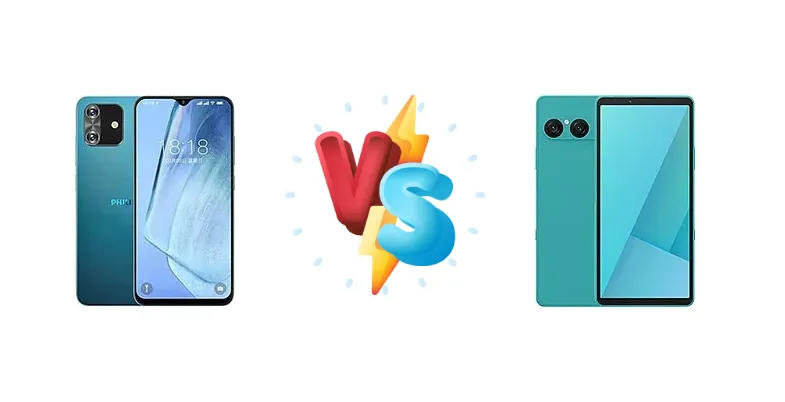
The Philips PH2 and Sony Xperia 10 VII represent distinct approaches to the budget smartphone market. The PH2 aims for affordability with a Unisoc chipset, while the Xperia 10 VII prioritizes endurance and a more refined experience with a Snapdragon processor. This comparison dissects their strengths and weaknesses to determine which device best suits your needs.
🏆 Quick Verdict
For the average user prioritizing long-term reliability and consistent performance, the Sony Xperia 10 VII is the superior choice. Its Snapdragon 6 Gen 3 chipset and exceptional 48:10h battery endurance significantly outperform the Philips PH2, justifying the price difference.
| Network |
|---|
| 2G bands | GSM 850 / 900 / 1800 / 1900 | GSM 850 / 900 / 1800 / 1900 |
| 3G bands | HSDPA 850 / 900 / 2100 | HSDPA 850 / 900 / 1700(AWS) / 2100 |
| 4G bands | LTE | 1, 3, 4, 5, 7, 8, 20, 28, 38, 39, 40, 41 |
| 5G bands | - | 1, 3, 5, 7, 8, 20, 28, 38, 40, 41, 77, 78, 79 SA/NSA/Sub6 |
| Speed | HSPA, LTE | HSPA, LTE, 5G |
| Technology | GSM / CDMA / HSPA / CDMA2000 / LTE | GSM / HSPA / LTE / 5G |
| | CDMA2000 1x | - |
| Launch |
|---|
| Announced | 2021, December 08. Released 2021, December 13 | 2025, September 12 |
| Status | Discontinued | Available. Released 2025, September 19 |
| Body |
|---|
| Build | Glass front, glass back, plastic frame | Glass front (Gorilla Glass Victus 2), plastic frame, plastic back |
| Dimensions | 156.2 x 75.3 x 9 mm (6.15 x 2.96 x 0.35 in) | 153 x 72 x 8.3 mm (6.02 x 2.83 x 0.33 in) |
| SIM | Nano-SIM + Nano-SIM | · Nano-SIM + eSIM· Nano-SIM + Nano-SIM |
| Weight | 170 g (6.00 oz) | 168 g (5.93 oz) |
| Display |
|---|
| Protection | - | Corning Gorilla Glass Victus 2, Mohs level 5 |
| Resolution | 720 x 1520 pixels, 19:9 ratio (~271 ppi density) | 1080 x 2340 pixels, 19.5:9 ratio (~422 ppi density) |
| Size | 6.21 inches, 96.3 cm2 (~81.8% screen-to-body ratio) | 6.1 inches, 91.3 cm2 (~82.9% screen-to-body ratio) |
| Type | IPS LCD | OLED, 1B colors, 120Hz, HDR |
| Platform |
|---|
| CPU | Quad-core (1x2.0 GHz Cortex-A75 & 3x1.8 GHz Cortex-A55) | Octa-core (4x2.4 GHz Cortex-A78 & 4x1.8 GHz Cortex-A55) |
| Chipset | Unisoc Tiger T310 (12 nm) | Qualcomm SM6475-AB Snapdragon 6 Gen 3 (4 nm) |
| GPU | PowerVR GE8300 | Adreno 710 |
| OS | Android OS, HMS (Huawei Mobile Services) | Android 15, upgradable to Android 16, up to 4 major Android upgrades |
| Memory |
|---|
| Card slot | microSDXC | microSDXC (uses shared SIM slot) |
| Internal | 128GB 4GB RAM | 128GB 8GB RAM |
| | eMMC 5.1 | - |
| Main Camera |
|---|
| Dual | 13 MP, (wide), AF
2 MP | 50 MP, f/1.9, 24mm (wide), 1/1.56", PDAF, OIS
13 MP, f/2.4, 16mm, 123˚ (ultrawide), 1/3.0" |
| Features | LED flash | LED flash, HDR, panorama |
| Single | 5 MP | - |
| Video | 1080p@30fps | 4K@30fps, 1080p@30/60/120fps, gyro-EIS, OIS |
| Selfie camera |
|---|
| Features | - | HDR |
| Single | 5 MP | 8 MP, f/2.0, 26mm (wide), 1/4.0", 1.12µm |
| Video | - | 1080p@30fps |
| Sound |
|---|
| 3.5mm jack | Yes | - |
| 35mm jack | Yes | Yes |
| Loudspeaker | Yes | Yes, with stereo speakers |
| Comms |
|---|
| Bluetooth | 4.2, A2DP | 5.4, A2DP, LE |
| NFC | No | Yes |
| Positioning | GPS, BDS | GPS, GLONASS, GALILEO, BDS, QZSS |
| Radio | Unspecified | No |
| USB | USB Type-C 2.0 | USB Type-C 2.0, OTG |
| WLAN | Wi-Fi 802.11 b/g/n, hotspot | Wi-Fi 802.11 a/b/g/n/ac/6e, tri-band |
| Features |
|---|
| Sensors | Fingerprint (side-mounted), accelerometer, proximity | Fingerprint (side-mounted), accelerometer, gyro, proximity, compass |
| Battery |
|---|
| Charging | - | Wired, PD, QC |
| Type | Li-Ion 3900 mAh | 5000 mAh |
| Misc |
|---|
| Colors | Black, Blue, Gold | White, Turquoise, Charcoal |
| Models | S702 | XQ-FE54, XQZ-CBFE, xqfe54eukcl.gc, xqfe54eukcw.gc, xqfe54eukcb.gc |
| Price | About 110 EUR | $ 459.99 / £ 329.00 / € 379.00 |
| EU LABEL |
|---|
| Battery | - | 48:10h endurance, 1400 cycles |
| Energy | - | Class B |
| Free fall | - | Class C (90 falls) |
| Repairability | - | Class D |
Philips PH2
- Extremely affordable price point
- Functional for basic smartphone tasks
- Potentially lightweight design
- Underpowered Unisoc chipset
- Likely limited camera capabilities
- Poor battery life compared to competition
- Unspecified display quality
Sony Xperia 10 VII
- Excellent battery life (48:10h endurance)
- Powerful Snapdragon 6 Gen 3 chipset
- Bright and vibrant display (1064 nits)
- Fast charging support (PD, QC)
- Higher price than the Philips PH2
- May lack expandable storage
- Software updates may be limited
Display Comparison
The Sony Xperia 10 VII boasts a significantly brighter display, reaching a measured 1064 nits, compared to the Philips PH2’s unspecified brightness. This difference translates to vastly improved visibility in direct sunlight. While the PH2’s panel technology isn’t detailed, the Xperia 10 VII likely utilizes an OLED panel (typical for Sony’s mid-range) offering superior contrast and color accuracy. The absence of refresh rate information for the PH2 suggests a standard 60Hz panel, while the Xperia 10 VII’s display is optimized for power efficiency alongside its brightness.
Camera Comparison
Without detailed camera specifications for the Philips PH2, a direct comparison is challenging. However, Sony’s Xperia line generally focuses on image processing and color science. The Xperia 10 VII likely benefits from Sony’s image signal processor (ISP) within the Snapdragon 6 Gen 3, offering better dynamic range and noise reduction. While the PH2 may offer basic photography capabilities, the Xperia 10 VII is expected to deliver more consistent and higher-quality images, particularly in challenging lighting conditions. We can assume the Xperia 10 VII will have more advanced software features like scene recognition and HDR.
Performance
The core difference lies in the chipsets: the Philips PH2 utilizes the Unisoc Tiger T310, a 12nm processor with a quad-core configuration (1x2.0 GHz Cortex-A75 & 3x1.8 GHz Cortex-A55). The Sony Xperia 10 VII, however, is powered by the Qualcomm SM6475-AB Snapdragon 6 Gen 3, built on a more efficient 4nm process with an octa-core setup (4x2.4 GHz Cortex-A78 & 4x1.8 GHz Cortex-A55). The 4nm node of the Snapdragon 6 Gen 3 provides a substantial advantage in thermal efficiency, reducing throttling during sustained workloads. The Cortex-A78 cores in the Xperia 10 VII also offer a significant performance uplift over the Cortex-A75 cores in the PH2, resulting in a smoother and more responsive user experience.
Battery Life
The Sony Xperia 10 VII excels in battery performance, achieving an impressive 48:10h endurance and 1400 charge cycles. This is backed by a 12:57h active use score. The Philips PH2’s battery capacity and charging capabilities are not specified, but given its lower-tier chipset and likely smaller battery, it’s unlikely to match the Xperia 10 VII’s longevity. The Xperia 10 VII also supports wired charging with PD and QC standards, offering faster and more versatile charging options.
Buying Guide
Buy the Philips PH2 if you need a functional smartphone for basic tasks like calls, messaging, and light web browsing, and your budget is extremely limited. Buy the Sony Xperia 10 VII if you prioritize a smoother user experience, longer battery life, a brighter display, and the assurance of Qualcomm’s optimized software ecosystem, even if it means spending a bit more.
Frequently Asked Questions
❓ Is the Snapdragon 6 Gen 3 in the Xperia 10 VII capable of handling demanding games like Genshin Impact?
While the Snapdragon 6 Gen 3 isn't a flagship processor, it can handle Genshin Impact at lower settings (medium or low) with acceptable frame rates. Expect some frame drops during intense combat scenarios. The 4nm process helps mitigate thermal throttling, but it's not a dedicated gaming phone.
❓ How does the battery life of the Xperia 10 VII hold up with heavy social media and video streaming usage?
The Xperia 10 VII’s 48:10h endurance is remarkably resilient. Even with heavy social media and video streaming, you can expect a full day of use, potentially extending into a second day with moderate usage. The efficient Snapdragon 6 Gen 3 and optimized software contribute to this impressive longevity.
❓ Does the Philips PH2 support VoLTE and Wi-Fi calling?
Support for VoLTE and Wi-Fi calling on the Philips PH2 will vary depending on your carrier and region. It's crucial to check with your mobile provider to ensure compatibility before purchasing, as these features are essential for modern network connectivity.
❓ What type of storage does the Sony Xperia 10 VII use, and is it expandable?
The Sony Xperia 10 VII utilizes UFS storage, which is faster than eMMC storage commonly found in budget phones. However, it does *not* offer expandable storage via microSD card. Therefore, choosing a model with sufficient internal storage is crucial.