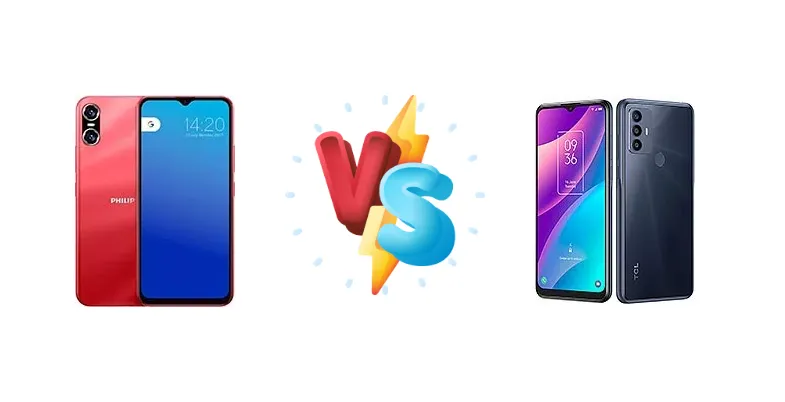
The Philips PH1 and TCL 30 SE represent the fiercely competitive sub-$150 smartphone market. Both aim to deliver essential smartphone functionality at an accessible price point, but they achieve this with different chipsets – Unisoc’s Tiger T310 in the PH1 and Mediatek’s Helio G25 in the 30 SE. This comparison dissects their core specifications to determine which device offers the best value for everyday users.
🏆 Quick Verdict
For most users, the TCL 30 SE emerges as the slightly better choice. While the Philips PH1 benefits from a more efficient Cortex-A75 core, the TCL 30 SE’s octa-core configuration and 15W charging provide a more consistently responsive experience and quicker top-ups, making it better suited for multitasking and sustained use.
| Network |
|---|
| 2G bands | GSM 850 / 900 / 1800 / 1900 | GSM 850 / 900 / 1800 / 1900 |
| 3G bands | HSDPA 850 / 900 / 2100 | HSDPA 850 / 900 / 1900 / 2100 - EMEA/APAC |
| 4G bands | 1, 3, 5, 8, 34, 38, 39, 40, 41 | 1, 3, 5, 7, 8, 20, 28, 38, 40, 41 - EMEA |
| Speed | HSPA, LTE | HSPA 42.2/11.5 Mbps, LTE Cat4 150/50 Mbps |
| Technology | GSM / CDMA / HSPA / CDMA2000 / LTE | GSM / HSPA / LTE |
| | CDMA2000 1x | 2, 3, 4, 5, 7, 8, 12, 13, 17, 26, 28, 66 - LATAM |
| Launch |
|---|
| Announced | 2021, December 20. Released 2021, December 20 | 2022, February 27 |
| Status | Discontinued | Available. Released 2022, April 20 |
| Body |
|---|
| Build | Glass front, plastic back, plastic frame | Glass front, plastic frame, plastic back |
| Dimensions | 165.5 x 76.5 x 9.5 mm (6.52 x 3.01 x 0.37 in) | 165.2 x 75.5 x 8.9 mm (6.50 x 2.97 x 0.35 in) |
| SIM | Nano-SIM + Nano-SIM | · Nano-SIM· Nano-SIM + Nano-SIM |
| Weight | 194 g (6.84 oz) | 190 g (6.70 oz) |
| Display |
|---|
| Resolution | 720 x 1440 pixels, 18:9 ratio (~247 ppi density) | 720 x 1600 pixels, 20:9 ratio (~269 ppi density) |
| Size | 6.51 inches, 109.4 cm2 (~86.4% screen-to-body ratio) | 6.52 inches, 102.6 cm2 (~82.3% screen-to-body ratio) |
| Type | IPS LCD | IPS LCD, 450 nits (typ) |
| Platform |
|---|
| CPU | Quad-core (1x2.0 GHz Cortex-A75 & 3x1.8 GHz Cortex-A55) | Octa-core (4x2.0 GHz Cortex-A53 & 4x1.5 GHz Cortex-A53) |
| Chipset | Unisoc Tiger T310 (12 nm) | Mediatek MT6762G Helio G25 (12 nm) |
| GPU | PowerVR GE8300 | PowerVR GE8320 |
| OS | Android OS | Android 12, TCL UI 4.0 |
| Memory |
|---|
| Card slot | microSDXC | microSDXC (dedicated slot) |
| Internal | 32GB 4GB RAM, 64GB 4GB RAM, 128GB 4GB RAM | 64GB 4GB RAM, 128GB 4GB RAM |
| | eMMC 5.1 | eMMC 5.1 |
| Main Camera |
|---|
| Dual | 13 MP, (wide), AF
3 MP | - |
| Features | LED flash | LED flash, HDR, panorama |
| Single | 5 MP | 8 MP, f/2.0, 26mm (wide), 1/4", 1.12µm |
| Triple | - | 50 MP, f/1.9, 28mm (wide), 1/2.76", 0.64µm, PDAF
2 MP (macro)
Auxiliary lens |
| Video | 1080p@30fps | 1080p@30fps |
| Selfie camera |
|---|
| Features | - | HDR |
| Single | 5 MP | 8 MP, f/2.0, 26mm (wide), 1/4.0", 1.12µm |
| Video | - | 1080p@30fps |
| Sound |
|---|
| 3.5mm jack | Yes | Yes |
| 35mm jack | Yes | Yes |
| Loudspeaker | Yes | Yes |
| Comms |
|---|
| Bluetooth | 4.2, A2DP | 5.0, A2DP, LE |
| NFC | No | Yes (6165H/6165H1 only) |
| Positioning | GPS, BDS | GPS, GLONASS, GALILEO, BDS |
| Radio | Unspecified | Unspecified |
| USB | USB Type-C 2.0 | USB Type-C 2.0 |
| WLAN | Wi-Fi 802.11 b/g/n, hotspot | Wi-Fi 802.11 b/g/n, Wi-Fi Direct |
| Features |
|---|
| Sensors | Accelerometer, proximity | Fingerprint (rear-mounted), accelerometer, proximity, compass |
| Battery |
|---|
| Charging | - | 15W wired |
| Type | Li-Ion 4700 mAh | Li-Po 5000 mAh |
| Misc |
|---|
| Colors | Gray, Blue, Red | Atlantic Blue, Space Gray, Glacial Blue |
| Models | S701, Xenium S701 | 6165H, 6156H1, 6165A, 6165A1, 6165S |
| Price | About 70 EUR | - |
Philips PH1
- Potentially more efficient chipset (Unisoc Tiger T310)
- Single-core performance advantage for basic tasks
- May offer a cleaner Android experience (depending on software skin)
- Lack of charging information
- Quad-core configuration may struggle with multitasking
- Less established brand reputation
TCL 30 SE
- Octa-core processor for better multitasking
- 15W wired charging for faster top-ups
- More widely available software support and updates
- Less efficient Cortex-A53 cores
- Potentially more bloatware
- May experience more thermal throttling under sustained load
Display Comparison
Neither device boasts a standout display. Both utilize 12nm chipsets, suggesting a focus on cost optimization over display technology. Specific display specs (resolution, panel type, brightness) are not provided, but given the price bracket, expect 720p LCD panels. The absence of high refresh rates or advanced features like LTPO is standard at this price point. Bezels are likely to be substantial on both devices, impacting the overall screen-to-body ratio.
Camera Comparison
Camera performance is likely to be similar on both devices, with both likely featuring a primary sensor paired with basic auxiliary lenses. Without specific sensor details, it’s difficult to make a definitive judgment. However, the image processing capabilities of Mediatek’s Helio G25 are generally more refined than Unisoc’s offerings at this level, potentially resulting in slightly better image quality in various lighting conditions. Expect both phones to struggle in low-light scenarios. The presence of a 2MP macro camera on either device is largely a marketing gimmick and offers limited practical benefit.
Performance
The core difference lies in the chipset architecture. The Philips PH1’s Unisoc Tiger T310 features a quad-core configuration with a single high-performance Cortex-A75 core clocked at 2.0 GHz, paired with three Cortex-A55 cores at 1.8 GHz. This setup prioritizes peak performance for single-threaded tasks. Conversely, the TCL 30 SE’s Mediatek Helio G25 employs an octa-core design, utilizing four Cortex-A53 cores at 2.0 GHz and another four at 1.5 GHz. While the individual A53 cores are less powerful than the A75, the increased core count allows for better multitasking and sustained performance. The Helio G25’s GPU is likely to offer a slight edge in graphics performance, benefiting casual gamers. The lack of LPDDR5x RAM on either device means memory bandwidth won't be a bottleneck, but it's not a performance enhancer either.
Battery Life
Battery capacity is not specified for either device. However, the TCL 30 SE’s 15W wired charging is a significant advantage over the Philips PH1, which lacks any charging information. This faster charging speed translates to quicker top-ups, reducing downtime and improving usability throughout the day. Even with a similar battery capacity, the 15W charging on the TCL 30 SE will provide a more convenient user experience.
Buying Guide
Buy the Philips PH1 if you prioritize potential single-core performance for less demanding tasks and appreciate a potentially more power-efficient chipset. This phone is ideal for users who primarily make calls, send texts, and occasionally browse the web. Buy the TCL 30 SE if you value consistent multitasking performance, faster charging, and a more readily available software ecosystem. This is the better option for users who stream videos, play casual games, and rely on their phone throughout the day.
Frequently Asked Questions
❓ Will the TCL 30 SE handle popular social media apps like TikTok and Instagram smoothly?
Yes, the Mediatek Helio G25’s octa-core configuration in the TCL 30 SE is well-suited for running social media applications. The increased core count allows for smoother multitasking between apps, preventing lag when switching between TikTok, Instagram, and other commonly used programs.
❓ Is the Unisoc Tiger T310 in the Philips PH1 capable of playing mobile games like PUBG Mobile or Call of Duty Mobile?
While the Philips PH1 can technically run PUBG Mobile or Call of Duty Mobile, the Unisoc Tiger T310’s limited GPU and quad-core CPU will likely result in low graphics settings and potentially choppy frame rates. The TCL 30 SE, with its Helio G25, will offer a slightly better gaming experience, though still requiring reduced settings for optimal performance.
❓ How long will it take to fully charge the TCL 30 SE with the 15W charger?
While a precise 0-100% charging time isn't available, a 15W charger on a typical smartphone battery (estimated around 5000mAh) will likely take between 2.5 to 3.5 hours for a full charge. This is significantly faster than a phone with a slower charging rate.