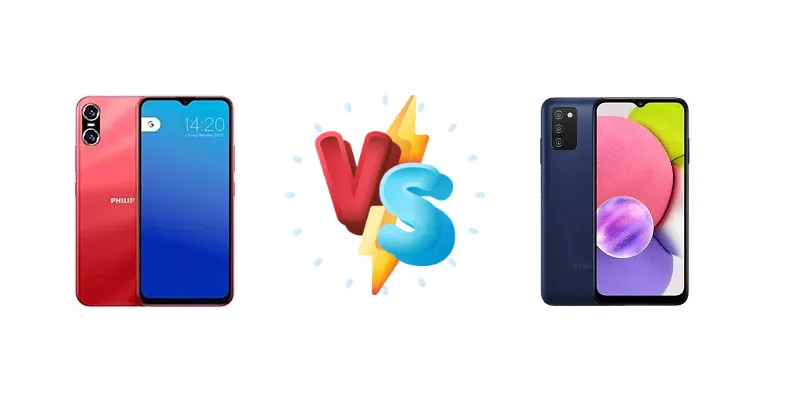
The sub-$150 smartphone market is fiercely competitive. Both the Philips PH1 and Samsung Galaxy A03s aim to deliver essential smartphone functionality at an accessible price point. However, they take different approaches: the Philips PH1 prioritizes a more modern, if less proven, chipset architecture, while the Samsung Galaxy A03s leans on brand recognition and a slightly more refined display experience. This comparison will dissect their key differences to determine which device offers the best value.
🏆 Quick Verdict
For most users, the Philips PH1 emerges as the better choice. Its Unisoc Tiger T310 chipset, featuring a Cortex-A75 core, provides a noticeable performance advantage over the Samsung Galaxy A03s’ Helio P35, especially in multitasking and app loading. While both phones offer similar battery endurance, the PH1’s superior processing power makes it the more versatile option.
| Network |
|---|
| 2G bands | GSM 850 / 900 / 1800 / 1900 | GSM 850 / 900 / 1800 / 1900 |
| 3G bands | HSDPA 850 / 900 / 2100 | HSDPA 850 / 900 / 2100 |
| 4G bands | 1, 3, 5, 8, 34, 38, 39, 40, 41 | 1, 3, 5, 7, 8, 20, 28, 38, 40, 41 |
| Speed | HSPA, LTE | HSPA 42.2/5.76 Mbps, LTE Cat4 150/50 Mbps |
| Technology | GSM / CDMA / HSPA / CDMA2000 / LTE | GSM / HSPA / LTE |
| | CDMA2000 1x | 2, 4, 5, 7, 12, 13, 14, 25, 26, 41, 66, 71 - SM-A037U |
| Launch |
|---|
| Announced | 2021, December 20. Released 2021, December 20 | 2021, August 18 |
| Status | Discontinued | Available. Released 2021, August 18 |
| Body |
|---|
| Build | Glass front, plastic back, plastic frame | Glass front, plastic frame, plastic back |
| Dimensions | 165.5 x 76.5 x 9.5 mm (6.52 x 3.01 x 0.37 in) | 164.2 x 75.9 x 9.1 mm (6.46 x 2.99 x 0.36 in) |
| SIM | Nano-SIM + Nano-SIM | Nano-SIM + Nano-SIM |
| Weight | 194 g (6.84 oz) | 196 g (6.91 oz) |
| Display |
|---|
| Resolution | 720 x 1440 pixels, 18:9 ratio (~247 ppi density) | 720 x 1600 pixels, 20:9 ratio (~270 ppi density) |
| Size | 6.51 inches, 109.4 cm2 (~86.4% screen-to-body ratio) | 6.5 inches, 102.0 cm2 (~81.8% screen-to-body ratio) |
| Type | IPS LCD | PLS LCD |
| Platform |
|---|
| CPU | Quad-core (1x2.0 GHz Cortex-A75 & 3x1.8 GHz Cortex-A55) | Octa-core (4x2.35 GHz Cortex-A53 & 4x1.8 GHz Cortex-A53) |
| Chipset | Unisoc Tiger T310 (12 nm) | Mediatek MT6765 Helio P35 (12 nm) |
| GPU | PowerVR GE8300 | PowerVR GE8320 |
| OS | Android OS | Android 11, upgradable to Android 13, One UI 5.1 Core |
| Memory |
|---|
| Card slot | microSDXC | microSDXC (dedicated slot) |
| Internal | 32GB 4GB RAM, 64GB 4GB RAM, 128GB 4GB RAM | 32GB 2GB RAM, 32GB 3GB RAM, 32GB 4GB RAM, 64GB 3GB RAM, 64GB 4GB RAM |
| | eMMC 5.1 | eMMC 5.1 |
| Main Camera |
|---|
| Dual | 13 MP, (wide), AF
3 MP | - |
| Features | LED flash | LED flash |
| Single | 5 MP | 5 MP, f/2.2 |
| Triple | - | 13 MP, f/2.2, (wide), AF
2 MP (macro)
Auxiliary lens |
| Video | 1080p@30fps | 1080p@30fps |
| Selfie camera |
|---|
| Single | 5 MP | 5 MP, f/2.2 |
| Video | - | 1080p@30fps |
| Sound |
|---|
| 3.5mm jack | Yes | Yes |
| 35mm jack | Yes | Yes |
| Loudspeaker | Yes | Yes |
| Comms |
|---|
| Bluetooth | 4.2, A2DP | 5.0, A2DP |
| NFC | No | Yes (market/region dependent) |
| Positioning | GPS, BDS | GPS, GLONASS, GALILEO, BDS |
| Radio | Unspecified | No |
| USB | USB Type-C 2.0 | USB Type-C 2.0 |
| WLAN | Wi-Fi 802.11 b/g/n, hotspot | Wi-Fi 802.11 b/g/n, Wi-Fi Direct |
| Features |
|---|
| Sensors | Accelerometer, proximity | Fingerprint (side-mounted), accelerometer, proximity |
| Battery |
|---|
| Charging | - | 15W wired |
| Type | Li-Ion 4700 mAh | Li-Po 5000 mAh |
| Misc |
|---|
| Colors | Gray, Blue, Red | Black, Blue, White |
| Models | S701, Xenium S701 | SM-A037F, SM-A037F/DS, SM-A037M, SM-A037G, SM-A037U, SM-S134DL, SM-A037W, SM-A037U1, SM-S135DL |
| Price | About 70 EUR | $ 65.65 / £ 82.99 / ₹ 10,800 |
| SAR EU | - | 0.36 W/kg (head) 1.09 W/kg (body) |
| Tests |
|---|
| Battery life | - |
Endurance rating 122h
|
| Camera | - |
Photo / Video |
| Display | - |
Contrast ratio: 1718:1 (nominal) |
| Loudspeaker | - |
-27.4 LUFS (Good)
|
| Performance | - |
AnTuTu: 103465 (v8), 101299 (v9)
GeekBench: 889 (v5.1)
GFXBench: 5.5fps (ES 3.1 onscreen) |
Philips PH1
- More powerful processor (Unisoc Tiger T310 with Cortex-A75)
- Potentially smoother multitasking experience
- More modern chipset architecture
- Display brightness not specified, likely lower than A03s
- Less established brand recognition
Samsung Galaxy A03s
- Brighter display (488 nits)
- Well-known brand (Samsung)
- 15W fast charging
- Less powerful processor (Helio P35)
- Older chipset architecture (all Cortex-A53 cores)
- Potentially slower app loading and multitasking
Display Comparison
Both the Philips PH1 and Samsung Galaxy A03s share a 1718:1 contrast ratio, suggesting similar panel characteristics in terms of black levels and color depth. However, the Samsung Galaxy A03s boasts a measured peak brightness of 488 nits, which will provide better visibility outdoors. The Philips PH1’s display brightness is not specified, but is likely lower. Both displays are likely LCD panels, common in this price bracket, and lack features like high refresh rates or HDR support. The A03s’ slightly higher brightness is a tangible benefit for outdoor usability.
Camera Comparison
Both devices offer basic photo and video capabilities, but details are sparse. Neither phone is expected to excel in image quality. The absence of specific sensor information suggests both likely utilize low-resolution primary sensors. Focusing on megapixel counts alone is misleading; sensor size and image processing algorithms are far more important. Given the price point, image quality will likely be similar, with both struggling in low-light conditions. The presence of a 'Photo/Video' specification on both is too vague to draw meaningful conclusions.
Performance
The core difference lies in the chipsets. The Samsung Galaxy A03s utilizes the Mediatek Helio P35, an octa-core processor comprised entirely of Cortex-A53 cores clocked at 2.35 GHz and 1.8 GHz. The Philips PH1, conversely, employs the Unisoc Tiger T310, a quad-core chip featuring a single high-performance Cortex-A75 core at 2.0 GHz alongside three Cortex-A55 cores at 1.8 GHz. While the Helio P35 has more cores, the A75 core in the Tiger T310 offers significantly higher single-core performance, crucial for responsive app launches and smoother multitasking. This architectural difference translates to a more fluid user experience on the Philips PH1, despite having fewer cores overall. The Helio P35’s all-A53 configuration will struggle more with demanding applications.
Battery Life
Both the Philips PH1 and Samsung Galaxy A03s achieve an endurance rating of 122 hours, indicating comparable battery life under similar usage conditions. The Samsung Galaxy A03s supports 15W wired charging, which is a standard speed for this segment. The Philips PH1’s charging speed is not specified, but is likely similar or slightly slower. The identical endurance ratings suggest that despite potential differences in battery capacity (not specified for either device), power efficiency is comparable, largely dictated by the LCD displays and low-power chipsets.
Buying Guide
Buy the Philips PH1 if you need a phone that feels responsive for everyday tasks, handles multiple apps without significant slowdown, and offers a more future-proof chipset. Buy the Samsung Galaxy A03s if you prioritize a well-established brand, a slightly brighter display (488 nits vs. an estimated lower value for the PH1), and are primarily focused on basic smartphone functions like calls, texts, and light social media use.
Frequently Asked Questions
❓ Will the Helio P35 in the Samsung Galaxy A03s struggle with modern mobile games?
Yes, the Helio P35 is a relatively weak chipset. While it can handle less demanding games, you'll likely experience significant frame rate drops and lag in more graphically intensive titles like PUBG Mobile or Call of Duty Mobile, even on low settings. The Philips PH1’s A75 core will offer a more playable experience, though still limited.
❓ Is the Unisoc Tiger T310 chipset reliable and well-supported?
Unisoc has been steadily improving its chipsets, and the Tiger T310 is a competent performer for its price range. While it doesn't have the same level of brand recognition as MediaTek or Qualcomm, it's generally considered reliable. Software support and updates may be less frequent compared to Samsung devices, however.
❓ How much storage do these phones typically come with, and is it expandable?
While not specified in the provided data, both the Philips PH1 and Samsung Galaxy A03s typically ship with 32GB or 64GB of internal storage. Crucially, both devices *do* support microSD card expansion, allowing you to add up to 1TB of additional storage, which is essential given the limited base storage.