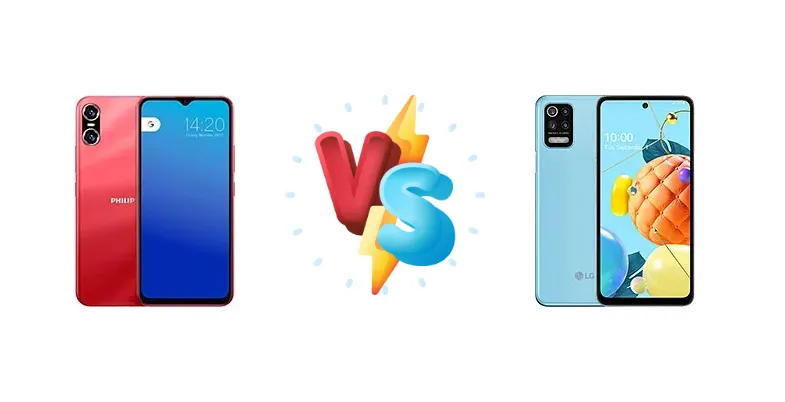
The Philips PH1 and LG K62 represent two contenders in the fiercely competitive budget smartphone market. Both devices aim to deliver essential smartphone functionality at an accessible price point, but they achieve this with significantly different approaches to core hardware. This comparison will dissect the key differences, focusing on the chipset architecture and its impact on everyday use.
🏆 Quick Verdict
For the average user prioritizing responsiveness and occasional multitasking, the Philips PH1 is the better choice. Its Unisoc Tiger T310, featuring a Cortex-A75 core, offers a noticeable performance advantage over the LG K62’s Helio P35, despite the latter’s octa-core configuration. However, the K62 may appeal to those who prefer a more widespread brand and potentially better software support.
| Network |
|---|
| 2G bands | GSM 850 / 900 / 1800 / 1900 | GSM 850 / 900 / 1800 / 1900 |
| 3G bands | HSDPA 850 / 900 / 2100 | HSDPA 850 / 900 / 1900 / 2100 |
| 4G bands | 1, 3, 5, 8, 34, 38, 39, 40, 41 | 1, 2, 3, 4, 5, 7, 8, 12, 13, 17, 28, 38, 66 - North America |
| Speed | HSPA, LTE | HSPA 42.2/5.76 Mbps, LTE (2CA) Cat6 300/50 Mbps |
| Technology | GSM / CDMA / HSPA / CDMA2000 / LTE | GSM / HSPA / LTE |
| | CDMA2000 1x | 1, 3, 5, 7, 28, 40 - Brazil |
| Launch |
|---|
| Announced | 2021, December 20. Released 2021, December 20 | 2020, September 23. Released 2020, November 27 |
| Status | Discontinued | Discontinued |
| Body |
|---|
| Build | Glass front, plastic back, plastic frame | - |
| Dimensions | 165.5 x 76.5 x 9.5 mm (6.52 x 3.01 x 0.37 in) | 165 x 76.7 x 8.4 mm (6.50 x 3.02 x 0.33 in) |
| SIM | Nano-SIM + Nano-SIM | Nano-SIM + Nano-SIM |
| Weight | 194 g (6.84 oz) | 186 g (6.56 oz) |
| | - | MIL-STD-810G compliant*
*does not guarantee ruggedness or use in extreme conditions |
| Display |
|---|
| Resolution | 720 x 1440 pixels, 18:9 ratio (~247 ppi density) | 720 x 1600 pixels, 20:9 ratio (~266 ppi density) |
| Size | 6.51 inches, 109.4 cm2 (~86.4% screen-to-body ratio) | 6.6 inches, 105.2 cm2 (~83.1% screen-to-body ratio) |
| Type | IPS LCD | IPS LCD |
| Platform |
|---|
| CPU | Quad-core (1x2.0 GHz Cortex-A75 & 3x1.8 GHz Cortex-A55) | Octa-core (4x2.3 GHz Cortex-A53 & 4x1.8 GHz Cortex-A53) |
| Chipset | Unisoc Tiger T310 (12 nm) | Mediatek MT6765 Helio P35 (12 nm) |
| GPU | PowerVR GE8300 | PowerVR GE8320 |
| OS | Android OS | Android 10 |
| Memory |
|---|
| Card slot | microSDXC | microSDXC |
| Internal | 32GB 4GB RAM, 64GB 4GB RAM, 128GB 4GB RAM | 64GB 4GB RAM, 128GB 4GB RAM |
| | eMMC 5.1 | - |
| Main Camera |
|---|
| Dual | 13 MP, (wide), AF
3 MP | - |
| Features | LED flash | Dual-LED flash, panorama, HDR |
| Quad | - | 48 MP, f/1.8, (wide), 1/2.0", 0.8µm, PDAF
5 MP, f/2.2, 115˚ (ultrawide), 1/5.0", 1.12µm
2 MP (macro)
Auxiliary lens |
| Single | 5 MP | - |
| Video | 1080p@30fps | 1080p@30fps |
| Selfie camera |
|---|
| Single | 5 MP | 28 MP |
| Video | - | 1080p@30fps |
| Sound |
|---|
| 3.5mm jack | Yes | Yes |
| 35mm jack | Yes | Yes |
| Loudspeaker | Yes | Yes |
| Comms |
|---|
| Bluetooth | 4.2, A2DP | 5.0, A2DP, LE |
| NFC | No | Yes |
| Positioning | GPS, BDS | GPS |
| Radio | Unspecified | No |
| USB | USB Type-C 2.0 | USB Type-C 3.1 |
| WLAN | Wi-Fi 802.11 b/g/n, hotspot | Wi-Fi 802.11 a/b/g/n/ac, dual-band, Wi-Fi Direct |
| Features |
|---|
| Sensors | Accelerometer, proximity | Fingerprint (side-mounted), accelerometer, proximity, compass |
| Battery |
|---|
| Type | Li-Ion 4700 mAh | Li-Po 4000 mAh |
| Misc |
|---|
| Colors | Gray, Blue, Red | White, Sky Blue, Red |
| Models | S701, Xenium S701 | LMK525H, LMK525, LM-K525H, LM-K525 |
| Price | About 70 EUR | About 290 EUR |
Philips PH1
- More efficient CPU architecture (Cortex-A75)
- Potentially smoother performance for daily tasks
- Likely better sustained performance due to core efficiency
- Less established brand recognition
- Limited information available on display and camera specs
LG K62
- Wider brand recognition (LG)
- Potentially better software support (LG)
- Octa-core configuration (though less efficient)
- Older and less efficient CPU architecture (Cortex-A53)
- Likely slower single-core performance
- May exhibit more noticeable slowdowns under load
Display Comparison
Neither Philips nor LG provide display specifications beyond the basic screen size. Given the price point, both likely utilize IPS LCD panels. The absence of details like peak brightness, color gamut coverage, or refresh rate suggests a focus on cost reduction. Expect similar viewing experiences in typical indoor lighting conditions, but neither will excel in direct sunlight. Bezels are likely to be substantial on both devices, consistent with their budget positioning.
Camera Comparison
Detailed camera specifications are unavailable. However, given the market segment, both phones likely feature a primary camera sensor paired with auxiliary lenses of limited utility (e.g., a 2MP macro or depth sensor). Image quality will heavily rely on software processing. Without knowing sensor sizes or apertures, it’s difficult to definitively declare a winner. The image processing style will likely differ between the two brands, potentially favoring different color profiles or levels of sharpening. Expect acceptable results in good lighting conditions, but both will struggle in low-light scenarios.
Performance
The core difference lies in the chipset architecture. The Philips PH1’s Unisoc Tiger T310 employs a quad-core configuration with a single high-performance Cortex-A75 core clocked at 2.0 GHz, paired with three Cortex-A55 cores at 1.8 GHz. This 'big.LITTLE' approach prioritizes efficiency and burst performance. Conversely, the LG K62’s MediaTek Helio P35 utilizes an octa-core setup of four Cortex-A53 cores at 2.3 GHz and another four at 1.8 GHz. While the K62 boasts more cores, the Cortex-A53 architecture is significantly older and less efficient than the Cortex-A75. The A75’s wider instruction set and improved IPC (Instructions Per Clock) translate to faster single-core performance, crucial for responsive app launches and smoother UI navigation. The K62’s higher clock speed on the A53 cores won’t fully compensate for this architectural disadvantage. Both chipsets are built on a 12nm process, suggesting similar power consumption characteristics, but the PH1’s more efficient core design will likely result in better sustained performance.
Battery Life
Battery capacity details are missing for both devices. However, given the chipset power consumption, both should offer all-day battery life with moderate usage. Charging wattage is also unknown. The Unisoc T310’s efficiency might give the PH1 a slight edge in battery endurance, but this is speculative without concrete data. The absence of fast charging support is highly probable on both models.
Buying Guide
Buy the Philips PH1 if you need a phone that feels snappier for daily tasks like browsing, social media, and light app usage. The Cortex-A75 core provides a tangible boost in single-core performance, making the experience more fluid. Buy the LG K62 if you prioritize a brand with a longer track record in the smartphone market and potentially more readily available accessories, even if it means sacrificing some raw processing power.
Frequently Asked Questions
❓ Will the LG K62’s Helio P35 struggle with multitasking compared to the Philips PH1?
Yes, the LG K62’s Helio P35, utilizing older Cortex-A53 cores, will likely exhibit more noticeable slowdowns when multitasking compared to the Philips PH1’s Unisoc Tiger T310 with its Cortex-A75 core. The A75 core provides a significant boost in single-core performance, which is crucial for handling multiple apps simultaneously.
❓ Is the octa-core configuration of the LG K62 more beneficial than the quad-core setup of the Philips PH1?
Not necessarily. While the LG K62 has more cores, the underlying architecture matters more. The Philips PH1’s Cortex-A75 core is significantly more powerful and efficient than the LG K62’s Cortex-A53 cores. A smaller number of more capable cores often outperform a larger number of less capable cores, especially in everyday tasks.
❓ Can either of these phones handle demanding games like PUBG Mobile?
Both phones will likely struggle with demanding games like PUBG Mobile at higher settings. The GPUs in both the Unisoc Tiger T310 and Helio P35 are entry-level. Expect to play at low to medium settings with reduced frame rates for a playable experience. The PH1 might offer slightly better performance due to its more efficient CPU, but neither is a gaming powerhouse.