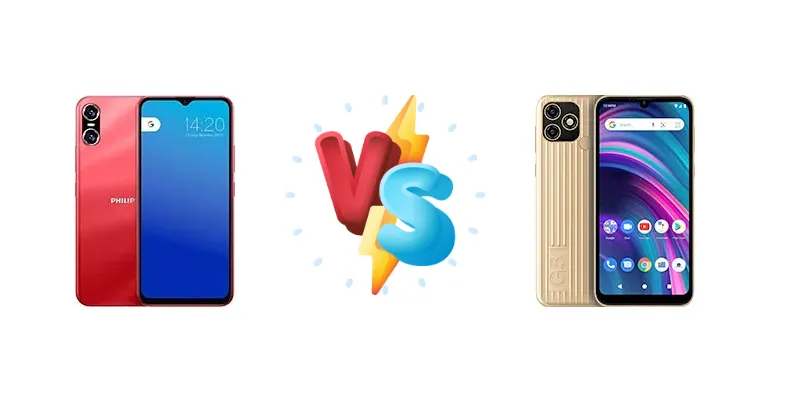
The Philips PH1 and BLU G51 represent the extreme end of the smartphone price spectrum, targeting users who prioritize affordability above all else. Both devices utilize 12nm process technology, but diverge significantly in their chipset choices – the Philips opting for Unisoc’s Tiger T310, while the BLU relies on MediaTek’s Helio A22. This comparison dissects these core differences to determine which phone delivers the best experience for basic smartphone tasks.
🏆 Quick Verdict
For the average user seeking a functional, ultra-budget smartphone, the Philips PH1 emerges as the slightly better choice. Its Unisoc Tiger T310, featuring a Cortex-A75 core, provides a noticeable performance edge over the BLU G51’s all-Cortex-A53 Helio A22, resulting in smoother multitasking and app loading.
| Network |
|---|
| 2G bands | GSM 850 / 900 / 1800 / 1900 | GSM 850 / 900 / 1800 / 1900 |
| 3G bands | HSDPA 850 / 900 / 2100 | HSDPA 850 / 900 / 1700(AWS) / 1900 / 2100 |
| 4G bands | 1, 3, 5, 8, 34, 38, 39, 40, 41 | 2, 3, 4, 5, 7, 12, 17, 28, 66 |
| Speed | HSPA, LTE | HSPA, LTE |
| Technology | GSM / CDMA / HSPA / CDMA2000 / LTE | GSM / HSPA / LTE |
| | CDMA2000 1x | - |
| Launch |
|---|
| Announced | 2021, December 20. Released 2021, December 20 | 2022, June 03 |
| Status | Discontinued | Available. Released 2022, June 03 |
| Body |
|---|
| Build | Glass front, plastic back, plastic frame | - |
| Dimensions | 165.5 x 76.5 x 9.5 mm (6.52 x 3.01 x 0.37 in) | 155.3 x 73.5 x 9.5 mm (6.11 x 2.89 x 0.37 in) |
| SIM | Nano-SIM + Nano-SIM | Nano-SIM + Nano-SIM |
| Weight | 194 g (6.84 oz) | 166 g (5.86 oz) |
| Display |
|---|
| Resolution | 720 x 1440 pixels, 18:9 ratio (~247 ppi density) | 720 x 1520 pixels, 19:9 ratio (~276 ppi density) |
| Size | 6.51 inches, 109.4 cm2 (~86.4% screen-to-body ratio) | 6.1 inches, 92.9 cm2 (~81.4% screen-to-body ratio) |
| Type | IPS LCD | IPS LCD |
| Platform |
|---|
| CPU | Quad-core (1x2.0 GHz Cortex-A75 & 3x1.8 GHz Cortex-A55) | Quad-core 2.0 GHz Cortex-A53 |
| Chipset | Unisoc Tiger T310 (12 nm) | Mediatek MT6761 Helio A22 (12 nm) |
| GPU | PowerVR GE8300 | PowerVR GE8320 |
| OS | Android OS | Android 11 (Go edition) |
| Memory |
|---|
| Card slot | microSDXC | microSDXC |
| Internal | 32GB 4GB RAM, 64GB 4GB RAM, 128GB 4GB RAM | 32GB 2GB RAM |
| | eMMC 5.1 | eMMC 5.1 |
| Main Camera |
|---|
| Dual | 13 MP, (wide), AF
3 MP | 8 MP
Auxiliary lens |
| Features | LED flash | LED flash, HDR, panorama |
| Single | 5 MP | 8 MP |
| Video | 1080p@30fps | 1080p@30fps |
| Selfie camera |
|---|
| Single | 5 MP | 8 MP |
| Video | - | 720p@30fps |
| Sound |
|---|
| 3.5mm jack | Yes | Yes |
| 35mm jack | Yes | Yes |
| Loudspeaker | Yes | Yes |
| Comms |
|---|
| Bluetooth | 4.2, A2DP | 4.2, A2DP, LE |
| NFC | No | No |
| Positioning | GPS, BDS | GPS |
| Radio | Unspecified | FM radio |
| USB | USB Type-C 2.0 | microUSB 2.0 |
| WLAN | Wi-Fi 802.11 b/g/n, hotspot | Wi-Fi 802.11 a/b/g/n, Wi-Fi Direct |
| Features |
|---|
| Sensors | Accelerometer, proximity | Fingerprint (rear-mounted), accelerometer, proximity |
| Battery |
|---|
| Type | Li-Ion 4700 mAh | Li-Po 3000 mAh |
| Misc |
|---|
| Colors | Gray, Blue, Red | Black, Blue, Green, Silver, Gold |
| Models | S701, Xenium S701 | - |
| Price | About 70 EUR | - |
Philips PH1
- More powerful CPU with Cortex-A75 core
- Potentially smoother multitasking
- Slightly better app loading times
- Brand recognition is lower than BLU in some markets
- Camera quality likely similar to BLU G51
BLU G51
- Established brand in the budget smartphone space
- Potentially longer battery life due to less demanding CPU
- Very affordable price point
- Less powerful CPU with all Cortex-A53 cores
- Struggles with multitasking and demanding apps
- Slower app loading times
Display Comparison
Neither Philips nor BLU provide detailed display specifications beyond resolution. Given the price point, both likely utilize IPS LCD panels. The focus here is on the chipset's ability to drive the display smoothly. The slightly more powerful CPU in the PH1 *may* translate to marginally faster UI responsiveness, but this will be minimal. Bezels are expected to be substantial on both devices, and color accuracy is unlikely to be a strong point.
Camera Comparison
Detailed camera specifications are unavailable for either device. However, given the target market, expectations should be tempered. Both phones likely feature a primary camera and potentially a secondary depth sensor. Image processing will be basic, and low-light performance will be limited. The chipset’s ISP (Image Signal Processor) capabilities are likely similar, meaning the camera experience will be largely determined by sensor quality, which is unknown. Focusing on the CPU, the PH1’s slightly more capable processor *could* contribute to marginally faster image processing times, but the difference will be minimal.
Performance
The core difference lies in the CPU architecture. The Philips PH1’s Unisoc Tiger T310 employs a quad-core configuration with one high-performance Cortex-A75 core clocked at 2.0 GHz, alongside three efficiency-focused Cortex-A55 cores at 1.8 GHz. This 'big.LITTLE' approach offers a significant advantage over the BLU G51’s Helio A22, which utilizes four Cortex-A53 cores all clocked at 2.0 GHz. The A75 core in the PH1 provides a substantial boost in single-core performance, crucial for app launch times and general responsiveness. While both chipsets are 12nm, the architectural advantage of the A75 gives the PH1 a clear edge. The Helio A22 is known for being adequate for basic tasks, but struggles with multitasking or demanding applications.
Battery Life
Battery capacity is not specified for either device. However, the more efficient CPU architecture of the Unisoc Tiger T310 in the Philips PH1 *could* lead to slightly better battery life, despite potentially having a similar capacity to the BLU G51. The Helio A22, while less powerful, is also relatively efficient. Charging wattage is also unknown, but both are likely to support standard 5W or 10W charging, resulting in relatively slow 0-100% charge times.
Buying Guide
Buy the Philips PH1 if you need a phone capable of handling slightly more demanding tasks like light web browsing with multiple tabs, or if you anticipate using apps that benefit from a more powerful CPU core. Buy the BLU G51 if your primary needs are limited to basic calling, texting, and extremely light app usage, and you prioritize maximizing battery life over performance.
Frequently Asked Questions
❓ Will the Philips PH1 handle popular social media apps like Facebook and Instagram without lag?
Yes, the Philips PH1’s Unisoc Tiger T310 chipset, with its Cortex-A75 core, should be capable of running Facebook and Instagram smoothly, even with multiple apps open. The Helio A22 in the BLU G51 can also run these apps, but may exhibit occasional lag or slowdowns during multitasking.
❓ Is either phone suitable for playing mobile games like PUBG Mobile or Call of Duty Mobile?
Neither the Philips PH1 nor the BLU G51 are well-suited for playing demanding mobile games like PUBG Mobile or Call of Duty Mobile. Both chipsets lack the graphical power to deliver a playable experience at acceptable frame rates and settings. They may be able to run less demanding 2D games, but 3D titles will likely be a struggle.
❓ Which phone is better for someone who primarily uses their phone for calls and texts?
For users who primarily use their phone for calls and texts, the BLU G51 is a perfectly adequate choice. Its Helio A22 chipset is sufficient for these basic tasks, and it may offer slightly better battery life. The Philips PH1 will perform these tasks equally well, but the extra performance is unlikely to be noticeable.