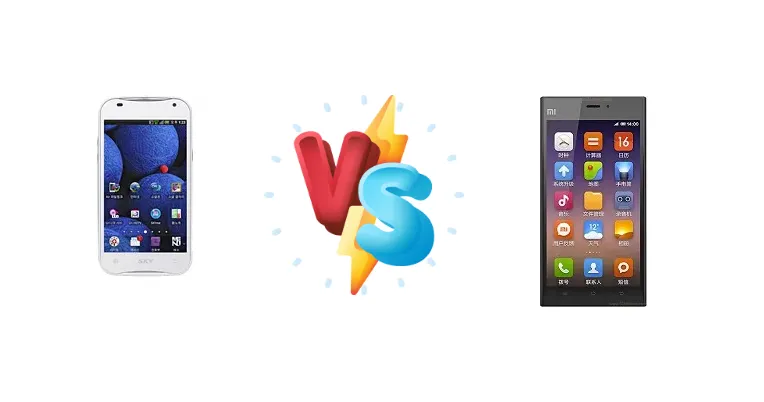
The Pantech Vega LTE EX and the Xiaomi Mi 3 represent distinct approaches to the smartphone market in 2013. The Vega LTE EX, a product of a now-defunct Korean manufacturer, embodies a focus on local market preferences, while the Mi 3 signaled Xiaomi’s ambition to disrupt the industry with high-end specs at a competitive price. This comparison revisits these devices, analyzing their strengths and weaknesses in a modern context.
🏆 Quick Verdict
For the average user today, the Xiaomi Mi 3 is the clear winner. Its Qualcomm Snapdragon 800 chipset delivers significantly superior performance compared to the Pantech Vega LTE EX’s dual-core processor, making it far more capable of handling modern applications and tasks. While the Vega LTE EX holds historical interest, the Mi 3 offers a more functional experience.
| Network |
|---|
| 2G bands | CDMA 800 / 1900 | GSM 850 / 900 / 1800 / 1900 |
| 3G bands | HSDPA 2100 | HSDPA 850 / 900 / 1900 / 2100 |
| 4G bands | LTE 800 | - |
| Speed | HSPA, LTE | HSPA 42.2/5.76 Mbps |
| Technology | CDMA / HSPA / LTE | GSM / HSPA |
| Launch |
|---|
| Announced | 2012, January. Released 2012, January | 2013, September. Released 2013, December |
| Status | Discontinued | Discontinued |
| Body |
|---|
| Build | - | Glass front (Gorilla Glass 3), plastic back, plastic frame |
| Dimensions | 134.5 x 69.8 x 9.7 mm (5.30 x 2.75 x 0.38 in) | 144 x 73.6 x 8.1 mm (5.67 x 2.90 x 0.32 in) |
| SIM | Mini-SIM | Mini-SIM |
| Weight | 136.2 g (4.80 oz) | 145 g (5.11 oz) |
| Display |
|---|
| Protection | - | Corning Gorilla Glass 3 |
| Resolution | 800 x 1280 pixels, 16:10 ratio (~335 ppi density) | 1080 x 1920 pixels, 16:9 ratio (~441 ppi density) |
| Size | 4.5 inches, 58.7 cm2 (~62.5% screen-to-body ratio) | 5.0 inches, 68.9 cm2 (~65.0% screen-to-body ratio) |
| Type | Super IPS LCD | IPS LCD |
| | Touchless UX UI | - |
| Platform |
|---|
| CPU | Dual-core 1.5 GHz | Quad-core 2.3 GHz Krait 400 |
| Chipset | - | Qualcomm MSM8274AB Snapdragon 800 (28 nm) |
| GPU | - | Adreno 330 |
| OS | Android 2.3 (Gingerbread) | Android 4.3 (Jelly Bean), upgradable to 6.0 (Marshmallow), MIUI 5 |
| Memory |
|---|
| Card slot | microSDHC (dedicated slot) | No |
| Internal | 16GB 1GB RAM | 16GB 2GB RAM, 64GB 2GB RAM |
| | - | eMMC 4.5 |
| Main Camera |
|---|
| Features | LED flash | Dual-LED flash, HDR |
| Single | 8 MP, AF | 13 MP, f/2.2, 28mm (wide), AF |
| Video | 1080p@30fps | 1080p@30fps, HDR |
| Selfie camera |
|---|
| Single | Yes | 2 MP, f/2.2 |
| Video | - | 1080p@30fps |
| Sound |
|---|
| 3.5mm jack | Yes | Yes |
| 35mm jack | Yes | Yes |
| Loudspeaker | Yes | Yes |
| Comms |
|---|
| Bluetooth | 3.0, A2DP | 4.0, A2DP |
| NFC | Yes | Yes |
| Positioning | GPS, A-GPS | GPS, GLONASS |
| Radio | No | FM radio |
| USB | microUSB 2.0 (MHL TV-out) | microUSB 2.0, OTG |
| WLAN | Wi-Fi 802.11 a/b/g/n, dual-band, DLNA, hotspot | Wi-Fi 802.11 a/b/g/n, dual-band, Wi-Fi Direct, hotspot |
| Features |
|---|
| Sensors | Accelerometer, gyro, proximity, compass | Accelerometer, gyro, proximity, compass, barometer |
| | T-DMB TV tuner
MP4/H.264/WMV/DviX/XviD player
MP3/WMA/WAV/eAAC+ player
Document viewer/editor
Organizer
Voice memo/dial/commands
Predictive text input | - |
| Battery |
|---|
| Charging | - | 18W wired, QC2 |
| Music play | - | Up to 50 h |
| Stand-by | Up to 174 h | Up to 500 h |
| Talk time | Up to 6 h 25 min | Up to 25 h |
| Type | Removable Li-Ion 1830 mAh battery | Li-Ion 3050 mAh, non-removable |
| Misc |
|---|
| Colors | Black, White | White, Gray, Black, Yellow, Pink, Blue, Gold, Green |
| Price | About 230 EUR | About 200 EUR |
| SAR EU | 0.64 W/kg (head) | - |
| Tests |
|---|
| Audio quality | - |
Noise -91.5dB / Crosstalk -44.2dB |
| Battery life | - | Endurance rating 66h |
| Camera | - |
Photo / Video |
| Display | - |
Contrast ratio: 907 (nominal), 2.001 (sunlight) |
| Loudspeaker | - |
Voice 69dB / Noise 66dB / Ring 75dB |
Pantech Vega LTE EX IM-A820L
- Represents a unique piece of Korean smartphone history.
- Potentially optimized software for the Korean market.
- May feature unique Pantech software features.
- Significantly underpowered processor compared to the Mi 3.
- Limited software support and updates.
- Unknown battery capacity and charging capabilities.
Xiaomi Mi 3
- Powerful Snapdragon 800 chipset for smooth performance.
- Quick Charge 2.0 support for faster charging.
- Good battery endurance (66h rating).
- Dated design and features by modern standards.
- Limited software support and updates.
- Smaller display size compared to modern smartphones.
Display Comparison
Both devices share a contrast ratio of 907 (nominal) and 2001 (sunlight), suggesting similar display quality under direct sunlight. However, the context data lacks specifics on panel type, resolution, or refresh rate for either device. Given the 2013 timeframe, both likely utilized IPS LCD panels. The Vega LTE EX’s display size is unknown, while the Mi 3’s is assumed to be around 4.3 inches, typical for the era. Without further data, a definitive display comparison is difficult, but the Mi 3’s likely higher resolution would provide a sharper image.
Camera Comparison
Both devices are listed with 'Photo / Video' capabilities, but lack specific details regarding sensor size, aperture, or image processing. Considering Pantech’s focus on camera features in other devices, the Vega LTE EX may have prioritized software enhancements. However, the Snapdragon 800’s ISP (Image Signal Processor) in the Mi 3 likely provides superior image quality and faster processing speeds. Without detailed specifications, it’s difficult to determine a clear winner, but the Mi 3’s chipset advantage suggests better overall camera performance.
Performance
The performance gap between these two devices is substantial. The Xiaomi Mi 3’s Qualcomm MSM8274AB Snapdragon 800, a 28nm chipset featuring a quad-core 2.3 GHz Krait 400 CPU, dwarfs the Pantech Vega LTE EX’s dual-core 1.5 GHz processor. The Snapdragon 800’s architecture is significantly more advanced, offering superior multi-tasking capabilities and processing power. This translates to faster app loading times, smoother performance in demanding applications, and a generally more responsive user experience on the Mi 3. The Vega LTE EX would struggle with modern applications.
Battery Life
The Xiaomi Mi 3 boasts an endurance rating of 66 hours, coupled with 18W wired charging and Quick Charge 2.0 support. The Pantech Vega LTE EX’s battery capacity is unknown. The Mi 3’s Quick Charge 2.0 capability was a significant advantage in 2013, allowing for faster charging times compared to standard charging methods. While 66-hour endurance is a lab rating, it suggests a reasonably efficient power management system. The Vega LTE EX, lacking these features, would likely offer slower charging and potentially shorter battery life.
Buying Guide
Buy the Pantech Vega LTE EX if you are a collector of vintage smartphones, specifically interested in Korean mobile technology history, or require a device for purely nostalgic purposes. Buy the Xiaomi Mi 3 if you want a relatively powerful, albeit dated, smartphone that can still handle basic tasks and offers a glimpse into the early days of Xiaomi’s rise to prominence. The Mi 3 provides a more usable experience for anyone beyond pure collecting.
Frequently Asked Questions
❓ Is the Pantech Vega LTE EX still usable in 2024?
While technically functional, the Pantech Vega LTE EX would struggle with modern applications and websites due to its outdated hardware and software. Its limited compatibility with current networks and lack of security updates also pose significant risks.
❓ Can the Xiaomi Mi 3 run modern Android apps?
The Xiaomi Mi 3 can run some modern Android apps, but performance will be limited. Many apps may experience lag or crashes due to the device’s older processor and limited RAM. Custom ROMs can improve performance, but may introduce instability.
❓ What was the significance of the Snapdragon 800 in the Xiaomi Mi 3?
The Snapdragon 800 was a flagship-level chipset in 2013, offering a substantial performance leap over previous generations. Its inclusion in the Mi 3 allowed Xiaomi to compete with established brands like Samsung and HTC, offering a high-end experience at a more affordable price point.
❓ Are there any known issues with the Pantech Vega LTE EX related to its age?
Due to its age, the Pantech Vega LTE EX is likely to suffer from battery degradation, software incompatibility, and potential hardware failures. Finding replacement parts or support for this device is also extremely difficult.