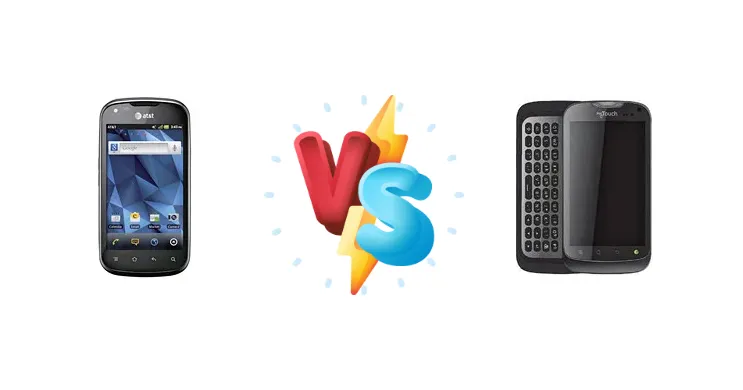
Released around the same timeframe, the Pantech Burst and T-Mobile myTouch qwerty represent different approaches to the Android experience. The Burst aimed for a balance of performance and affordability with a modern Snapdragon processor, while the myTouch qwerty focused on physical keyboard enthusiasts. This comparison dissects their core specifications to determine which device offered the better value proposition in its era.
🏆 Quick Verdict
For the average user seeking a more responsive experience, the Pantech Burst is the clear winner. Its dual-core 1.5 GHz Snapdragon S3 chipset provides a significant performance advantage over the myTouch qwerty’s single-core 1.4 GHz processor, translating to smoother multitasking and app loading. While the myTouch’s keyboard is a draw for some, the Burst’s overall capabilities are superior.
| Network |
|---|
| 2G bands | GSM 850 / 900 / 1800 / 1900 | GSM 850 / 900 / 1800 / 1900 |
| 3G bands | HSDPA 850 / 1900 / 2100 | HSDPA 850 / 1700 / 1900 / 2100 |
| 4G bands | 4, 17 | - |
| Speed | HSPA, LTE | HSPA 21.1/5.76 Mbps |
| Technology | GSM / HSPA / LTE | GSM / HSPA |
| Launch |
|---|
| Announced | 2012, January. Released 2012, January | Not officially announced yet |
| Status | Discontinued | Cancelled |
| Body |
|---|
| Dimensions | 126.5 x 62.5 x 11.4 mm (4.98 x 2.46 x 0.45 in) | - |
| Keyboard | - | QWERTY |
| SIM | Micro-SIM | Mini-SIM |
| Weight | 122.5 g (4.30 oz) | - |
| Display |
|---|
| Resolution | 480 x 800 pixels, 5:3 ratio (~233 ppi density) | 480 x 800 pixels, 5:3 ratio (~233 ppi density) |
| Size | 4.0 inches, 45.5 cm2 (~57.6% screen-to-body ratio) | 4.0 inches, 45.5 cm2 |
| Type | Super AMOLED, 256K colors | IPS LCD |
| Platform |
|---|
| CPU | Dual-core 1.5 GHz Scorpion | 1.4 GHz |
| Chipset | Qualcomm MSM8660 Snapdragon S3 | - |
| GPU | Adreno 220 | - |
| OS | Android 2.3.5 (Gingerbread), upgradable to 4.0 (Ice Cream Sandwich) | Android 4.0 (Ice Cream Sandwich) |
| Memory |
|---|
| Card slot | microSDHC (dedicated slot) | microSDHC |
| Internal | 16GB 1GB RAM | 4GB 1GB RAM |
| Main Camera |
|---|
| Features | LED flash | LED flash, HDR |
| Single | 5 MP, AF | 5 MP, AF |
| Video | 720p@30fps | 1080p@30fps |
| Selfie camera |
|---|
| Single | VGA | Yes |
| Sound |
|---|
| 3.5mm jack | Yes | Yes |
| 35mm jack | Yes | Yes |
| Loudspeaker | Yes | Yes |
| Comms |
|---|
| Bluetooth | 3.0, A2DP | 4.0, A2DP |
| Positioning | GPS, A-GPS | GPS, A-GPS |
| Radio | No | FM Radio |
| USB | microUSB 2.0 | microUSB 2.0 |
| WLAN | Wi-Fi 802.11 b/g/n, hotspot | Wi-Fi 802.11 b/g/n, DLNA, hotspot |
| Features |
|---|
| Sensors | Accelerometer, proximity, compass | Accelerometer, proximity, compass |
| | MP4/WMV/H.264 player
MP3/WAV/eAAC+ player
Organizer
Photo/video editor
Document viewer
Voice memo/dial
Predictive text input | T-Mobile TV
MP4/WMV/H.264 player
MP3/WAV/WMA/eAAC+ player
Organizer
Document viewer
Voice memo/dial/commands
Predictive text input |
| Battery |
|---|
| Stand-by | Up to 240 h | - |
| Talk time | Up to 4 h 30 min | - |
| Type | Removable Li-Ion 1650 mAh battery | Removable Li-Ion battery |
| Misc |
|---|
| Colors | Titanium, Ruby Red | White, Black |
| Price | About 270 EUR | - |
| Tests |
|---|
| Battery life |
Endurance rating 31h
| - |
Pantech Burst
- Faster dual-core processor for smoother performance
- More efficient Snapdragon S3 chipset for better battery life
- Potentially better graphics performance
- Lack of a physical keyboard
- Limited camera information available
T-Mobile myTouch qwerty
- Physical QWERTY keyboard for tactile typing
- Compact form factor
- Familiar T-Mobile branding
- Slower single-core processor
- Likely shorter battery life
- Less responsive user experience
Display Comparison
Information regarding display specifications (resolution, panel type, brightness) is unavailable for either device. However, given their release timeframe and market positioning, it's reasonable to assume both utilized LCD panels with resolutions typical of the era (likely 480x800). The absence of detailed display specs makes a direct comparison impossible, but the Burst's focus on processing power suggests a potentially more responsive UI, even on a similar display.
Camera Comparison
Camera specifications for both devices are largely unavailable. It’s safe to assume both featured basic rear cameras typical of the time, likely around 5MP. Without knowing sensor sizes, lens apertures, or image processing capabilities, a meaningful comparison is impossible. The Burst’s more powerful processor *could* have facilitated slightly better image processing, but this is speculative. The lack of advanced camera features suggests neither device was a standout in this area.
Performance
The Pantech Burst’s Qualcomm MSM8660 Snapdragon S3, featuring a dual-core 1.5 GHz Scorpion processor, represents a substantial leap in performance over the T-Mobile myTouch qwerty’s single-core 1.4 GHz processor. The Snapdragon S3’s architecture allows for more efficient multitasking and faster application loading times. While the exact GPU details are missing, the S3’s Adreno 205 GPU would have provided a significantly better graphics experience than the myTouch’s likely less powerful GPU. This difference would be noticeable in gaming and video playback. The dual-core nature of the Burst’s CPU is a key advantage, allowing it to handle multiple tasks concurrently without significant slowdown.
Battery Life
The Pantech Burst boasts an endurance rating of 31 hours, indicating reasonable battery life for its time. The myTouch qwerty’s battery life is not specified, but given its less power-efficient processor, it likely offered shorter usage times. While the Burst’s battery capacity is unknown, the Snapdragon S3’s power efficiency contributes to its longer endurance. The 31-hour rating suggests the Burst could comfortably last a full day of moderate use, while the myTouch qwerty might require more frequent charging.
Buying Guide
Buy the Pantech Burst if you prioritize performance and a more modern Android experience. Its Snapdragon S3 chipset will handle multitasking and app usage with greater ease. Buy the T-Mobile myTouch qwerty if a physical QWERTY keyboard is essential for your workflow, and you primarily need a device for messaging and light tasks. Be prepared for a slower overall experience compared to the Burst.
Frequently Asked Questions
❓ Is the Pantech Burst’s Snapdragon S3 capable of running modern Android apps?
While the Snapdragon S3 was a capable processor for its time, it’s unlikely to run modern Android apps smoothly. The chipset is too old and lacks the processing power and memory support required by current applications. It would be limited to older Android versions and lightweight apps.
❓ How does the T-Mobile myTouch qwerty’s keyboard compare to other physical keyboards of the era?
The myTouch qwerty’s keyboard was generally considered decent for a smartphone keyboard, offering a reasonable key travel and layout. However, it wasn’t as spacious or comfortable as dedicated portable keyboards or larger QWERTY devices like the BlackBerry Bold. It was a compromise for those wanting physical keys on a smartphone.
❓ Would I experience significant lag when multitasking on the T-Mobile myTouch qwerty?
Yes, you would likely experience noticeable lag when multitasking on the T-Mobile myTouch qwerty. Its single-core 1.4 GHz processor struggles with running multiple applications simultaneously, leading to slowdowns and app crashes. The Pantech Burst’s dual-core processor would offer a much smoother multitasking experience.