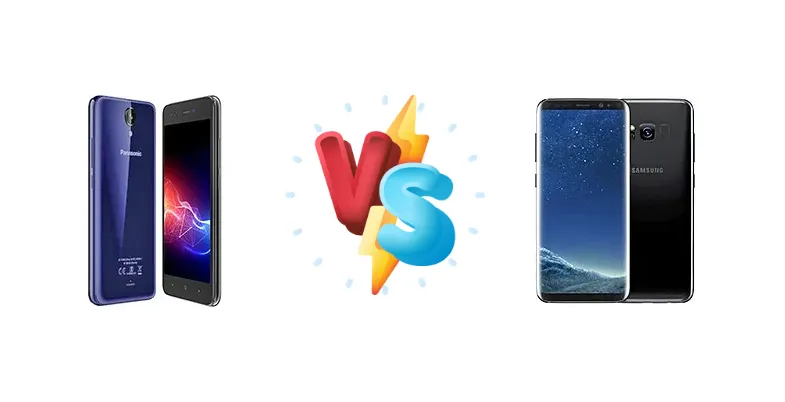
Released years apart and targeting vastly different price points, the Panasonic P91 and Samsung Galaxy S8 represent opposite ends of the smartphone spectrum. The P91 aimed for affordability, while the S8 was a premium flagship. This comparison examines whether the S8’s advanced features justify its higher cost, or if the P91 offers sufficient functionality for everyday use.
🏆 Quick Verdict
For the average user in 2024, the Samsung Galaxy S8 remains the superior device, despite its age. Its significantly more powerful Exynos 8895 (or Snapdragon 835) chipset, coupled with a higher-quality display and more refined software experience, outweighs the P91’s lower price. However, the P91 is a viable option for basic smartphone needs.
| Network |
|---|
| 2G bands | GSM 850 / 900 / 1800 / 1900 - SIM 1 & SIM 2 | GSM 850 / 900 / 1800 / 1900 - SIM 1 & SIM 2 (dual-SIM model only) |
| 3G bands | HSDPA 900 / 2100 | HSDPA 850 / 900 / 1700(AWS) / 1900 / 2100 |
| 4G bands | 1, 3, 5, 40 | 1, 2, 3, 4, 5, 7, 8, 12, 13, 17, 18, 19, 20, 25, 26, 28, 32, 66, 38, 39, 40, 41 |
| Speed | HSPA 42.2/5.76 Mbps, LTE Cat4 150/50 Mbps | HSPA 42.2/5.76 Mbps, LTE (5CA) Cat16 1024/150 Mbps |
| Technology | GSM / HSPA / LTE | GSM / HSPA / LTE |
| Launch |
|---|
| Announced | 2017, November. Released 2017, November | 2017, March 29. Released 2017, April 24 |
| Status | Discontinued | Discontinued |
| Body |
|---|
| Build | - | Glass front (Gorilla Glass 5), glass back (Gorilla Glass 5), aluminum frame |
| Dimensions | 144.7 x 72.4 x 10.1 mm (5.70 x 2.85 x 0.40 in) | 148.9 x 68.1 x 8 mm (5.86 x 2.68 x 0.31 in) |
| SIM | Dual SIM (Micro-SIM, dual stand-by) | · Nano-SIM· Nano-SIM + Nano-SIM |
| Weight | 161 g (5.68 oz) | 155 g (5.47 oz) |
| | - | IP68 dust/water resistant (up to 1.5m for 30 mins) |
| Display |
|---|
| Protection | Asahi Dragontrail Glass | Corning Gorilla Glass 5 |
| Resolution | 480 x 854 pixels, 16:9 ratio (~196 ppi density) | 1440 x 2960 pixels, 18.5:9 ratio (~570 ppi density) |
| Size | 5.0 inches, 68.9 cm2 (~65.8% screen-to-body ratio) | 5.8 inches, 84.8 cm2 (~83.6% screen-to-body ratio) |
| Type | IPS LCD | Super AMOLED, HDR10 |
| | - | 3D Touch (home button only)
Always-on display |
| Platform |
|---|
| CPU | Quad-core 1.1 GHz Cortex-A7 | Octa-core (4x2.3 GHz Mongoose M2 & 4x1.7 GHz Cortex-A53) - EMEAOcta-core (4x2.35 GHz Kryo & 4x1.9 GHz Kryo) - USA & China |
| Chipset | Mediatek MT6737M (28 nm) | Exynos 8895 (10 nm) - EMEAQualcomm MSM8998 Snapdragon 835 (10 nm) - USA & China |
| GPU | Mali-T720 | Mali-G71 MP20 - EMEAAdreno 540 - USA & China |
| OS | Android 7.0 (Nougat) | Android 7.0 (Nougat), upgradable to Android 9.0 (Pie), One UI |
| Memory |
|---|
| Card slot | microSDXC (dedicated slot) | microSDXC (uses shared SIM slot) - dual SIM model only |
| Internal | 16GB 1GB RAM | 64GB 4GB RAM |
| | eMMC 5.0 | UFS 2.0 or UFS 2.1 |
| Main Camera |
|---|
| Features | LED flash, HDR, panorama | LED flash, auto-HDR, panorama |
| Single | 8 MP, AF | 12 MP, f/1.7, 26mm (wide), 1/2.55", 1.4µm, dual pixel PDAF, OIS |
| Video | 720p@30fps | 4K@30fps, 1080p@30/60fps, 720p@240fps, HDR, stereo sound rec., gyro-EIS, OIS |
| Selfie camera |
|---|
| Dual | - | 8 MP, f/1.7, 25mm (wide), 1/3.6", 1.22µm, AF
2 MP (dedicated iris scanner camera) |
| Features | - | HDR |
| Single | 5 MP | - |
| Video | - | 1440p@30fps |
| Sound |
|---|
| 3.5mm jack | Yes | Yes |
| 35mm jack | Yes | Yes |
| Loudspeaker | Yes | Yes |
| | - | 32-bit/384kHz audio
|
| Comms |
|---|
| Bluetooth | 4.0, A2DP | 5.0, A2DP, LE, aptX |
| Infrared port | Yes | - |
| NFC | No | Yes |
| Positioning | GPS | GPS, GLONASS, BDS, GALILEO |
| Radio | FM radio | No |
| USB | microUSB 2.0, OTG | USB Type-C 3.1 |
| WLAN | Wi-Fi 802.11 b/g/n, Wi-Fi Direct | Wi-Fi 802.11 a/b/g/n/ac, dual-band, Wi-Fi Direct |
| Features |
|---|
| Sensors | Accelerometer, proximity | Iris scanner, fingerprint (rear-mounted), accelerometer, gyro, proximity, compass, barometer, heart rate, SpO2 |
| | - | Samsung DeX (desktop experience support)
ANT+
Bixby natural language commands and dictation
Samsung Pay (Visa, MasterCard certified) |
| Battery |
|---|
| Charging | - | 15W wired, QC2
Wireless (Qi) (market dependent) |
| Music play | - | Up to 67 h |
| Talk time | - | Up to 20 h (3G) |
| Type | Li-Ion 2500 mAh, non-removable | Li-Ion 3000 mAh, non-removable (11.55 Wh) |
| Misc |
|---|
| Colors | Gold, Black, Blue | Midnight Black, Orchid Gray, Arctic Silver, Coral Blue, Maple Gold, Rose Pink, Burgundy Red |
| Models | - | SM-G950FD, SM-G950W, SM-G950S, SM-G950K, SM-G950L, SM-G9500, SM-G950A, SM-G950P, SM-G950T, SM-G950U, SM-G950V, SM-G950F, SM-G950U1, SM-G950N, SC-02J, SCV36, SM-G950, G950F |
| Price | About 6500 INR | About 230 EUR |
| SAR | - | 0.44 W/kg (head) 0.75 W/kg (body) |
| SAR EU | - | 0.32 W/kg (head) 1.27 W/kg (body) |
| Tests |
|---|
| Audio quality | - |
Noise -92.5dB / Crosstalk -92.8dB |
| Battery life | - | Endurance rating 84h |
| Camera | - |
Photo / Video |
| Display | - |
Contrast ratio: Infinite (nominal), 4.768 (sunlight) |
| Loudspeaker | - |
Voice 66dB / Noise 70dB / Ring 72dB |
| Performance | - |
AnTuTu: 199022 (v7)
GeekBench: 6656 (v4.4)
GFXBench: 13fps (ES 3.1 onscreen) |
Panasonic P91
- Extremely affordable price point
- Potentially longer battery life due to lower power chipset
- Simple and straightforward user experience
- Significantly slower performance
- Lower-quality display
- Limited camera capabilities
Samsung Galaxy S8
- Powerful processor for smooth performance
- Vibrant and high-resolution display
- Advanced camera features and image quality
- Higher price (even used)
- Battery degradation due to age
- Software updates are no longer available
Display Comparison
Both the Panasonic P91 and Samsung Galaxy S8 feature displays with an 'Infinite' contrast ratio (nominal), and 4.768 contrast ratio in sunlight. However, the S8’s Super AMOLED panel offers significantly better color accuracy and vibrancy compared to the P91’s likely LCD panel. While both share similar contrast ratios, the S8’s display technology provides a far more immersive viewing experience. The S8’s smaller bezels also contribute to a more modern aesthetic, maximizing screen real estate within a comparable form factor. The P91’s display resolution is not specified, but is likely 720p or lower, while the S8 boasts a higher resolution QHD+ display.
Camera Comparison
While both phones offer photo and video capabilities, the Samsung Galaxy S8’s camera system is far more advanced. Details regarding the P91’s camera are scarce, but it likely features a lower-resolution sensor and lacks features like Optical Image Stabilization (OIS) found in the S8. The S8’s camera benefits from Samsung’s image processing algorithms, resulting in better dynamic range and low-light performance. The S8’s camera is capable of recording high-quality video, while the P91’s video capabilities are likely limited. The presence of a 2MP macro camera on the P91 is unlikely to provide significant benefit due to its low resolution.
Performance
The performance gap between these devices is substantial. The Samsung Galaxy S8’s Exynos 8895 (EMEA) or Snapdragon 835 (USA & China), both built on a 10nm process, dwarfs the Panasonic P91’s Mediatek MT6737M (28nm). The S8’s octa-core CPU (4x2.3 GHz Mongoose M2/Kryo & 4x1.7/1.9 GHz Cortex-A53/Kryo) delivers significantly faster processing speeds and smoother multitasking. The 28nm process of the MT6737M is less efficient, leading to higher power consumption and potentially more heat. The S8’s superior GPU also enables a far more capable gaming experience. The P91 is suitable for basic apps, but will struggle with demanding games or applications.
Battery Life
Both devices achieve an endurance rating of 84 hours, suggesting comparable battery life under similar usage conditions. However, this doesn’t tell the whole story. The S8’s 15W wired charging with Quick Charge 2.0 and optional Qi wireless charging provide more convenient charging options than the P91’s likely slower charging speeds. While the P91’s battery capacity is unknown, the S8’s more efficient chipset and optimized software contribute to its overall endurance. Given the age of the S8, battery degradation is a significant factor to consider; a replacement battery may be necessary.
Buying Guide
Buy the Panasonic P91 if you need a functional, extremely affordable smartphone for basic tasks like calls, texts, and light web browsing, and battery life is paramount. Buy the Samsung Galaxy S8 if you prioritize performance, a vibrant display, a more capable camera, and a premium user experience, even if it means accepting an older device with potentially degrading battery health.
Frequently Asked Questions
❓ Does the Exynos 8895 in the Galaxy S8 overheat during prolonged gaming sessions?
While the Exynos 8895 is a powerful chip, it was known to exhibit some thermal throttling under sustained heavy load. However, the S8’s thermal management system is generally effective at preventing overheating, and performance degradation is usually moderate. The Snapdragon 835 variant generally runs cooler.
❓ Is the battery on the Samsung Galaxy S8 likely to hold a charge well in 2024?
Given the Galaxy S8’s age, battery degradation is a significant concern. Expect reduced battery capacity and potentially shorter runtimes. Replacing the battery is a viable option to restore the device’s original battery life.
❓ What kind of storage options did the Panasonic P91 offer, and is it expandable?
Information on the P91's storage is limited, but it likely came with a small amount of internal storage (16GB or 32GB). It almost certainly supports microSD card expansion, which is a key advantage for users needing more storage space.
❓ Can the Samsung Galaxy S8 still receive security updates?
No, Samsung has ended software support for the Galaxy S8. This means it no longer receives security updates, making it potentially vulnerable to security threats. Users should exercise caution when using the device for sensitive tasks.