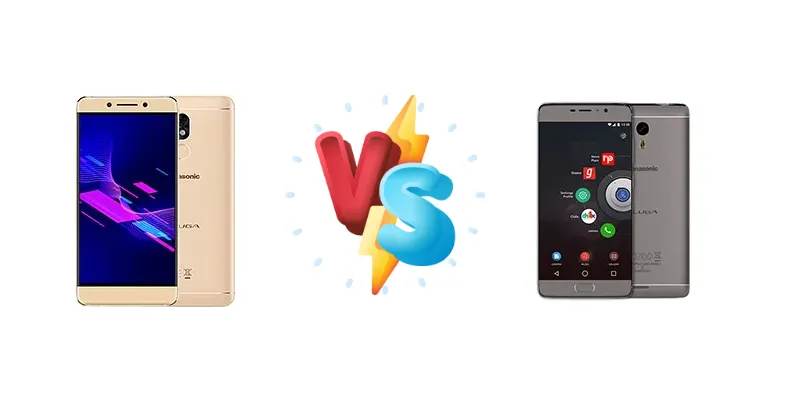
The Panasonic Eluga Ray 800 and Eluga A3 represent Panasonic's offerings in the budget smartphone segment. While both aim to provide affordable connectivity, they diverge significantly in their core processing power. This comparison dissects the architectural differences between the Ray 800’s octa-core CPU and the A3’s MediaTek MT6737 quad-core chipset, helping you determine which device best suits your needs.
🏆 Quick Verdict
For users prioritizing responsiveness and multitasking, the Panasonic Eluga Ray 800 is the clear winner. Its octa-core 1.8 GHz CPU offers a substantial performance advantage over the Eluga A3’s quad-core 1.25 GHz processor, making it better suited for demanding applications and smoother daily use. However, the A3 may offer better battery life due to its less power-hungry chipset.
| Network |
|---|
| 2G bands | GSM 850 / 900 / 1800 / 1900 | GSM 850 / 900 / 1800 / 1900 - SIM 1 & SIM 2 |
| 3G bands | HSDPA 900 / 2100 | HSDPA 900 / 2100 |
| 4G bands | 1, 3, 5, 7, 8, 20, 38, 40, 41 | 3, 5, 40 |
| Speed | HSPA, LTE | HSPA 42.2/5.76 Mbps, LTE Cat4 150/50 Mbps |
| Technology | GSM / HSPA / LTE | GSM / HSPA / LTE |
| Launch |
|---|
| Announced | 2019, March. Released 2019, March | 2017, August. Released 2017, August |
| Status | Discontinued | Discontinued |
| Body |
|---|
| Dimensions | 152.8 x 75.3 x 8.6 mm (6.02 x 2.96 x 0.34 in) | 148.7 x 72.4 x 9.1 mm (5.85 x 2.85 x 0.36 in) |
| SIM | Nano-SIM + Nano-SIM | Dual SIM |
| Weight | 162 g (5.71 oz) | 161 g (5.68 oz) |
| Display |
|---|
| Protection | Corning Gorilla Glass 3 | - |
| Resolution | 1080 x 1920 pixels, 16:9 ratio (~401 ppi density) | 720 x 1280 pixels, 16:9 ratio (~282 ppi density) |
| Size | 5.5 inches, 83.4 cm2 (~72.5% screen-to-body ratio) | 5.2 inches, 74.5 cm2 (~69.2% screen-to-body ratio) |
| Type | IPS LCD | IPS LCD |
| Platform |
|---|
| CPU | Octa-core 1.8 GHz | Quad-core 1.25 GHz Cortex-A53 |
| Chipset | - | Mediatek MT6737 (28 nm) |
| GPU | - | Mali-T720MP1 |
| OS | Android 7.0 (Nougat) | Android 7.0 (Nougat), FitHome UI |
| Memory |
|---|
| Card slot | microSDXC (dedicated slot) | microSDXC (dedicated slot) |
| Internal | 64GB 4GB RAM | 16GB 3GB RAM |
| | - | eMMC 5.0 |
| Main Camera |
|---|
| Features | Dual-LED flash, HDR, panorama | LED flash |
| Single | 13 MP, f/2.0, PDAF | 13 MP, PDAF |
| Video | 1080p@30fps | 1080p@30fps |
| Selfie camera |
|---|
| Features | LED flash | - |
| Single | 8 MP | 8 MP |
| Video | 1080p@30fps | - |
| Sound |
|---|
| 3.5mm jack | Yes | Yes |
| 35mm jack | Yes | Yes |
| Loudspeaker | Yes | Yes |
| Comms |
|---|
| Bluetooth | 4.2, A2DP, LE | 4.0, A2DP |
| Infrared port | Yes | - |
| NFC | No | No |
| Positioning | GPS | GPS |
| Radio | FM radio | FM radio |
| USB | microUSB 2.0, OTG | microUSB 2.0 |
| WLAN | Wi-Fi 802.11 b/g/n, Wi-Fi Direct | Wi-Fi 802.11 b/g/n, Wi-Fi Direct |
| Features |
|---|
| Sensors | Fingerprint (rear-mounted), accelerometer, proximity, compass | Accelerometer, proximity |
| Battery |
|---|
| Type | Li-Ion 4000 mAh, non-removable | Li-Ion 4000 mAh, non-removable |
| Misc |
|---|
| Colors | Gold | Gold, Silver |
| Price | About 10000 INR | About 11300 INR |
Panasonic Eluga Ray 800
- Faster Octa-Core Processor
- Improved Multitasking Capabilities
- Potentially better app performance
- Likely shorter battery life
- Potentially higher price
Panasonic Eluga A3
- Potentially longer battery life
- More power-efficient chipset
- Likely lower price
- Slower Quad-Core Processor
- Limited multitasking capabilities
- Laggy performance with demanding apps
Display Comparison
Unfortunately, display specifications are not provided for either device. However, given their market positioning, it’s reasonable to assume both utilize LCD panels. The Ray 800, being positioned slightly higher, *may* feature a slightly higher resolution or improved color calibration. Without concrete data, it's difficult to assess display quality beyond speculation. Bezels are likely to be substantial on both devices, typical of this price bracket.
Camera Comparison
Camera specifications are not detailed beyond the existence of cameras on both devices. Given the price point, image quality is unlikely to be a key differentiator. The absence of information regarding sensor size or aperture makes a direct comparison impossible. It’s probable that both phones feature basic camera setups suitable for casual snapshots, but not for serious photography. Any 2MP macro cameras included would likely offer limited practical benefit due to their small sensor size and lack of optical image stabilization.
Performance
The core difference lies in the CPU. The Eluga Ray 800 boasts an octa-core processor clocked at 1.8 GHz, suggesting a more complex and powerful architecture capable of handling more threads concurrently. In contrast, the Eluga A3 utilizes the MediaTek MT6737, a quad-core processor based on the Cortex-A53 architecture at 1.25 GHz. The MT6737, built on a 28nm process, is known for its efficiency but lags behind in raw processing power. The Ray 800 will exhibit significantly faster app launch times, smoother scrolling, and better performance in multitasking scenarios. The A3 will likely struggle with demanding applications and may exhibit noticeable lag during intensive tasks.
Battery Life
Battery capacity is not specified for either device. However, the Eluga A3’s less powerful MT6737 chipset, built on a 28nm process, is inherently more power-efficient than the Ray 800’s octa-core processor. This suggests the A3 *could* offer longer battery life on a single charge, even with a smaller battery capacity. Charging wattage is also unknown, making it impossible to estimate 0-100% charging times. The Ray 800’s higher performance demands will likely result in faster battery drain during active use.
Buying Guide
Buy the Panasonic Eluga Ray 800 if you need a phone capable of handling multiple apps simultaneously, enjoy occasional gaming, or simply prefer a snappier user experience. Buy the Panasonic Eluga A3 if your primary needs are basic communication – calls, texts, and light social media – and you prioritize maximizing battery life over raw performance. The A3 is ideal for first-time smartphone users or those on a very tight budget.
Frequently Asked Questions
❓ Will the Eluga A3 struggle with popular social media apps like Facebook and Instagram?
While the Eluga A3 can run these apps, the MediaTek MT6737 processor may result in slower loading times, occasional lag when scrolling through feeds, and a less fluid overall experience compared to the Eluga Ray 800. Users who heavily rely on social media may find the Ray 800 more enjoyable.
❓ Is the difference in CPU performance noticeable for everyday tasks like calling and texting?
For basic tasks like making calls and sending texts, the difference between the two CPUs will be minimal. However, the Ray 800’s faster processor will be more apparent when switching between apps, opening new apps, or performing any task that requires processing power beyond simple communication.
❓ Can the Eluga Ray 800 handle basic mobile games?
The Eluga Ray 800’s octa-core processor is better equipped to handle basic mobile games than the Eluga A3. While it won’t deliver a high-end gaming experience, it should be able to run less demanding titles with acceptable frame rates. The A3 may struggle with even moderately demanding games.