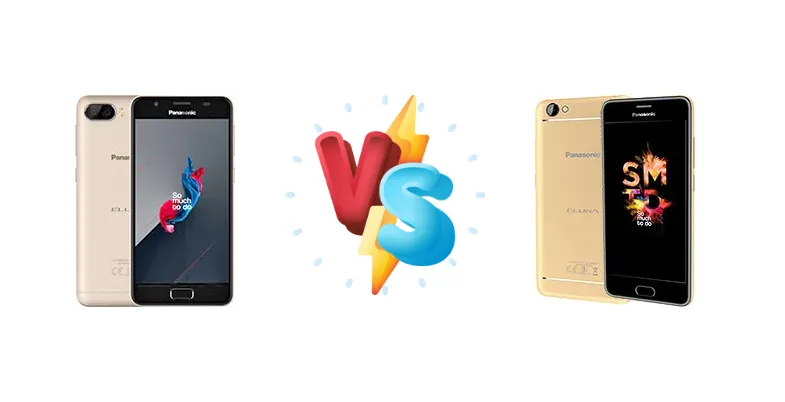
The Panasonic Eluga Ray 500 and Eluga I4 present a curious case for smartphone buyers. Both devices are powered by the same Mediatek MT6737 chipset, featuring a quad-core 1.25 GHz Cortex-A53 CPU. This comparison aims to dissect whether any differences in other areas – potentially in software optimization, build quality, or included accessories – justify choosing one over the other, especially given their likely positioning within Panasonic’s product stack.
🏆 Quick Verdict
For the average user prioritizing pure value, the Panasonic Eluga I4 is likely the better choice. Given the identical Mediatek MT6737 chipset and CPU, any price difference will likely be better spent on accessories or a more robust data plan, as performance will be virtually indistinguishable in day-to-day tasks.
| Network |
|---|
| 2G bands | GSM 850 / 900 / 1800 / 1900 - SIM 1 & SIM 2 | GSM 850 / 900 / 1800 / 1900 - SIM 1 & SIM 2 |
| 3G bands | HSDPA 900 / 2100 | HSDPA 900 / 2100 |
| 4G bands | 3, 5, 40 | 3, 5, 40 |
| Speed | HSPA, LTE | HSPA 42.2/5.76 Mbps, LTE Cat4 150/50 Mbps |
| Technology | GSM / HSPA / LTE | GSM / HSPA / LTE |
| Launch |
|---|
| Announced | 2017, September. Released 2017, September | 2017, September. Released 2017, September |
| Status | Discontinued | Discontinued |
| Body |
|---|
| Dimensions | 144.3 x 71.3 x 9.2 mm (5.68 x 2.81 x 0.36 in) | 146.7 x 71.3 x 8.3 mm (5.78 x 2.81 x 0.33 in) |
| SIM | Nano-SIM + Nano-SIM | Dual SIM |
| Weight | 163 g (5.75 oz) | 150.7 g (5.33 oz) |
| Display |
|---|
| Resolution | 720 x 1280 pixels, 16:9 ratio (~294 ppi density) | 720 x 1280 pixels, 16:9 ratio (~294 ppi density) |
| Size | 5.0 inches, 68.9 cm2 (~67.0% screen-to-body ratio) | 5.0 inches, 68.9 cm2 (~65.9% screen-to-body ratio) |
| Type | IPS LCD | IPS LCD |
| Platform |
|---|
| CPU | Quad-core 1.25 GHz Cortex-A53 | Quad-core 1.25 GHz Cortex-A53 |
| Chipset | Mediatek MT6737 (28 nm) | Mediatek MT6737 (28 nm) |
| GPU | Mali-T720MP1 | Mali-T720 |
| OS | Android 7 (Nougat) | Android 7.0 (Nougat) |
| Memory |
|---|
| Card slot | microSDXC (uses shared SIM slot) | microSDXC (dedicated slot) |
| Internal | 32GB 3GB RAM | 16GB 2GB RAM |
| | eMMC 5.0 | eMMC 5.0 |
| Main Camera |
|---|
| Dual | 13 MP, f/2.0, AF
8 MP, f/2.4 | - |
| Features | LED flash, HDR, panorama | LED flash |
| Single | - | 8 MP, AF |
| Video | 1080p@30fps | Yes |
| Selfie camera |
|---|
| Features | HDR | - |
| Single | 5 MP, f/2.4 | 5 MP |
| Sound |
|---|
| 3.5mm jack | Yes | Yes |
| 35mm jack | Yes | Yes |
| Loudspeaker | Yes | Yes |
| Comms |
|---|
| Bluetooth | 4.0, A2DP | 4.0, A2DP |
| Infrared port | Yes | - |
| NFC | No | No |
| Positioning | GPS | GPS |
| Radio | FM radio | FM radio |
| USB | microUSB 2.0, OTG | microUSB 2.0, OTG |
| WLAN | Wi-Fi 802.11 b/g/n, Wi-Fi Direct | Wi-Fi 802.11 b/g/n, Wi-Fi Direct |
| Features |
|---|
| Sensors | Fingerprint (front-mounted), accelerometer, proximity | Fingerprint (front-mounted), accelerometer, proximity |
| Battery |
|---|
| Type | Li-Ion 4000 mAh, non-removable | Li-Ion 3000 mAh, non-removable |
| Misc |
|---|
| Colors | Champagne gold, Mocha gold, Marine Blue | Black, Blue, Gold |
| Price | About 110 EUR | About 8300 INR |
Panasonic Eluga Ray 500
- Identical Mediatek MT6737 chipset for consistent performance.
- Potential for lower price point, offering better value.
- Likely similar battery life due to chipset efficiency.
- May have fewer included accessories.
- Potentially less refined software experience.
Panasonic Eluga I4
- Identical Mediatek MT6737 chipset for consistent performance.
- Potentially better build quality and materials.
- Likely a more polished software experience.
- May be more expensive than the Ray 500.
- Performance will be identical to the Ray 500.
Display Comparison
With the provided data lacking display specifications, we can infer both devices likely feature similar LCD panels targeting the budget segment. The 28nm process of the MT6737 suggests a focus on efficiency rather than driving high-resolution or high-refresh-rate displays. Expect resolutions around 720p, and color accuracy will likely be standard for this price range. Differences, if any, will be subtle and related to panel calibration rather than fundamental technology.
Camera Comparison
Without specific camera sensor details, it’s reasonable to assume both devices feature similar camera setups targeting basic photography needs. The MT6737’s ISP (Image Signal Processor) is capable of handling standard image processing tasks, but don’t expect flagship-level image quality. Any differences in camera performance will likely stem from software optimization and lens quality, rather than a significant disparity in sensor size or capabilities. The inclusion of a 2MP macro camera on either device is likely a marketing feature with limited practical benefit.
Performance
The core of both devices is the Mediatek MT6737, a 28nm chipset with a quad-core 1.25 GHz Cortex-A53 CPU. This configuration is geared towards basic multitasking and app usage. The 28nm fabrication process, while not cutting-edge, offers a reasonable balance between performance and power efficiency. Users should expect smooth operation for tasks like web browsing, messaging, and light social media, but demanding games or heavy multitasking will likely result in noticeable slowdowns. Thermal management will be adequate for the workload, but sustained peak performance is unlikely due to the chipset's limitations.
Battery Life
Battery capacity is not specified, but given the Mediatek MT6737’s power efficiency and the target market, both devices likely house batteries in the 2500-3000 mAh range. Charging wattage is also unknown, but expect relatively slow charging speeds – likely around 5W-10W. Real-world battery life will depend heavily on usage patterns, but users can reasonably expect a full day of moderate use with both devices. The 28nm process helps to minimize power draw, contributing to acceptable standby times.
Buying Guide
Buy the Panasonic Eluga Ray 500 if you find it at a significantly lower price point than the I4, and are comfortable with potentially fewer included accessories or a less refined software experience. Buy the Panasonic Eluga I4 if you prefer a potentially more polished user experience, a slightly better build quality (assuming differences exist), and are willing to pay a small premium for it. Both are suited for basic smartphone tasks like calling, texting, and light social media use.
Frequently Asked Questions
❓ Will I be able to play demanding games like PUBG Mobile on either the Eluga Ray 500 or I4?
While PUBG Mobile may be playable on the lowest settings, the Mediatek MT6737 chipset is not designed for demanding gaming. Expect significant frame rate drops and potential lag, especially during intense action. These phones are better suited for casual gaming and less graphically intensive titles.
❓ Does the Mediatek MT6737 chipset in these phones support VoLTE (Voice over LTE) for improved call quality?
Support for VoLTE depends on the carrier and software implementation. While the MT6737 chipset is technically capable of supporting VoLTE, it's crucial to verify with your mobile carrier whether their network is compatible with these specific Panasonic models to ensure VoLTE functionality.
❓ How much storage do these phones typically come with, and is it expandable via microSD card?
Storage capacity is not specified in the provided data. However, budget smartphones like these typically come with 16GB or 32GB of internal storage. It's highly likely that both the Eluga Ray 500 and I4 feature a dedicated microSD card slot for storage expansion, allowing you to add more space for photos, videos, and apps.