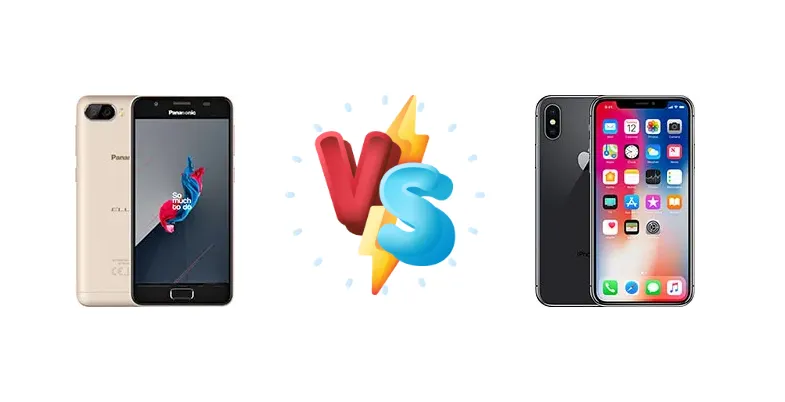
The Panasonic Eluga Ray 500 and the Apple iPhone X represent vastly different points in the smartphone timeline. The Eluga Ray 500, released as a budget-friendly option, contrasts sharply with the iPhone X, Apple’s premium 2017 offering. This comparison isn’t about crowning a single winner, but understanding where each phone excels and who benefits from its strengths, especially considering the iPhone X's age and current market position.
🏆 Quick Verdict
For the average user in 2024, the Apple iPhone X remains the superior choice, despite its age. The A11 Bionic chipset delivers significantly better performance than the Mediatek MT6737, offering a smoother and more responsive experience. While the Eluga Ray 500 offers a lower price point, the iPhone X’s longevity, software support (though limited), and overall refinement justify the investment.
| Network |
|---|
| 2G bands | GSM 850 / 900 / 1800 / 1900 - SIM 1 & SIM 2 | GSM 850 / 900 / 1800 / 1900 |
| 3G bands | HSDPA 900 / 2100 | HSDPA 850 / 900 / 1700(AWS) / 1900 / 2100 |
| 4G bands | 3, 5, 40 | 1, 2, 3, 4, 5, 7, 8, 12, 13, 17, 18, 19, 20, 25, 26, 28, 29, 30, 34, 38, 39, 40, 41, 66 |
| Speed | HSPA, LTE | HSPA 42.2/5.76 Mbps, LTE (3CA) Cat12 600/150 Mbps, EV-DO Rev.A 3.1 Mbps |
| Technology | GSM / HSPA / LTE | GSM / HSPA / LTE |
| Launch |
|---|
| Announced | 2017, September. Released 2017, September | 2017, September 12. Released 2017, November 03 |
| Status | Discontinued | Discontinued |
| Body |
|---|
| Build | - | Glass front (Corning-made glass), glass back (Corning-made glass), stainless steel frame |
| Dimensions | 144.3 x 71.3 x 9.2 mm (5.68 x 2.81 x 0.36 in) | 143.6 x 70.9 x 7.7 mm (5.65 x 2.79 x 0.30 in) |
| SIM | Nano-SIM + Nano-SIM | Nano-SIM |
| Weight | 163 g (5.75 oz) | 174 g (6.14 oz) |
| | - | IP67 dust/water resistant (up to 1m for 30 mins)
Apple Pay (Visa, MasterCard, AMEX certified) |
| Display |
|---|
| Protection | - | Scratch-resistant glass |
| Resolution | 720 x 1280 pixels, 16:9 ratio (~294 ppi density) | 1125 x 2436 pixels, 19.5:9 ratio (~458 ppi density) |
| Size | 5.0 inches, 68.9 cm2 (~67.0% screen-to-body ratio) | 5.8 inches, 84.4 cm2 (~82.9% screen-to-body ratio) |
| Type | IPS LCD | Super Retina OLED, HDR10, Dolby Vision, 625 nits (HBM) |
| | - | 3D Touch |
| Platform |
|---|
| CPU | Quad-core 1.25 GHz Cortex-A53 | Hexa-core 2.39 GHz (2x Monsoon + 4x Mistral) |
| Chipset | Mediatek MT6737 (28 nm) | Apple A11 Bionic (10 nm) |
| GPU | Mali-T720MP1 | Apple GPU (three-core graphics) |
| OS | Android 7 (Nougat) | iOS 11.1.1, up to iOS 16.7.12 |
| Memory |
|---|
| Card slot | microSDXC (uses shared SIM slot) | No |
| Internal | 32GB 3GB RAM | 64GB 3GB RAM, 256GB 3GB RAM |
| | eMMC 5.0 | NVMe |
| Main Camera |
|---|
| Dual | 13 MP, f/2.0, AF
8 MP, f/2.4 | 12 MP, f/1.8, 28mm (wide), 1/3.0", 1.22µm, dual pixel PDAF, OIS
12 MP, f/2.4, 52mm (telephoto), 1/3.4", 1.0µm, PDAF, OIS, 2x optical zoom |
| Features | LED flash, HDR, panorama | Quad-LED dual-tone flash, HDR (photo/panorama), panorama, HDR |
| Video | 1080p@30fps | 4K@24/30/60fps, 1080p@30/60/120/240fps |
| Selfie camera |
|---|
| Features | HDR | HDR |
| Single | 5 MP, f/2.4 | 7 MP, f/2.2, 32mm (standard)
SL 3D, (depth/biometrics sensor) |
| Video | - | 1080p@30fps |
| Sound |
|---|
| 3.5mm jack | Yes | No |
| 35mm jack | Yes | No |
| Loudspeaker | Yes | Yes, with stereo speakers |
| Comms |
|---|
| Bluetooth | 4.0, A2DP | 5.0, A2DP, LE |
| Infrared port | Yes | - |
| NFC | No | Yes |
| Positioning | GPS | GPS, GLONASS, GALILEO, QZSS |
| Radio | FM radio | No |
| USB | microUSB 2.0, OTG | Lightning, USB 2.0 |
| WLAN | Wi-Fi 802.11 b/g/n, Wi-Fi Direct | Wi-Fi 802.11 a/b/g/n/ac, dual-band, hotspot |
| Features |
|---|
| Sensors | Fingerprint (front-mounted), accelerometer, proximity | Face ID, accelerometer, gyro, proximity, compass, barometer |
| Battery |
|---|
| Charging | - | 15W wired, PD2.0, 50% in 30 min
Wireless (Qi) |
| Talk time | - | Up to 21 h (3G) |
| Type | Li-Ion 4000 mAh, non-removable | Li-Ion 2716 mAh, non-removable (10.35 Wh) |
| Misc |
|---|
| Colors | Champagne gold, Mocha gold, Marine Blue | Space Gray, Silver |
| Models | - | A1865, A1901, A1902, A1903, iPhone10,3, iPhone10,6 |
| Price | About 110 EUR | About 100 EUR |
| SAR | - | 1.09 W/kg (head) 1.17 W/kg (body) |
| Tests |
|---|
| Audio quality | - |
Noise -93.7dB / Crosstalk -82.8dB |
| Battery life | - | Endurance rating 74h |
| Camera | - |
Photo / Video |
| Display | - |
Contrast ratio: Infinity (nominal), 5.013 (sunlight) |
| Loudspeaker | - |
Voice 68dB / Noise 74dB / Ring 76dB |
| Performance | - |
AnTuTu: 233100 (v7)
GeekBench: 10215 (v4.4)
GFXBench: 28fps (ES 3.1 onscreen) |
Panasonic Eluga Ray 500
- Significantly lower price point
- Functional for basic smartphone tasks
- Acceptable battery endurance rating
- Outdated and slow processor
- Inferior camera performance
- Limited software support and updates
Apple iPhone X
- Powerful A11 Bionic processor
- Superior camera quality and features
- Faster and more versatile charging options
- Higher price (even used)
- Older device with limited software updates
- Battery health degradation due to age
Display Comparison
Both devices share a contrast ratio of Infinity (nominal) and 5.013 in sunlight, suggesting similar outdoor visibility. However, the iPhone X’s display technology and calibration are likely superior, offering more accurate colors and wider viewing angles. The Eluga Ray 500’s display specifications are minimal, suggesting a lower-quality panel. While both have similar contrast ratios, the iPhone X benefits from Apple’s display expertise, resulting in a more visually pleasing experience.
Camera Comparison
Both phones feature photo and video capabilities, but the iPhone X’s camera system is expected to be significantly more advanced. While specific sensor details are missing for both, Apple’s image signal processing (ISP) and computational photography algorithms are renowned for their quality. The Eluga Ray 500’s camera is likely to produce acceptable images in good lighting conditions, but will struggle in low-light scenarios. The iPhone X’s superior processing power allows for features like Portrait Mode and better dynamic range.
Performance
The performance gap between these two devices is substantial. The Apple A11 Bionic, a hexa-core processor built on a 10nm process, dwarfs the Mediatek MT6737’s quad-core 1.25 GHz Cortex-A53 processor fabricated on a 28nm node. The A11 Bionic’s architecture – featuring two high-performance Monsoon cores and four Mistral cores – allows for efficient task handling and superior multitasking. The MT6737, designed for budget devices, will struggle with demanding applications and modern games. The 10nm process of the A11 Bionic also contributes to better thermal efficiency, reducing throttling during sustained workloads.
Battery Life
Interestingly, both devices have an endurance rating of 74 hours. However, this doesn’t tell the whole story. The iPhone X supports 15W wired charging with PD2.0 and Qi wireless charging, offering convenient and relatively fast charging options (50% in 30 minutes). The Eluga Ray 500’s charging specifications are unknown, but likely slower and less versatile. While the endurance rating is the same, the iPhone X’s charging capabilities and overall power efficiency of the A11 Bionic contribute to a more practical user experience.
Buying Guide
Buy the Panasonic Eluga Ray 500 if you need a functional, extremely affordable smartphone for basic tasks like calls, texts, and light web browsing, and are comfortable with a significantly slower processor and limited software updates. Buy the Apple iPhone X if you prioritize performance, a better camera experience, and a more polished user interface, even if it means paying a premium and accepting an older device with diminishing software support.
Frequently Asked Questions
❓ Is the iPhone X still receiving software updates in 2024?
Apple officially ended software support for the iPhone X with iOS 16.7. While it remains a functional device, users will no longer receive security patches or new features. This is a significant consideration compared to the Eluga Ray 500, which likely has even more limited update availability.
❓ Will the Mediatek MT6737 in the Eluga Ray 500 struggle with modern apps?
Yes, the Mediatek MT6737 is a low-end processor that will likely exhibit significant lag and slowdowns when running demanding apps like social media, streaming services, or modern mobile games. It's best suited for basic tasks like calls, texts, and simple web browsing.
❓ How does the battery health of a used iPhone X impact its usability?
The battery health of a used iPhone X is a critical factor. Over time, lithium-ion batteries degrade, resulting in shorter battery life. A significantly degraded battery will require frequent charging and may limit the phone's usability. Checking the battery health in settings (if possible) is crucial before purchasing.
❓ Is the iPhone X's camera still competitive in 2024?
While not on par with the latest smartphone cameras, the iPhone X's camera remains capable of producing good-quality photos and videos, especially in well-lit conditions. Its image processing and features like Portrait Mode still hold up reasonably well.