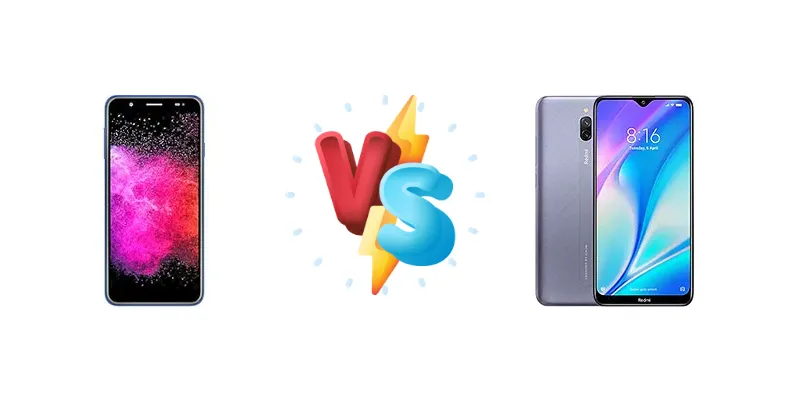
The Panasonic Eluga I7 (2019) and Xiaomi Redmi 8A Dual represent different approaches to the entry-level smartphone market. The Eluga I7, released in 2019, offers a basic experience, while the Redmi 8A Dual, leveraging Qualcomm's Snapdragon 439, aims for a more modern and capable user experience. This comparison dissects their key differences to help you determine which device best suits your needs.
🏆 Quick Verdict
For the vast majority of users, the Xiaomi Redmi 8A Dual is the clear winner. Its octa-core Snapdragon 439 chipset provides significantly better performance than the Eluga I7’s quad-core processor, and the inclusion of 18W fast charging is a substantial advantage. While the Eluga I7 may have been competitive at launch, it's now outpaced by the Redmi 8A Dual’s more efficient and powerful hardware.
| Network |
|---|
| 2G bands | GSM 850 / 900 / 1800 / 1900 | GSM 850 / 900 / 1800 / 1900 |
| 3G bands | HSDPA 900 / 2100 | HSDPA 850 / 900 / 1900 / 2100 |
| 4G bands | 1, 3, 5, 8, 40, 41 | 1, 3, 5, 8, 40, 41 |
| Speed | HSPA 42.2/11.5 Mbps, LTE Cat4 150/50 Mbps | HSPA, LTE |
| Technology | GSM / HSPA / LTE | GSM / HSPA / LTE |
| Launch |
|---|
| Announced | 2019, June. Released 2019, July | 2020, February 11. Released 2020, February 18 |
| Status | Discontinued | Discontinued |
| Body |
|---|
| Build | - | Glass front (Gorilla Glass 5), plastic back, plastic frame |
| Dimensions | 148.8 x 70.9 x 9.3 mm (5.86 x 2.79 x 0.37 in) | 156.5 x 75.4 x 9.4 mm (6.16 x 2.97 x 0.37 in) |
| SIM | Nano-SIM + Micro-SIM | Nano-SIM + Nano-SIM |
| Weight | 168 g (5.93 oz) | 188 g (6.63 oz) |
| | - | Water-repellent coating |
| Display |
|---|
| Protection | - | Corning Gorilla Glass 5 |
| Resolution | 720 x 1440 pixels, 18:9 ratio (~295 ppi density) | 720 x 1520 pixels, 19:9 ratio (~270 ppi density) |
| Size | 5.45 inches, 76.7 cm2 (~72.7% screen-to-body ratio) | 6.22 inches, 96.6 cm2 (~81.8% screen-to-body ratio) |
| Type | IPS LCD | IPS LCD, 400 nits (typ) |
| Platform |
|---|
| CPU | Quad-core 1.5 GHz | Octa-core (4x1.95 GHz Cortex-A53 & 4x1.45 GHz Cortex A53) |
| Chipset | - | Qualcomm SDM439 Snapdragon 439 (12 nm) |
| GPU | - | Adreno 505 |
| OS | Android 9.0 (Pie) | Android 9.0 (Pie), upgradable to Android 10, MIUI 12 |
| Memory |
|---|
| Card slot | microSDXC (dedicated slot) | microSDXC (dedicated slot) |
| Internal | 16GB 2GB RAM | 32GB 2GB RAM, 32GB 3GB RAM, 64GB 3GB RAM |
| | - | eMMC 5.1 |
| Main Camera |
|---|
| Dual | - | 13 MP, f/2.2, (wide), 1/3.1", 1.12µm, PDAF
Auxiliary lens |
| Features | LED flash, HDR, panorama | LED flash, HDR, panorama |
| Single | 8 MP, f/2.0, 1.12 µm, AF | - |
| Video | 1080p@30fps | 1080p@30fps |
| Selfie camera |
|---|
| Features | LED flash | HDR |
| Single | 8 MP, f/2.0, 1/4.0", 1.12µm | 8 MP, f/2.0, 1/4.0", 1.12µm |
| Video | - | 1080p@30fps |
| Sound |
|---|
| 3.5mm jack | Yes | Yes |
| 35mm jack | Yes | Yes |
| Loudspeaker | Yes | Yes |
| Comms |
|---|
| Bluetooth | 4.2, A2DP, LE | 4.2, A2DP, LE |
| NFC | No | No |
| Positioning | GPS | GPS, GLONASS, BDS |
| Radio | FM radio with RDS | FM Radio, built-in antenna |
| USB | microUSB 2.0, OTG | USB Type-C 2.0, OTG |
| WLAN | Wi-Fi 802.11 b/g/n, Wi-Fi Direct | Wi-Fi 802.11 b/g/n, Wi-Fi Direct |
| Features |
|---|
| Sensors | Fingerprint (rear-mounted), accelerometer, proximity, compass | Accelerometer, proximity, compass |
| Battery |
|---|
| Charging | - | 18W wired
2.5W reverse wired |
| Type | Li-Ion 4000 mAh, non-removable | Li-Po 5000 mAh |
| Misc |
|---|
| Colors | Black, Gold, Blue | Sky White, Sea Blue, Midnight Grey |
| Models | - | M2001C3K3I |
| Price | About 9990 INR | About 110 EUR |
| SAR | - | 0.34 W/kg (head) 1.00 W/kg (body) |
Panasonic Eluga I7 (2019)
- Potentially lower price (depending on availability)
- May have specific software customizations pre-installed
- Simple and straightforward user experience
- Significantly slower processor
- Outdated hardware
- Likely inferior camera performance
- No fast charging
Xiaomi Redmi 8A Dual
- Faster and more efficient Snapdragon 439 processor
- 18W fast charging
- Larger 5000mAh battery
- Dual camera setup
- Reverse wired charging
- May require software updates
- Plastic build quality
Display Comparison
Neither device is known for display prowess. The Eluga I7’s display specifications are largely unavailable, suggesting a standard LCD panel. The Redmi 8A Dual also features an LCD, but its focus is on size (6.22 inches) rather than resolution or color accuracy. Given the Eluga I7’s age, it’s likely to exhibit lower brightness and wider viewing angle limitations compared to the Redmi 8A Dual. Both likely lack features like high refresh rates or HDR support, common in more expensive devices.
Camera Comparison
Camera performance is likely to be similar in real-world usage, as both devices target the budget segment. The Redmi 8A Dual features a dual-camera setup, including a 13MP main sensor and a 2MP depth sensor. While the 2MP sensor adds minimal value, the larger 13MP sensor provides a better baseline for image quality than the Eluga I7’s likely lower-resolution camera. Image processing on the Redmi 8A Dual, powered by the Snapdragon 439’s ISP, is also likely to be more sophisticated, resulting in better dynamic range and noise reduction. The Eluga I7’s camera specifications are unavailable, but it’s reasonable to assume it lacks features like HDR or dedicated night mode.
Performance
The performance gap is the most significant differentiator. The Panasonic Eluga I7’s quad-core 1.5 GHz processor is a generation behind the Xiaomi Redmi 8A Dual’s Qualcomm Snapdragon 439. The Snapdragon 439 utilizes an octa-core configuration (4x1.95 GHz Cortex-A53 & 4x1.45 GHz Cortex A53) built on a more efficient 12nm process. This translates to noticeably faster app loading times, smoother multitasking, and a more responsive user interface on the Redmi 8A Dual. The architectural advantage of the Snapdragon 439, with its mix of high and low-power cores, also improves power efficiency during less demanding tasks.
Battery Life
The Redmi 8A Dual’s 18W wired charging is a game-changer in this price bracket. While battery capacity isn’t specified for the Eluga I7, the Redmi 8A Dual’s 5000mAh battery, combined with the efficient Snapdragon 439, delivers excellent battery life. The 18W charging allows for significantly faster top-ups, reducing downtime. The Redmi 8A Dual also supports 2.5W reverse wired charging, allowing it to act as a power bank for other devices, a feature absent on the Eluga I7.
Buying Guide
Buy the Panasonic Eluga I7 (2019) if you absolutely require a device with a specific software customization already installed, or if you find it at a drastically reduced price and only need basic calling and messaging functionality. Buy the Xiaomi Redmi 8A Dual if you prioritize performance for everyday tasks, enjoy faster charging, and want a phone that feels more responsive and future-proof.
Frequently Asked Questions
❓ Is the Snapdragon 439 in the Redmi 8A Dual powerful enough for modern apps like WhatsApp and Facebook?
Yes, the Snapdragon 439 is more than capable of handling everyday apps like WhatsApp, Facebook, and web browsing. Its octa-core architecture and efficient 12nm process ensure smooth performance even with multiple apps open.
❓ How long does it take to fully charge the Xiaomi Redmi 8A Dual with the 18W charger?
The Xiaomi Redmi 8A Dual can be fully charged from 0% to 100% in approximately 2 hours and 30 minutes using the included 18W charger. This is significantly faster than the Eluga I7, which likely lacks fast charging support and would take considerably longer.
❓ Does the Redmi 8A Dual support software updates?
The Redmi 8A Dual originally launched with Android 9 Pie, and has received updates to Android 10. While future updates are unlikely, it still receives security patches, ensuring a reasonably secure user experience. The Eluga I7, being an older device, is less likely to receive ongoing software support.