
Panasonic Eluga I7 vs Samsung Galaxy S23 Ultra: A Tale of Two Android Eras
| Phones Images | |||||
|---|---|---|---|---|---|
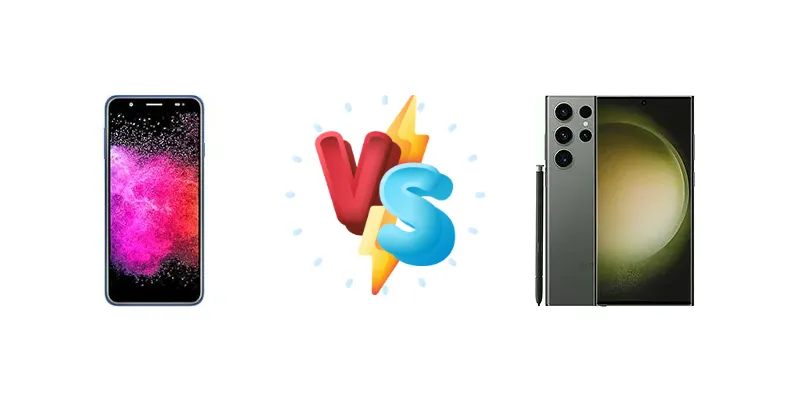
|
🏆 Quick Verdict
The Samsung Galaxy S23 Ultra unequivocally wins this comparison. Its Snapdragon 8 Gen 2 chipset, superior display, and significantly longer battery life offer a user experience light years ahead of the Panasonic Eluga I7. While the Eluga I7 may suffice for basic tasks, the S23 Ultra is the clear choice for anyone demanding performance and features.
| PHONES | ||
|---|---|---|
| Phone Names | Panasonic Eluga I7 (2019) | Samsung Galaxy S23 Ultra |
| Network | ||
|---|---|---|
| 2G bands | GSM 850 / 900 / 1800 / 1900 | GSM 850 / 900 / 1800 / 1900 |
| 3G bands | HSDPA 900 / 2100 | HSDPA 850 / 900 / 1700(AWS) / 1900 / 2100 |
| 4G bands | 1, 3, 5, 8, 40, 41 | 1, 2, 3, 4, 5, 7, 8, 12, 13, 17, 18, 19, 20, 25, 26, 28, 32, 38, 39, 40, 41, 66 - International |
| 5G bands | - | 1, 2, 3, 5, 7, 8, 12, 20, 25, 28, 38, 40, 41, 66, 75, 77, 78 SA/NSA/Sub6 - International |
| Speed | HSPA 42.2/11.5 Mbps, LTE Cat4 150/50 Mbps | HSPA, LTE (up to 7CA), 5G |
| Technology | GSM / HSPA / LTE | GSM / CDMA / HSPA / EVDO / LTE / 5G |
| - | 1, 7, 28, 41, 66, 71, 78, 258, 260, 261 SA/NSA/Sub6/mmWave - USA | |
| Launch | ||
|---|---|---|
| Announced | 2019, June. Released 2019, July | 2023, February 01 |
| Status | Discontinued | Available. Released 2023, February 17 |
| Body | ||
|---|---|---|
| Build | - | Glass front (Gorilla Glass Victus 2), glass back (Gorilla Glass Victus 2), aluminum frame |
| Dimensions | 148.8 x 70.9 x 9.3 mm (5.86 x 2.79 x 0.37 in) | 163.4 x 78.1 x 8.9 mm (6.43 x 3.07 x 0.35 in) |
| SIM | Nano-SIM + Micro-SIM | · Nano-SIM + eSIM· Nano-SIM + Nano-SIM + eSIM (max 2 at a time) |
| Weight | 168 g (5.93 oz) | 234 g (8.25 oz) |
| - | IP68 dust/water resistant (up to 1.5m for 30 min) Armor aluminum frame with tougher drop and scratch resistance (advertised) Stylus (Bluetooth integration, accelerometer, gyro) | |
| Display | ||
|---|---|---|
| Protection | - | Corning Gorilla Glass Victus 2 |
| Resolution | 720 x 1440 pixels, 18:9 ratio (~295 ppi density) | 1440 x 3088 pixels, 19.3:9 ratio (~500 ppi density) |
| Size | 5.45 inches, 76.7 cm2 (~72.7% screen-to-body ratio) | 6.8 inches, 114.7 cm2 (~89.9% screen-to-body ratio) |
| Type | IPS LCD | Dynamic AMOLED 2X, 120Hz, HDR10+, 1200 nits (HBM), 1750 nits (peak) |
| - | Always-on display | |
| Platform | ||
|---|---|---|
| CPU | Quad-core 1.5 GHz | Octa-core (1x3.36 GHz Cortex-X3 & 2x2.8 GHz Cortex-A715 & 2x2.8 GHz Cortex-A710 & 3x2.0 GHz Cortex-A510) |
| Chipset | - | Qualcomm SM8550-AC Snapdragon 8 Gen 2 (4 nm) |
| GPU | - | Adreno 740 |
| OS | Android 9.0 (Pie) | Android 13, up to 4 major Android upgrades, One UI 8 |
| Memory | ||
|---|---|---|
| Card slot | microSDXC (dedicated slot) | No |
| Internal | 16GB 2GB RAM | 256GB 8GB RAM, 256GB 12GB RAM, 512GB 12GB RAM, 1TB 12GB RAM |
| - | UFS 4.0 | |
| Main Camera | ||
|---|---|---|
| Features | LED flash, HDR, panorama | Laser AF, LED flash, auto-HDR, panorama |
| Quad | - | 200 MP, f/1.7, 24mm (wide), 1/1.3", 0.6µm, multi-directional PDAF, OIS 10 MP, f/2.4, 70mm (telephoto), 1/3.52", 1.12µm, PDAF, OIS, 3x optical zoom 10 MP, f/4.9, 230mm (periscope telephoto), 1/3.52", 1.12µm, PDAF, OIS, 10x optical zoom 12 MP, f/2.2, 13mm, 120˚ (ultrawide), 1/2.55", 1.4µm, dual pixel PDAF, Super Steady video |
| Single | 8 MP, f/2.0, 1.12 µm, AF | 12 MP, f/2.2, 26mm (wide), Dual Pixel PDAF |
| Video | 1080p@30fps | 8K@24/30fps, 4K@30/60fps, 1080p@30/60/120/240fps, HDR10+, stereo sound rec., gyro-EIS |
| Selfie camera | ||
|---|---|---|
| Features | LED flash | HDR, HDR10+ |
| Single | 8 MP, f/2.0, 1/4.0", 1.12µm | 12 MP, f/2.2, 26mm (wide), 1/3.2", 1.12µm, dual pixel PDAF |
| Video | - | 4K@30/60fps, 1080p@30fps |
| Sound | ||
|---|---|---|
| 3.5mm jack | Yes | No |
| 35mm jack | Yes | No |
| Loudspeaker | Yes | Yes, with stereo speakers |
| - | 32-bit/384kHz audio Tuned by AKG | |
| Comms | ||
|---|---|---|
| Bluetooth | 4.2, A2DP, LE | 5.3, A2DP, LE |
| NFC | No | Yes |
| Positioning | GPS | GPS, GALILEO, GLONASS, BDS, QZSS |
| Radio | FM radio with RDS | No |
| USB | microUSB 2.0, OTG | USB Type-C 3.2, OTG |
| WLAN | Wi-Fi 802.11 b/g/n, Wi-Fi Direct | Wi-Fi 802.11 a/b/g/n/ac/6e, tri-band, Wi-Fi Direct |
| Features | ||
|---|---|---|
| Sensors | Fingerprint (rear-mounted), accelerometer, proximity, compass | Fingerprint (under display, ultrasonic), accelerometer, gyro, proximity, compass, barometer |
| - | Samsung DeX, Samsung Wireless DeX (desktop experience support) Bixby natural language commands and dictation Samsung Pay (Visa, MasterCard certified) Ultra Wideband (UWB) support | |
| Battery | ||
|---|---|---|
| Charging | - | 45W wired, PD3.0, 65% in 30 min 15W wireless (Qi) 4.5W reverse wireless |
| Type | Li-Ion 4000 mAh, non-removable | Li-Ion 5000 mAh |
| Misc | ||
|---|---|---|
| Colors | Black, Gold, Blue | Phantom Black, Green, Cream, Lavender, Graphite, Sky Blue, Lime, Red, BMW M Edition |
| Models | - | SM-S918B, SM-S918B/DS, SM-S918U, SM-S918U1, SM-S918W, SM-S918N, SM-S9180, SM-S918E, SM-S918E/DS |
| Price | About 9990 INR | € 549.90 / $ 454.99 / £ 433.00 |
| SAR | - | 1.12 W/kg (head) 0.92 W/kg (body) |
| SAR EU | - | 0.96 W/kg (head) 1.40 W/kg (body) |
| Tests | ||
|---|---|---|
| Battery life | - | Endurance rating 126h |
| Camera | - | Photo / Video |
| Display | - | Contrast ratio: Infinite (nominal) |
| Loudspeaker | - | -25.6 LUFS (Very good) |
| Performance | - | AnTuTu: 1241531 (v9) GeekBench: 4927 (v5.1) GFXBench: 67fps (ES 3.1 onscreen) |
Panasonic Eluga I7 (2019)
- Extremely affordable
- Simple and easy to use
- Lightweight and compact
- Outdated processor
- Poor camera quality
- Short battery life
- Low display brightness
Samsung Galaxy S23 Ultra
- Exceptional performance with Snapdragon 8 Gen 2
- Stunning and bright display
- Long-lasting battery life with fast charging
- Advanced camera system
- High price point
- Large and heavy design
- Complex feature set may be overwhelming for some
Display Comparison
The Samsung Galaxy S23 Ultra boasts a significantly brighter display, peaking at 1274 nits, compared to the Eluga I7’s unspecified brightness. This difference is crucial for outdoor visibility. While the Eluga I7’s display technology isn’t detailed, it’s likely a standard LCD panel, whereas the S23 Ultra likely utilizes a Dynamic AMOLED 2X panel with an infinite contrast ratio, delivering richer colors and deeper blacks. The S23 Ultra’s likely higher resolution and refresh rate (not specified, but standard for flagships) further enhance the viewing experience. The S23 Ultra’s display is geared towards immersive content consumption, while the Eluga I7’s is purely functional.
Camera Comparison
Both devices feature 'Photo / Video' capabilities, but the implementation differs drastically. The S23 Ultra’s camera system, while details are limited in the provided data, is expected to include advanced features like optical image stabilization (OIS) and a high-resolution main sensor (likely 200MP). The Eluga I7’s camera is likely a basic setup, lacking the sophisticated image processing and features found in the S23 Ultra. The S23 Ultra’s camera is designed for professional-quality photos and videos, while the Eluga I7’s is suitable for casual snapshots.
Performance
The performance gap is immense. The Panasonic Eluga I7’s quad-core 1.5 GHz CPU is dwarfed by the Samsung Galaxy S23 Ultra’s Octa-core Snapdragon 8 Gen 2 (4nm). The Snapdragon 8 Gen 2’s architecture – featuring Cortex-X3, A715, A710, and A510 cores – provides a massive leap in processing power and efficiency. The 4nm fabrication process of the Snapdragon 8 Gen 2 translates to better thermal management and reduced power consumption compared to the likely older, larger process node used in the Eluga I7’s chipset. This means the S23 Ultra can sustain peak performance for longer periods without throttling, making it ideal for gaming and demanding applications. The Eluga I7 will struggle with even moderately intensive tasks.
Battery Life
The Samsung Galaxy S23 Ultra’s battery life is a standout feature, achieving an endurance rating of 126 hours and 13:24 hours of active use. This is likely due to the efficient Snapdragon 8 Gen 2 chipset and optimized software. The Eluga I7’s battery capacity is unknown, but given its older hardware, it’s unlikely to match the S23 Ultra’s endurance. The S23 Ultra also supports 45W wired charging with PD3.0, achieving 65% charge in 30 minutes, 15W wireless charging, and even 4.5W reverse wireless charging – features absent in the Eluga I7.
Buying Guide
Buy the Panasonic Eluga I7 (2019) if you need a very basic, affordable smartphone for essential communication – calls, texts, and light web browsing – and are unwilling to spend more than a minimal amount. Buy the Samsung Galaxy S23 Ultra if you prioritize performance for gaming and demanding applications, a stunning display for media consumption, a versatile camera system, and all-day battery life, and are willing to invest in a premium device.