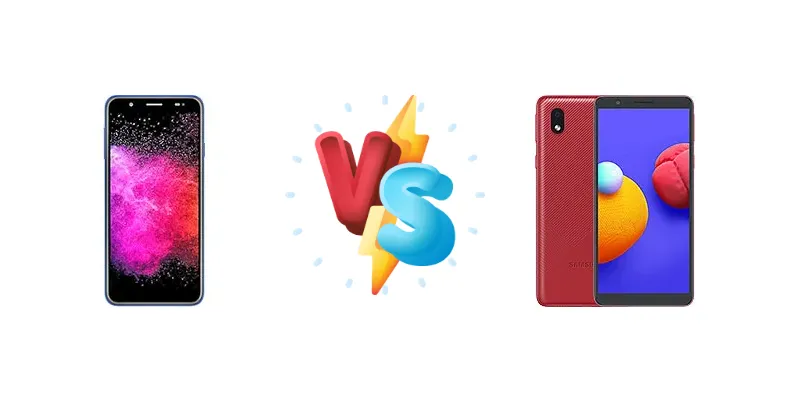
The Panasonic Eluga I7 (2019) and the Samsung Galaxy M01 Core represent the extreme end of the budget smartphone spectrum. Released in 2019, both devices aimed to provide basic smartphone functionality at the lowest possible price point. This comparison dissects their specifications to determine which offers the better experience for users prioritizing affordability.
🏆 Quick Verdict
For the average user seeking a marginally smoother experience, the Samsung Galaxy M01 Core edges out the Panasonic Eluga I7. The Mediatek MT6739 chipset, while still entry-level, benefits from the Cortex-A53 architecture, offering a slight performance advantage over the Eluga I7’s unspecified quad-core processor.
| Network |
|---|
| 2G bands | GSM 850 / 900 / 1800 / 1900 | GSM 850 / 900 / 1800 / 1900 |
| 3G bands | HSDPA 900 / 2100 | HSDPA 850 / 900 / 2100 |
| 4G bands | 1, 3, 5, 8, 40, 41 | 1, 3, 5, 7, 8, 20, 38, 40, 41 |
| Speed | HSPA 42.2/11.5 Mbps, LTE Cat4 150/50 Mbps | HSPA 21.1/5.76 Mbps, LTE |
| Technology | GSM / HSPA / LTE | GSM / HSPA / LTE |
| Launch |
|---|
| Announced | 2019, June. Released 2019, July | 2020, July 27. Released 2020, July 29 |
| Status | Discontinued | Discontinued |
| Body |
|---|
| Build | - | Plastic back, plastic frame |
| Dimensions | 148.8 x 70.9 x 9.3 mm (5.86 x 2.79 x 0.37 in) | 141.7 x 67.5 x 8.6 mm (5.58 x 2.66 x 0.34 in) |
| SIM | Nano-SIM + Micro-SIM | · Nano-SIM· Nano-SIM + Nano-SIM |
| Weight | 168 g (5.93 oz) | 150 g (5.29 oz) |
| Display |
|---|
| Resolution | 720 x 1440 pixels, 18:9 ratio (~295 ppi density) | 720 x 1480 pixels, 18.5:9 ratio (~311 ppi density) |
| Size | 5.45 inches, 76.7 cm2 (~72.7% screen-to-body ratio) | 5.3 inches, 71.3 cm2 (~74.5% screen-to-body ratio) |
| Type | IPS LCD | PLS LCD |
| Platform |
|---|
| CPU | Quad-core 1.5 GHz | Quad-core 1.5 GHz Cortex-A53 |
| Chipset | - | Mediatek MT6739 (28 nm) |
| GPU | - | PowerVR GE8100 |
| OS | Android 9.0 (Pie) | Android 10 (Go edition) |
| Memory |
|---|
| Card slot | microSDXC (dedicated slot) | microSDXC (dedicated slot) |
| Internal | 16GB 2GB RAM | 16GB 1GB RAM, 32GB 2GB RAM |
| | - | eMMC 5.1 |
| Main Camera |
|---|
| Features | LED flash, HDR, panorama | LED flash |
| Single | 8 MP, f/2.0, 1.12 µm, AF | 8 MP, f/2.2, AF |
| Video | 1080p@30fps | 1080p@30fps |
| Selfie camera |
|---|
| Features | LED flash | - |
| Single | 8 MP, f/2.0, 1/4.0", 1.12µm | 5 MP, f/2.4 |
| Sound |
|---|
| 3.5mm jack | Yes | Yes |
| 35mm jack | Yes | Yes |
| Loudspeaker | Yes | Yes |
| Comms |
|---|
| Bluetooth | 4.2, A2DP, LE | 5.0, A2DP, LE |
| NFC | No | No |
| Positioning | GPS | GPS, GLONASS |
| Radio | FM radio with RDS | FM radio |
| USB | microUSB 2.0, OTG | microUSB 2.0 |
| WLAN | Wi-Fi 802.11 b/g/n, Wi-Fi Direct | Wi-Fi 802.11 b/g/n, Wi-Fi Direct |
| Features |
|---|
| Sensors | Fingerprint (rear-mounted), accelerometer, proximity, compass | Accelerometer |
| Battery |
|---|
| Type | Li-Ion 4000 mAh, non-removable | Li-Ion 3000 mAh |
| Misc |
|---|
| Colors | Black, Gold, Blue | Black, Blue, Red |
| Models | - | SM-M013F, SM-M013F/DS |
| Price | About 9990 INR | About 60 EUR |
| SAR | - | 0.86 W/kg (head) |
Panasonic Eluga I7 (2019)
- Potentially simpler software experience (depending on Android version)
- May be available at a slightly lower price point
- Basic smartphone functionality
- Unspecified processor architecture likely results in lower performance
- Limited software support
- Unknown display quality
Samsung Galaxy M01 Core
- More modern Cortex-A53 processor architecture
- Slightly better GPU performance
- Likely more responsive user interface
- Still an entry-level chipset with limited capabilities
- Basic camera system
- Slow charging speeds
Display Comparison
Neither device boasts a standout display. Given both target the ultra-budget segment, details like panel type (IPS vs TFT) and resolution are likely low. The absence of specific display specs for the Eluga I7 suggests a basic panel. The M01 Core’s display is likely 720p, common for this price point, but neither will offer vibrant colors or wide viewing angles. Bezels are expected to be substantial on both.
Camera Comparison
Camera performance on both devices will be limited. Both are likely to feature a primary camera alongside a depth sensor, but image quality will be heavily reliant on software processing. The Eluga I7’s camera specs are unavailable, but given its market position, it’s unlikely to outperform the M01 Core. The M01 Core’s camera setup is likely to be a basic 13MP main sensor paired with a 2MP depth sensor. While the 2MP sensor adds depth information for portrait mode, its image quality is negligible. Expect washed-out colors and limited detail in low-light conditions on both.
Performance
The core difference lies in the chipset. The Samsung Galaxy M01 Core utilizes the Mediatek MT6739, a 28nm chipset featuring quad-core Cortex-A53 processors clocked at 1.5 GHz. This architecture, while dated, is more efficient than a generic quad-core 1.5 GHz processor like the one in the Panasonic Eluga I7. The Cortex-A53 offers improved instruction set performance, translating to slightly faster app loading and smoother scrolling. The MT6739 also includes a Mali-T720 MP2 GPU, providing a modest graphical boost over whatever GPU accompanies the Eluga I7’s processor. Both phones will struggle with demanding games, but the M01 Core will likely handle simpler titles better.
Battery Life
Battery capacity is a critical factor in this segment. While specific battery sizes are not provided, both devices likely feature batteries around 3000mAh. The Mediatek MT6739’s 28nm process, while not the most efficient, may offer slightly better power management than the Eluga I7’s processor. Charging speeds are expected to be slow on both, likely utilizing Micro-USB, and a full charge will take several hours.
Buying Guide
Buy the Panasonic Eluga I7 (2019) if you prioritize a potentially simpler software experience and are comfortable with a processor that may struggle with even moderate multitasking. Buy the Samsung Galaxy M01 Core if you prefer a chipset with a more modern architecture, even if it’s still entry-level, and anticipate needing slightly better responsiveness for basic tasks like web browsing and social media.
Frequently Asked Questions
❓ Will the Samsung Galaxy M01 Core struggle with popular apps like WhatsApp and Facebook?
While the M01 Core can run WhatsApp and Facebook, expect a somewhat sluggish experience, especially with multiple chats or heavy media usage. The Mediatek MT6739 is an entry-level chipset, and these apps are not optimized for low-end hardware. Closing background apps will help improve performance.
❓ Is the Panasonic Eluga I7 a good choice for someone completely new to smartphones?
The Eluga I7 could be suitable for a first-time smartphone user with very basic needs, such as making calls and sending texts. However, its limited processing power and potential lack of software updates may lead to frustration as app requirements increase over time. The M01 Core offers a slightly more future-proof experience.
❓ Can either of these phones play PUBG Mobile?
Playing PUBG Mobile on either the Panasonic Eluga I7 or the Samsung Galaxy M01 Core is not recommended. The processors and GPUs are simply too weak to handle the game's demanding graphics and gameplay. You might be able to run it at the lowest settings with significant frame rate drops, but the experience will be far from enjoyable.